Description
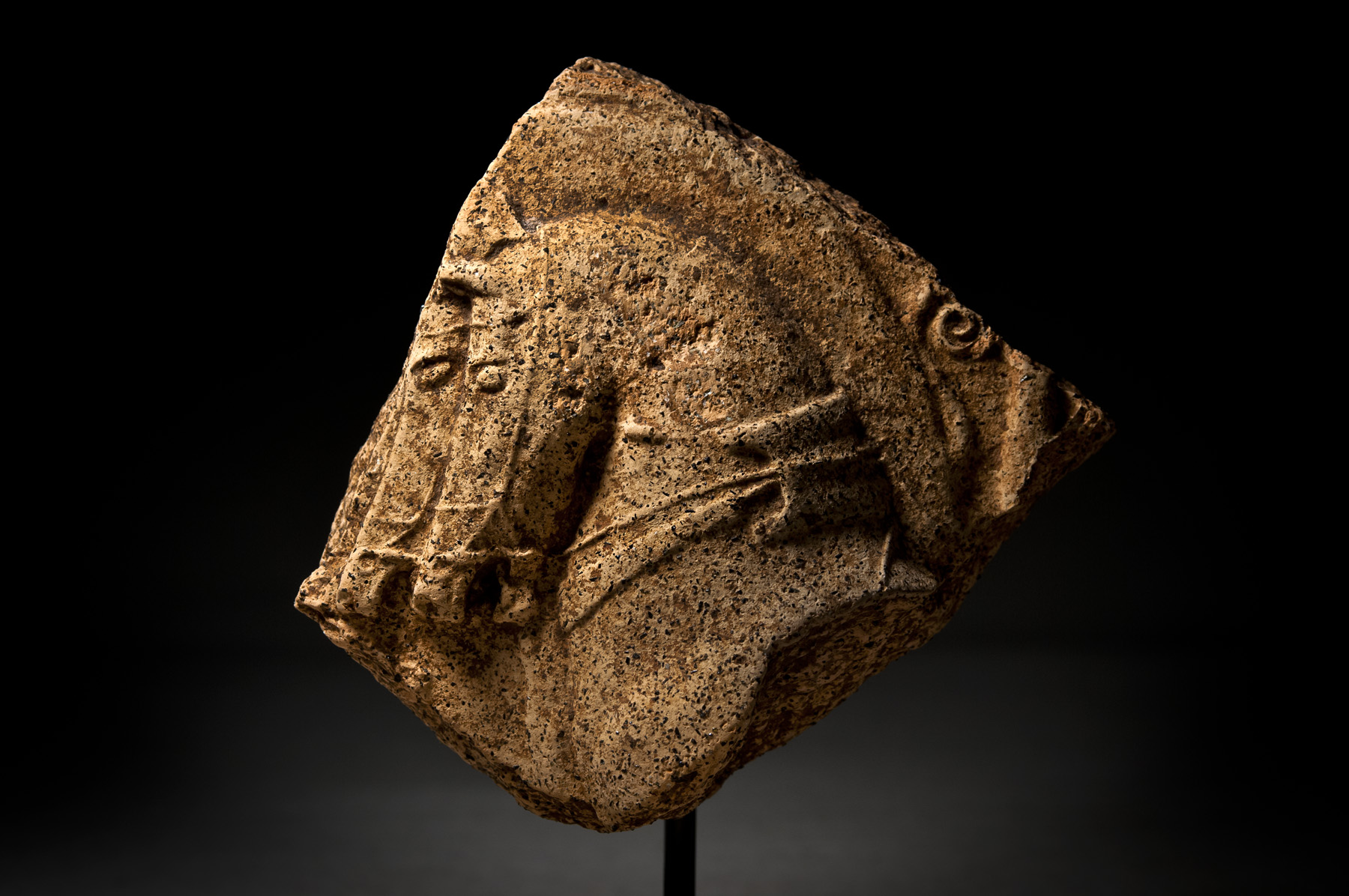
Over the past few centuries, Greek architecture has influenced countless civilizations in a search to connect to the classic ideals of form and aesthetics. This fragment of a Greek terracotta roof frieze shows how the Greeks themselves were influenced by previous civilizations, notably the Egyptians, as they adorned their buildings with these intricate and highly stylized carvings.
This fragment shows two horses harnessed with a hint of a chariot or some other vehicle just outside the existing frame. The horse in the foreground has a well-coiffed mane that looks as though it has been manicured for prominent display. The heads of these horses are titled downward towards their necks as though they are fighting against the reins, yet their eyes are focused forward in a resolve to continue their journey. The artisan who carved this scene took pains to render the fine ropes of the harness, and even the slight curves of the foreground horse’s upper shoulder speak to an understanding of depth and perception.
REFERENCE #
SI_GR_1014
CIVILIZATION
Greek, 525 B.C.E. – 500 B.C.E.
SIZE
H. 14 cm
CONDITION
Fine condition
PRICE
Sold
Frequently Asked Questions
The fragment depicts two horses harnessed, possibly to a chariot or another vehicle, with detailed carvings showing their manes, harness ropes, and muscular features. The horses appear to be in motion, with their heads tilted downward and eyes focused forward, symbolizing determination.
The fragment illustrates how Greek artisans were influenced by earlier civilizations, particularly the Egyptians, in their use of intricate and stylized carvings to decorate architectural elements like roof friezes. This cross-cultural influence is evident in the detailed and formalized style of the horses.
This fragment dates from approximately 525 B.C.E. to 500 B.C.E., placing it in the late Archaic period of Greek art and architecture, a time when Greek artists were developing more naturalistic and detailed representations.
Notable features include the well-coiffed mane of the foreground horse, the detailed rendering of the harness ropes, and the subtle depiction of muscle and depth, such as the curves of the horse’s upper shoulder. These details demonstrate the artisan’s skill in creating a sense of realism and movement.
The fragment measures 14 centimeters in height and is described as being in fine condition, indicating it has been well-preserved over the centuries despite its age.
No, the fragment has been sold and is no longer available for purchase. It is a valuable artifact representing Greek architectural decoration from the late Archaic period.