Description
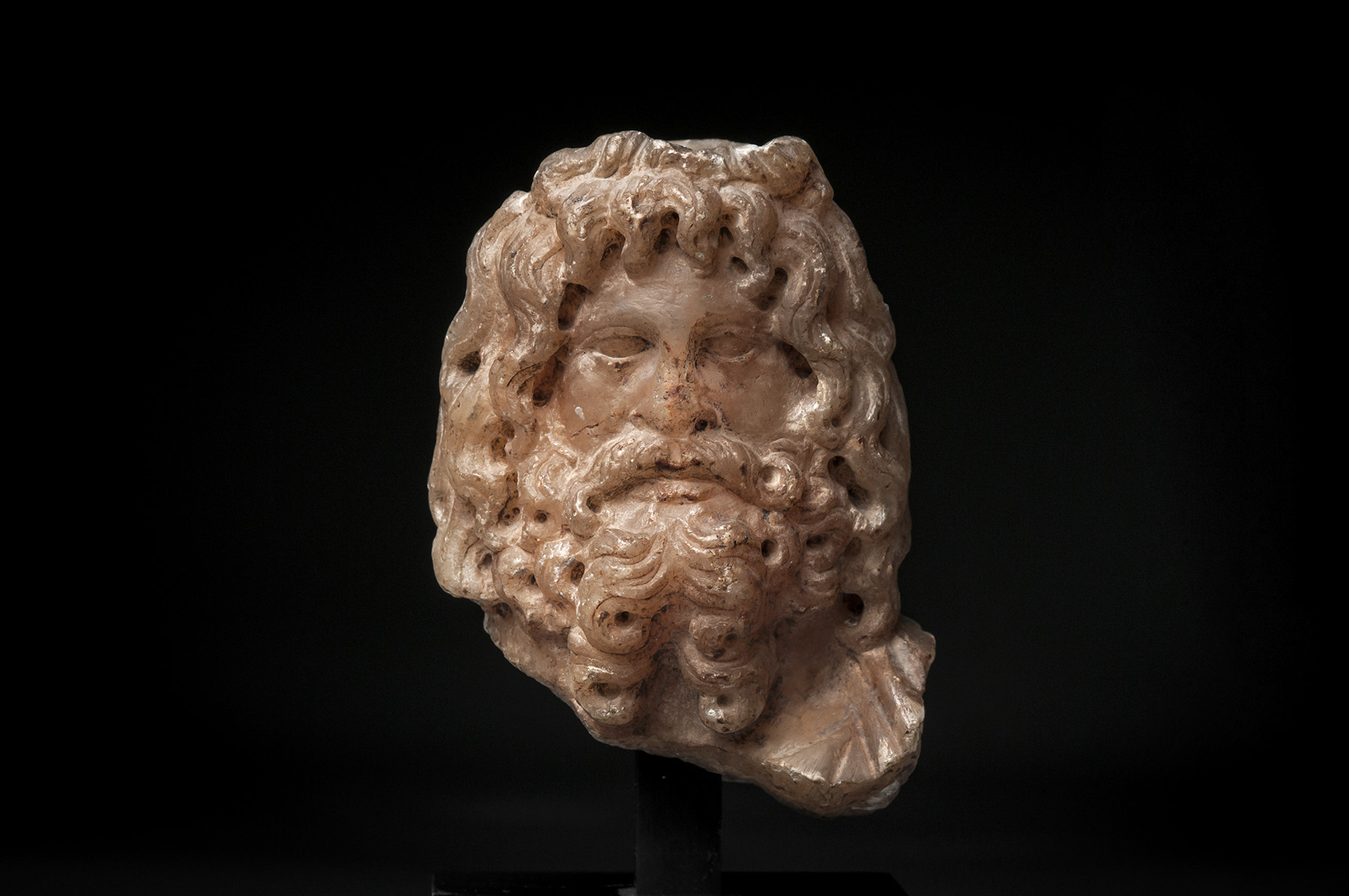
Alabaster head of Greek god Serapis enveloped in thick hair yet with detailed facial features. Lavish curls of the beard and head show deep rivets cut into the soft pink alabaster. The beard itself has been manicured into a distinctively regal fashion. Some of the body remains, with folds from the figurine’s robes seen on the remaining lower neck and upper shoulder.
The most famous representation of the deity is that by Bryaxis, a namesake of the famous sculptor who is credited with creating the sculptures on the north side of the tomb of Mausolus, one of the wonders of the ancient world. Representations of Serapis are uncommon. Ptolemy Soter commissioned the god in order that the native population of Egypt – who already had an extensive pantheon of deities – and the occupying forces could have a common ritual focus. The god therefore shared a group of attributes common to Greeks (physically robust, bearded male) and to Egyptians (attire and accessories): he was originally shown seated, with a sceptre of power, wearing a grain measure on his head, accompanied by a snake (identified with the Egyptian royal uraeus) and with a dog (originally held to be Anubis, later Cerberus) by his side. The cult of Serapis was banned in 391 C.E. and many of the sculptures destroyed. This is therefore a rare survival and a notable piece of ancient art.
REFERENCE #
SI_RM_1091
CIVILIZATION
Egypt, Roman period, 100 C.E. – 200 C.E.
SIZE
H. 11.5 cm
CONDITION
Fine condition
PRICE
Sold
Frequently Asked Questions
Serapis is a syncretic deity created during the Ptolemaic period to unify Greek and Egyptian religious practices. Commissioned by Ptolemy Soter, Serapis combined Greek attributes like a robust, bearded male figure with Egyptian symbols such as the grain measure on his head and the uraeus snake, serving as a common ritual focus for both cultures.
The alabaster head of Serapis features thick, lavish curls in the beard and hair, with deep rivets cut into the soft pink alabaster to highlight detailed facial features. The beard is styled in a regal manner, and some of the body remains show folds of the deity’s robes on the neck and shoulders, indicating fine craftsmanship.
Representations of Serapis are uncommon because the cult was banned in 391 C.E., leading to the destruction of many sculptures and artifacts. This makes surviving pieces, like the alabaster head, rare and significant examples of ancient art from the Roman period in Egypt.
Serapis is typically depicted seated, holding a sceptre of power, wearing a grain measure on his head, and accompanied by a snake symbolizing the Egyptian royal uraeus. Additionally, a dog is often shown by his side, initially identified as Anubis and later as Cerberus, blending Greek and Egyptian iconography.
Bryaxis was a renowned sculptor credited with creating sculptures on the tomb of Mausolus, one of the ancient wonders. The most famous representation of Serapis is attributed to a namesake of Bryaxis, linking the deity to high-quality artistic traditions of the period.
The cult of Serapis was significant as it represented a political and religious effort to unify the Greek and Egyptian populations under Ptolemaic rule. By combining elements from both cultures, Serapis served as a shared deity fostering cultural integration until the cult was banned in 391 C.E.