Description
According to ancient literary sources, the sphinx was a monster with the face and bust of a woman, the talons of a lion, the body of a dog, a serpent’s tail and wings of a bird. Its pale appearance, venomous mouth and stony gaze characterised this demon of divine origin. Its presence amongst humans created uncertainty and fear. It is possible that this hybrid had its origin in Egyptian iconography, where it was represented with the body of a feline and a human face, and was probably related to the divine power of the pharaoh.
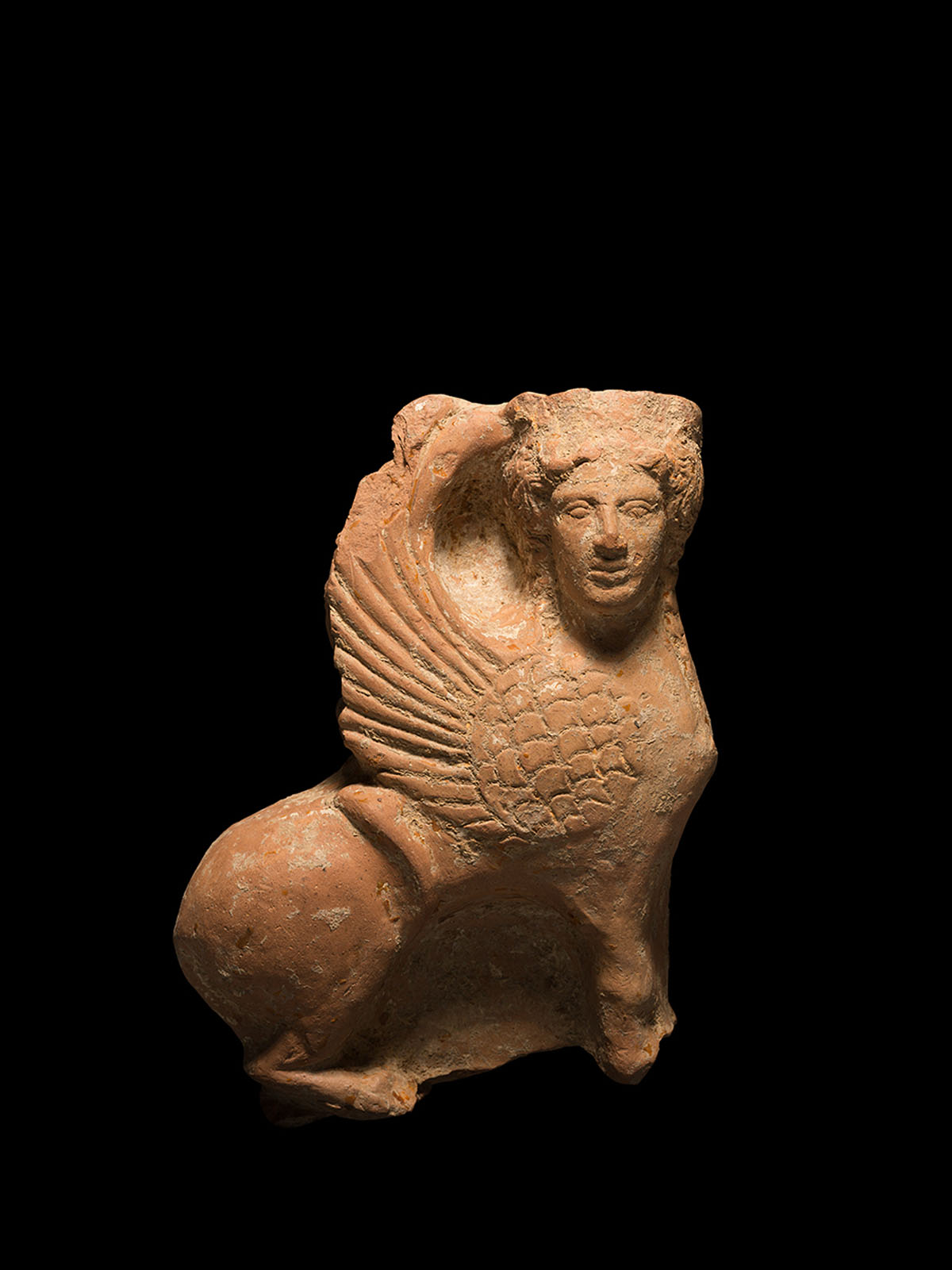
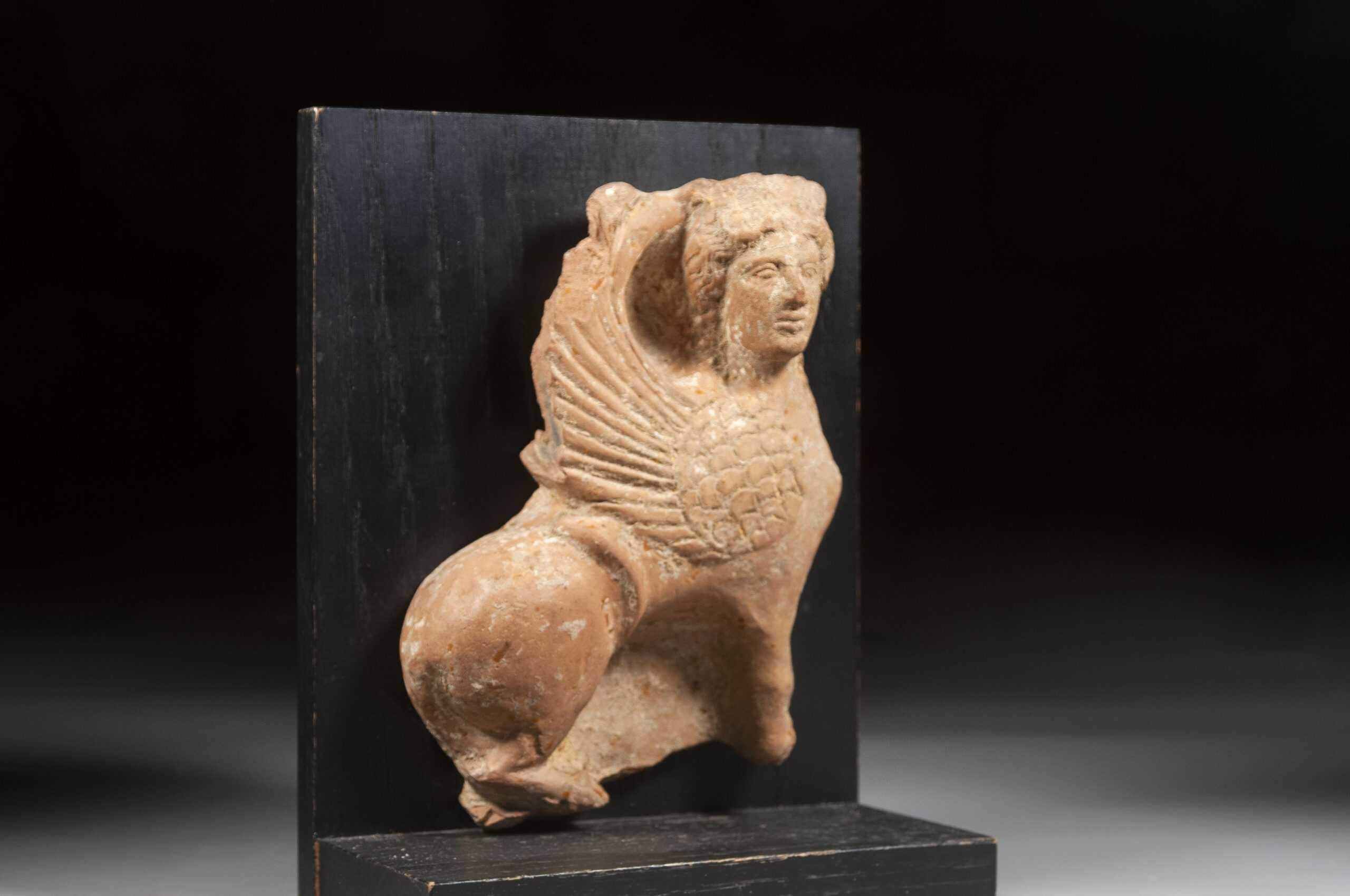
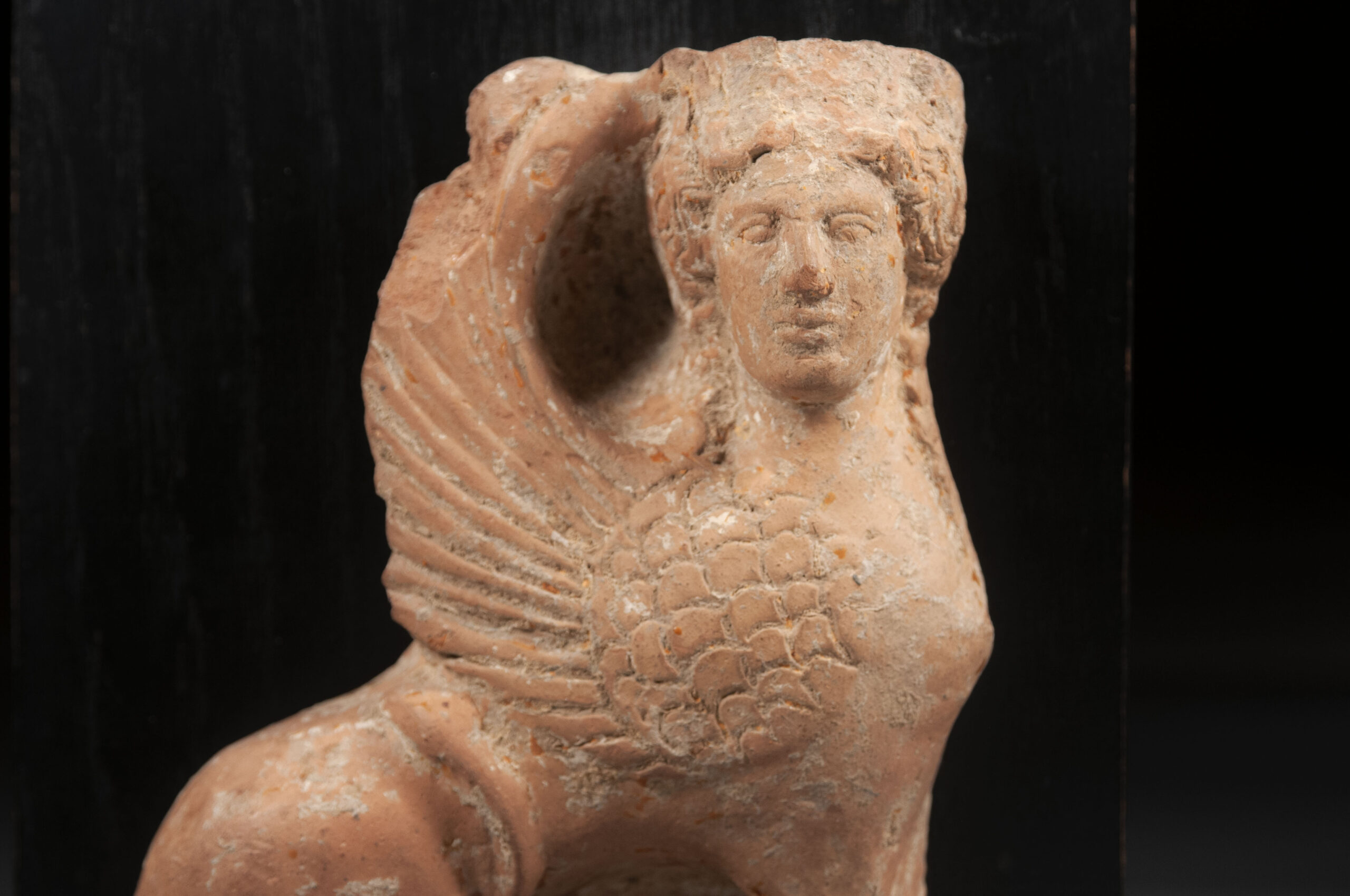
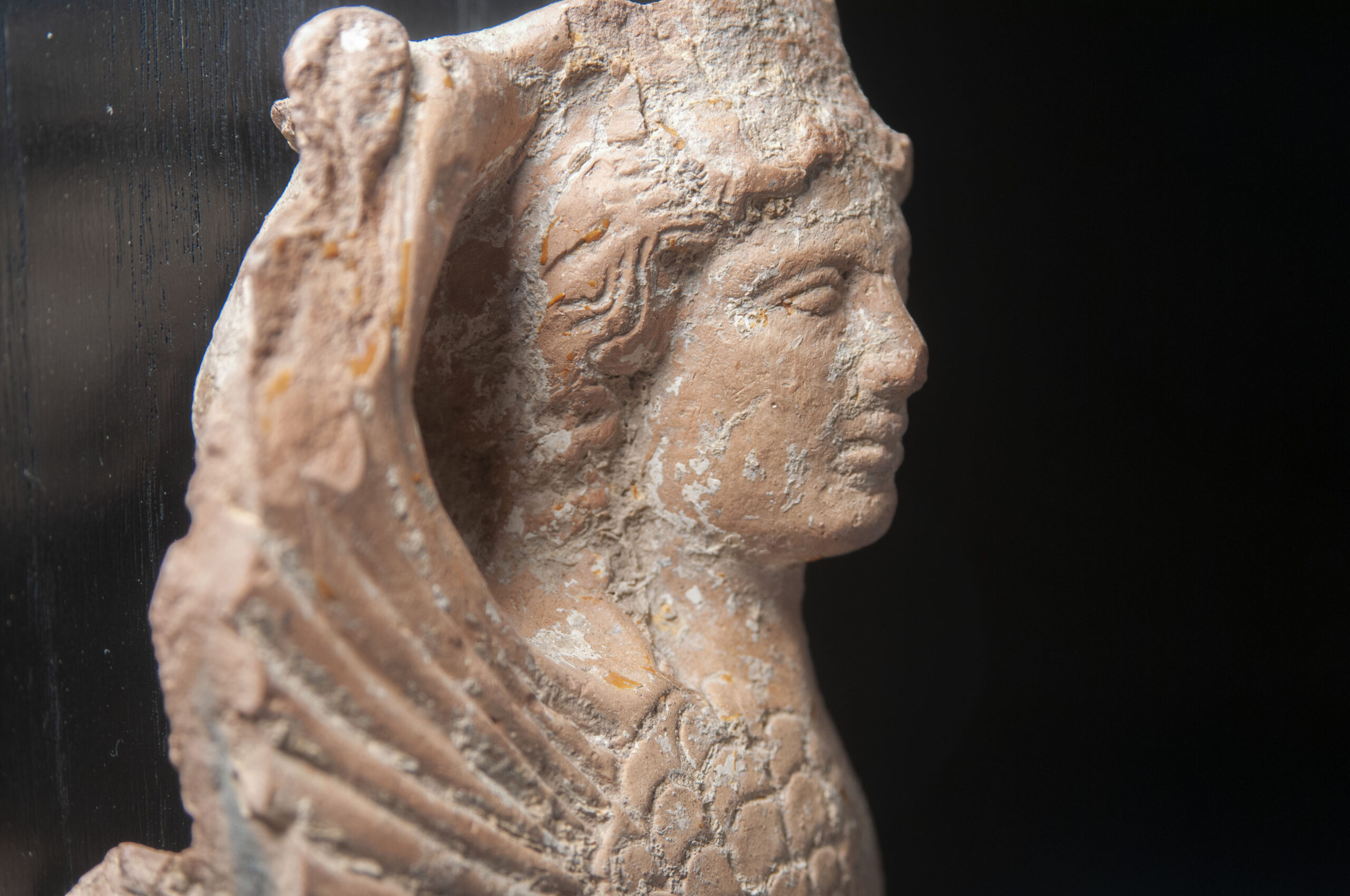
This terracotta piece shows a monster seated on its haunches and in profile, with its head turned to the right toward the public. The female countenance has idealised features of great beauty. The thick, wavy hair is crowned with a polos or crown on the Corinthian model. On the right wing the rendering of the feathers shows a clear interest in the anatomical details of birds: the feathers inserted into the body itself are small and short, rather like scales, while those at the extreme end of the wing are long and narrow, to help the bird take flight.
The sculptural prototype of Greek sphinxes appears around the 7th century BC in terracotta, and was usually found decorating large receptacles. A century later they appeared in marble crowning seated ex-votos on a column. The monstrous, aggressive nature of the hybrid was channelled into funerary art, serving as an apotropaic symbol to keep away malevolent forces. It was usual, therefore, to find this iconography in metopes and hollow acroteria in Greek necropoleis of the 6th century BC, usually with the animal in profile and turning its head toward the public in an attitude of defiance.
BIBLIOGRAPHY:
- BILLOT, M.F. “Le Sphinx du Louvre CA 637”, Bulletin de Correspondence Hellénique. 1977.
- MARCONI, C. Temple Decoration and Cultural Identity in the Archaic Greek World. Getty Foundation. 2007, p. 90.
- RENGER, A.B. Oedipus and the Sphinx: The Threshold Myth from Sophocles through Freud to Cocteau. UCP. 2013.
- STILLWELL, A. N. Corinth: The Potters’ Quarter. Harvard Univ. Press. 1952.
Reference #
SI_GR_1037
Civilization Greek,
6th – 5th century B.C.E.
Size
H. 18 cm
Condition
In a good state of preservation, without any restoration.
Provenance,
Private collection G. A., Gardena, California, USA.
Frequently Asked Questions
The sphinx likely originated from Egyptian iconography, where it was depicted with the body of a feline and a human face, symbolizing the divine power of the pharaoh. Ancient literary sources describe it as a hybrid monster with features from various animals and a woman's face, embodying a demon of divine origin.
The terracotta sphinx is shown seated on its haunches in profile, with its head turned to the right. It has a female face with idealized beauty, thick wavy hair crowned with a Corinthian-style polos, and detailed bird-like wings with feathers rendered anatomically. This depiction emphasizes both its monstrous and elegant features.
In Greek funerary art, the sphinx served as an apotropaic symbol meant to ward off malevolent forces. Its monstrous and aggressive nature was used to protect the dead, often appearing in metopes and acroteria in necropoleis during the 6th century BC, typically shown in profile with a defiant gaze toward the public.
Greek sphinxes first appeared as terracotta sculptures around the 7th century BC, commonly decorating large receptacles. By the 6th century BC, they were also crafted in marble, often crowning seated ex-votos on columns, reflecting their evolving artistic and symbolic significance.
Ancient sources describe the sphinx as having the face and bust of a woman, the talons of a lion, the body of a dog, a serpent’s tail, and wings of a bird. It was characterized by a pale appearance, venomous mouth, and a stony gaze, marking it as a fearsome divine monster.
The Corinthian-style polos, or crown, worn by the sphinx in the terracotta sculpture signifies a cultural and artistic influence from Corinth. It highlights the idealized beauty and status of the sphinx, linking it to Greek artistic traditions and possibly to divine or royal symbolism.
The terracotta sphinx is part of a private collection owned by G. A. in Gardena, California, USA. It measures 18 cm in height and is in a good state of preservation without any restoration, maintaining its original artistic details.