

Description
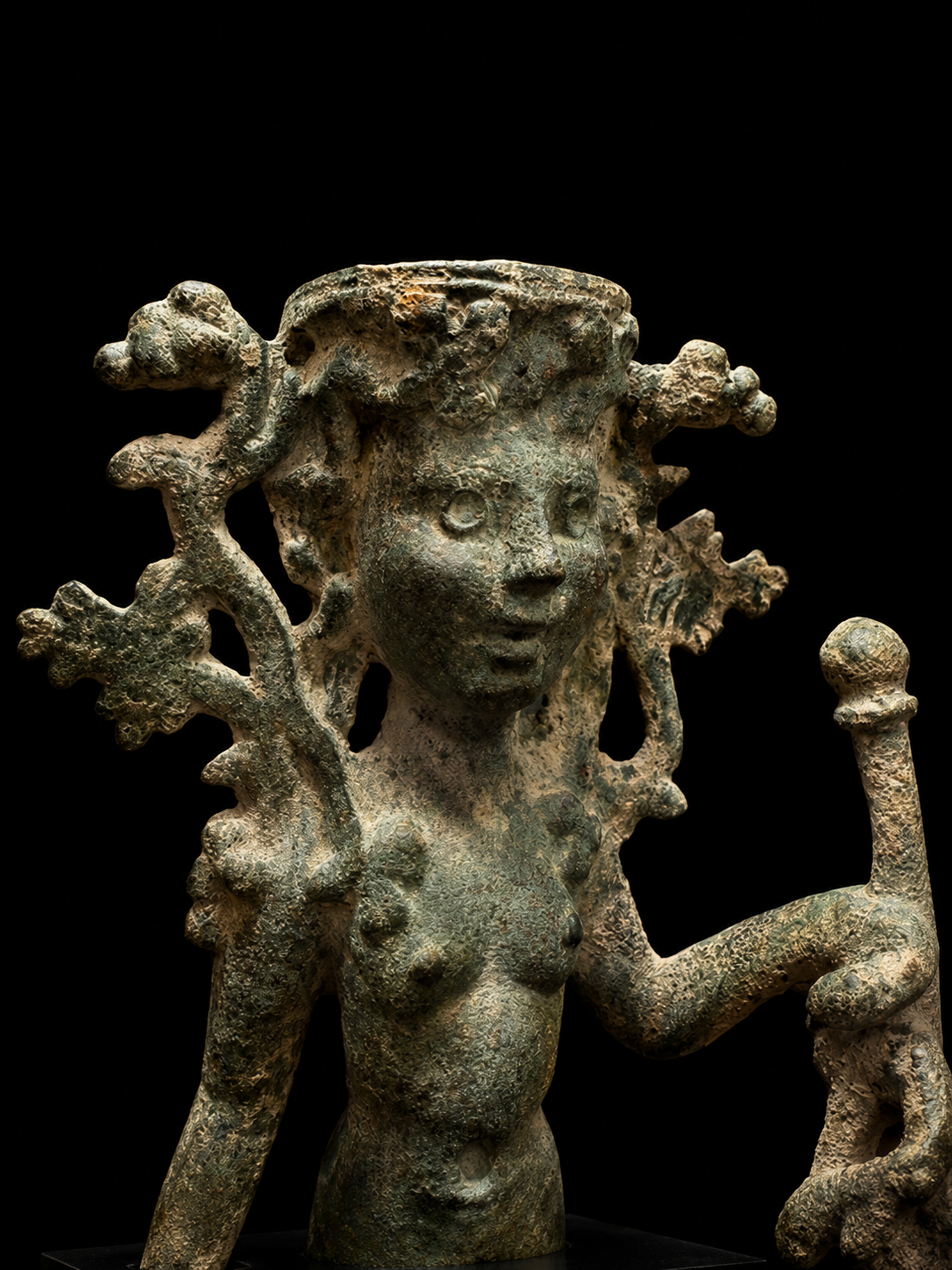
A highly animated Roman bronze statuette depicting the youthful Bacchus (Dionysus), god of wine, fertility, ecstatic celebration and the transformative power of nature. The youthful deity stands nude upon an integral base, surrounded by attributes associated with his Dionysiac character.
Bacchus is represented with an idealized youthful body and an elaborate coiffure crowned and surrounded by luxuriant clusters of grapes and vine leaves. The abundant vegetation framing the head immediately identifies the figure with wine and the vine, among the most recognizable attributes of the god.
In his left hand Bacchus holds a tall staff, around which a serpentine form appears to coil. The staff may be understood within the tradition of the thyrsus, the ritual staff carried by Dionysus/Bacchus and his followers, although its unusual treatment here gives the attribute a particularly dynamic appearance.
His lowered right hand holds a small vessel from which an animal raises its head to drink. This charming detail introduces a narrative element into the composition: rather than presenting the god as an isolated standing figure, the sculptor has created an intimate scene centered upon wine, nature and the animal world.
The composition is unusually rich for a small bronze. The spreading vine clusters surrounding the head, extended arms, tall staff, twisting serpentine element and upward-reaching animal create an intricate silhouette and give the statuette a pronounced sense of movement and vitality.
Bacchus — God of Wine and Fertility
Known to the Greeks as Dionysus and to the Romans as Bacchus, the god presided over wine, viticulture, fertility, theater and ecstatic religious celebration. His cult was closely connected with the regenerative forces of nature: the vine dies back and returns with each growing season, making Dionysiac imagery particularly evocative of fertility, renewal and abundance.
Bacchus was frequently accompanied by a lively retinue of satyrs, maenads and animals and was represented with grapevines, drinking vessels and the thyrsus. Such imagery celebrated not simply intoxication, but the god’s power to transcend ordinary boundaries and release both nature and humanity from conventional restraint.
The present statuette brings these themes together with unusual richness. The youthful nudity of the god emphasizes vitality and beauty; the abundant grapes proclaim the gift of wine; the animal drinking from his vessel evokes the natural world under his influence; and the elaborate staff reinforces the ritual character of the image.
Artistic Character
Particularly noteworthy is the almost baroque complexity of the composition. Instead of the restrained frontal pose encountered on many small Roman bronzes, the figure is surrounded by projecting attributes that animate the sculpture from every angle. The luxuriant vegetation, raised staff and interaction between Bacchus and the drinking animal transform the statuette into a miniature Dionysiac tableau.
Small bronze representations of Bacchus were popular throughout the Roman world and could function as domestic devotional images, decorative bronzes or objects associated with private religious practice. The precise original context of the present statuette cannot be established, but its elaborate iconography and carefully conceived composition indicate that it was intended as considerably more than a simple generic representation of the god.
REFERENCE #
B-22098
CIVILIZATION
Roman. ca. 1st century AD – 3rd century AD
SIZE
H. 22.5 cm W. 9.5 cm
CONDITION
Condition
Preserved with extensive surface patination and encrustation consistent with age. The principal figure and much of the elaborate surrounding iconography remain legible, including the grape-laden coiffure, staff, coiling element, vessel and accompanying animal. Minor losses and surface wear are visible, particularly among the delicate projecting elements.
An unusually elaborate and expressive Roman bronze representation of the youthful Bacchus, distinguished by its abundant Dionysiac imagery and remarkable sense of movement. The interaction between the god and the drinking animal is especially engaging, presenting Bacchus not merely as the god of wine, but as a youthful embodiment of fertility, abundance, nature and ecstatic life.
PRICE
$38000
PROVENANCE
Jerusalem Private Collection
Frequently Asked Questions
The sculpture represents the Roman god of wine, revelry, and fertility, often associated with Bacchus or Dionysus. He is depicted as a young deity adorned with grape clusters and leaves, symbolizing his connection to wine and fertility.
This Roman sculpture features a nude young deity with a head adorned by grape clusters and leaves. He holds a staff with a serpent in his left hand and a wine vessel in his right, from which an animal is drinking, creating a dynamic and lively composition full of movement.
The sculpture dates back to the Roman period, specifically between the 1st century AD and the 3rd century AD, reflecting the artistic style and religious symbolism of that era.
The sculpture measures 22.5 cm in height and 9.5 cm in width, making it a relatively small but detailed piece of Roman art.
The sculpture is reported to be in perfect condition, indicating it has been well-preserved without significant damage or deterioration over time.
This Roman sculpture comes from a private collection in Jerusalem, which adds to its historical and cultural value by tracing its ownership and origin.
The listed price for this Roman sculpture is $38,000, reflecting its historical significance, condition, and provenance.