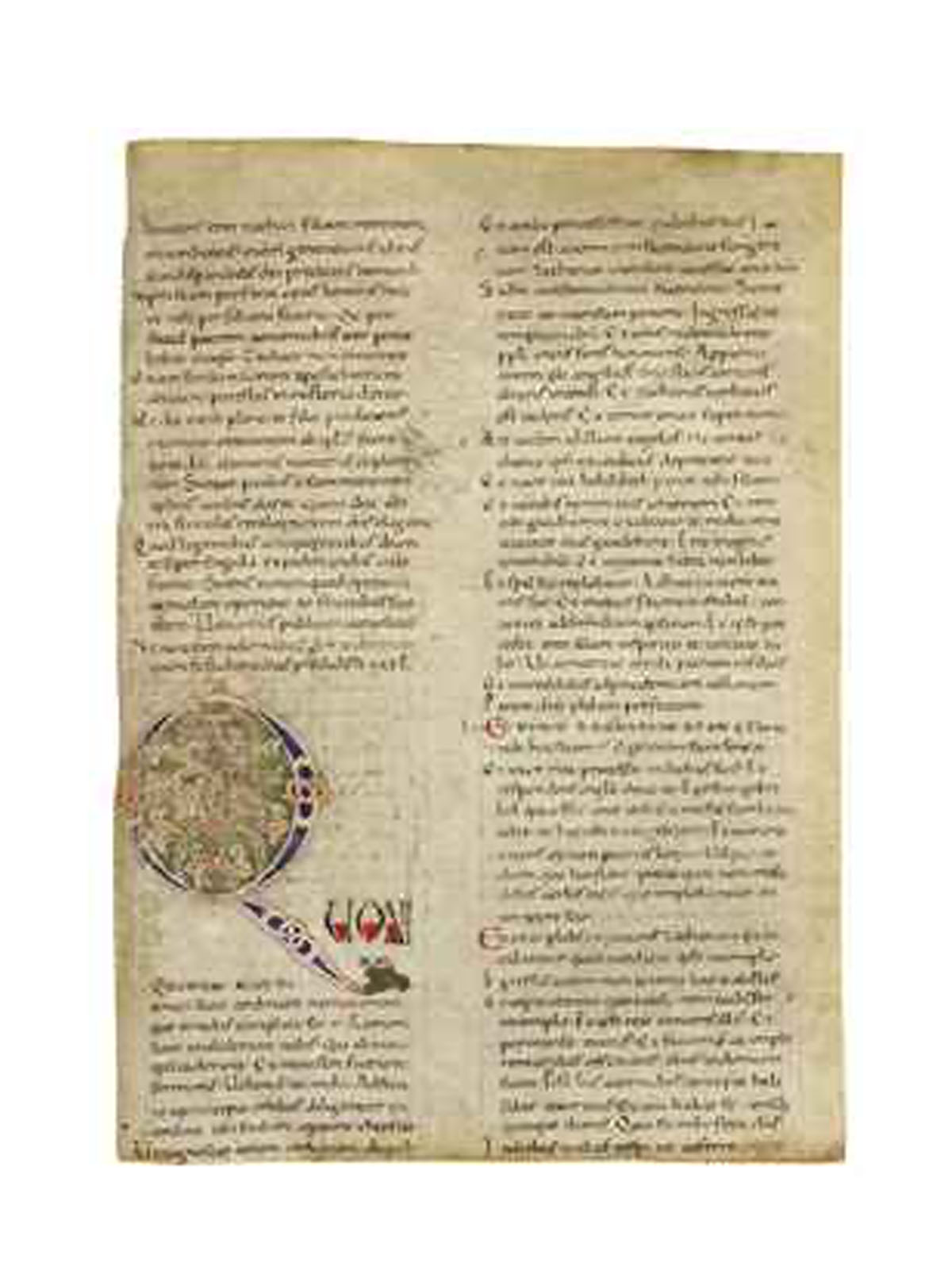
Description
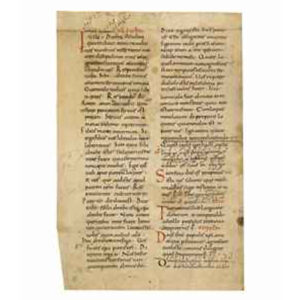
The initial in white, yellow, and blue, the shape of the ‘Q’ formed by an elaborate interlace pattern of white-vine scroll outlined in red, the infill with stylised foliage against a ground of green, 45 lines of text written in a handsome rounded protogothic transitional script in two columns, incipits in uncials touched red, initials in red (approximately 50 words, or 10 lines, trimmed from the bottom of each column, verso with adhesive stains to upper margin, not affecting the text). In a modern cloth binding. The recto opens with the end of thestandard Lucan prologue and continues with the beginning of Luke’s Gospel (Luke 1:1-25) — ‘Quoniam quidam multi conati sunt’; the verso continues with Luke 1:29-76. The layout of the text is unusual and interesting: verse 1 is here treated as the start of the book; often verses 1-4, the Dedication to Theophilus, are treated as a prologue, and verse 5 as the start of the Gospel proper. Both theMagnificat and the Benedictus, two of the six biblical canticles that were sung every week in all monasteries, are here written with enlarged red initials, their incipits in rustic capitals touched with red dots, and with left-justified red initials at the start of each phrase. The first lines of verses 18, 56, and 57 are treated similarly. The abstract, stylised design of the initial, with its intricate white-vine pattern and stark palette of primary colours testifies to the influence in Romanesque decoration of pre-Christian ornamental traditions. The fine example in the present leaf is closely reminiscent of an initial ‘A’ cut from another Romanesque bible, now at the Free Library in Philadelphia (Lewis E M 16:10)
Reference #
MS_BZ_1004
Civilization
Byzantine
Size
L. 38.2 cm , W. 27 cm
Condition
Fine Condition
Price
Price available upon request
Provenance
Baidun Collection
Frequently Asked Questions
The Romanesque initial 'Q' is elaborately designed with a white-vine scroll pattern outlined in red and filled with stylised foliage against a green background. This intricate design reflects the influence of pre-Christian ornamental traditions on Romanesque decoration, highlighting the manuscript's artistic and historical value.
This manuscript leaf contains the end of the standard Lucan prologue and the beginning of Luke's Gospel (Luke 1:1-25) on the recto, and continues with Luke 1:29-76 on the verso. It includes notable biblical canticles such as the Magnificat and the Benedictus, which are highlighted with enlarged red initials and rustic capitals.
The text layout is unusual because verse 1 of Luke is treated as the start of the book, whereas typically verses 1-4 serve as a prologue and verse 5 begins the Gospel proper. Additionally, biblical canticles are emphasized with enlarged red initials and left-justified red initials at the start of each phrase, enhancing readability and decoration.
The manuscript is written in a handsome rounded protogothic transitional script arranged in two columns with 45 lines of text. Incipits are in uncials touched with red, and initials are in red, reflecting a careful and decorative script style typical of Byzantine manuscripts.
The manuscript leaf measures 38.2 cm in length and 27 cm in width. It is in fine condition, bound in modern cloth, with some adhesive stains on the verso's upper margin that do not affect the text.
This manuscript leaf is part of the Baidun Collection, indicating its ownership and curation within this collection. The provenance helps establish its authenticity and historical context within Byzantine civilization.
The abstract and stylised design of the initial 'Q' closely resembles an initial 'A' from another Romanesque bible held at the Free Library in Philadelphia (Lewis E M 16:10). This similarity highlights common artistic influences and styles in Romanesque biblical manuscripts.