Description
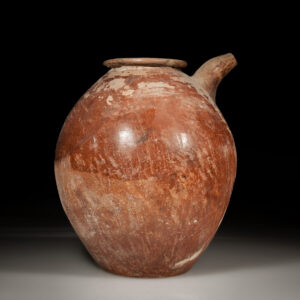
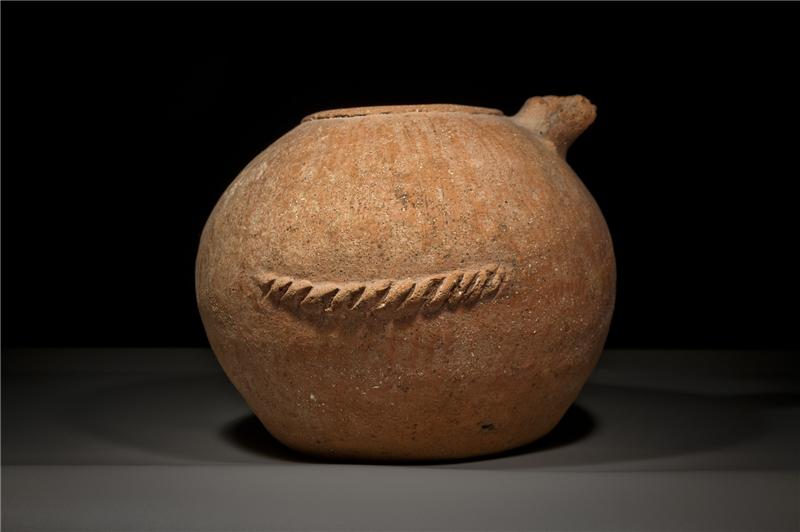
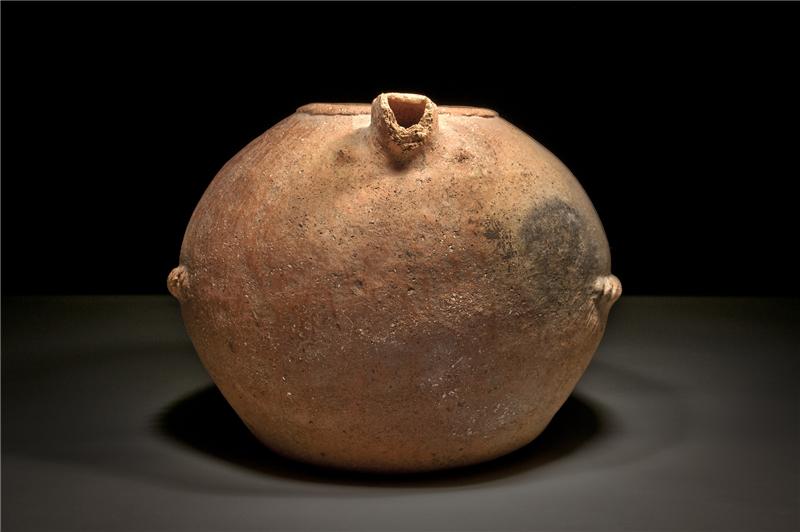
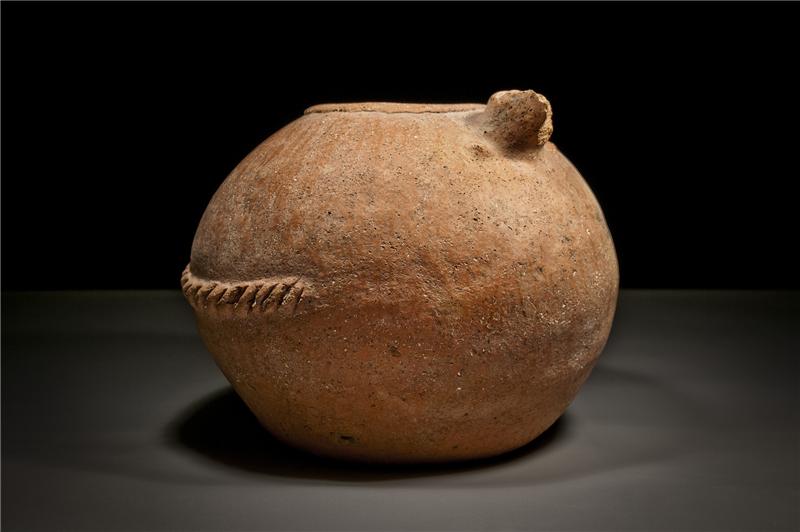
This elegant globular vessel was made in the ancient region of Canaan, about four and a half thousand years ago. It is deceptively simple – the main body is essentially globular, as stated, tapering slightly from the shoulders to a discrete raised, non-carinated rim. The sides bear a pair of so-called ‘pie-crust’ ledge handles with hatched relief, and a short, tubular spout. The ground is plain red and burnished to a smooth surface, reflecting the original, practical function. While it is impossible to be certain about how it was used, it seems probable that it was a storage and dispensing vessel for liquids – probably milk, water or wine – in a domestic setting.
The Canaanites are renowned for pieces such as this: their artistic heritage is characterised by well-proportioned, harmonious and subtle compositions, and an evident enjoyment of aesthetic forms, even in everyday objects. The Canaanites were one of the ‘tribal’ groups of what was to become Israel, Palestine and Jordan, who had their cultural roots in the Neolithic revolution when agriculture became the standard economy in the Near East. By the Bronze Age the stability of the area and their position between great trading powers – notably Egypt and Mesopotamia – made them prosperous and culturally diverse, and was a high point for artistic creation. The culture contracted with economic issues suffered by Egypt and the Mesopotamians, and went through a collapse at the end of the Bronze Age due to a combination of ‘Sea People’ invasions, environmental meltdown and internal troubles in Egypt leading to loss of infrastructure throughout the Near East. Their resurgence of power in the Iron Age was matched by that of the Ammonites and Moabites, among others, and the region eventually came under control of the Neo-Assyrians by the mid 8th century B.C.E. This piece is typical in its functionalism, geometric simplicity and harmonious use of colour – it is a mature and impressive piece of ancient art.
Cf. Hendrix, R., Ancient Pottery of Transjordan, no. 96, pp. 114-115
REFERENCE #
CR_CN_1009
CIVILIZATION
Early Bronze I 3100 B.C.E. – 2900 B.C.E.
SIZE
H. 20.5 cm
CONDITION
Part of the spout is missing.
PRICE
Price available upon request
PROVENANCE
The Baidun Collection
Frequently Asked Questions
This elegant globular vessel was made in the ancient region of Canaan approximately four and a half thousand years ago, dating back to the Early Bronze I period (3100 B.C.E. - 2900 B.C.E.).
While the exact use cannot be confirmed, it is probable that the vessel served as a storage and dispensing container for liquids such as milk, water, or wine in a domestic setting, indicated by its shape and spout design.
The vessel features a globular body tapering slightly to a raised, non-carinated rim, with a pair of 'pie-crust' ledge handles decorated with hatched relief and a short tubular spout. Its plain red, burnished surface reflects its practical function.
This piece exemplifies the Canaanite artistic heritage through its well-proportioned, harmonious, and subtle composition, demonstrating an appreciation for aesthetic forms even in everyday objects, characteristic of their mature and impressive ancient art.
The vessel was produced during a prosperous period in the Bronze Age when Canaan was culturally diverse and stable, benefiting from its position between major trading powers like Egypt and Mesopotamia before the region's decline at the end of the Bronze Age.
After the Bronze Age collapse caused by invasions, environmental issues, and internal troubles in Egypt, the Canaanite culture contracted but later resurged in the Iron Age before the region came under Neo-Assyrian control by the mid-8th century B.C.E.
The vessel is generally well-preserved, though part of the spout is missing, which is noted in its condition report.
This vessel is from the Baidun Collection, and its price is available upon request, indicating interested buyers should contact the holder or seller directly for pricing information.