Description
An impressive Jewish limestone ossuary dating to the late Second Temple period, when the practice of secondary burial became widespread among Jewish communities in Jerusalem and the surrounding region. Following an initial period of burial in a rock-cut tomb, the bones of the deceased were gathered and placed within a stone ossuary, which was then deposited in a niche or chamber within the family tomb.
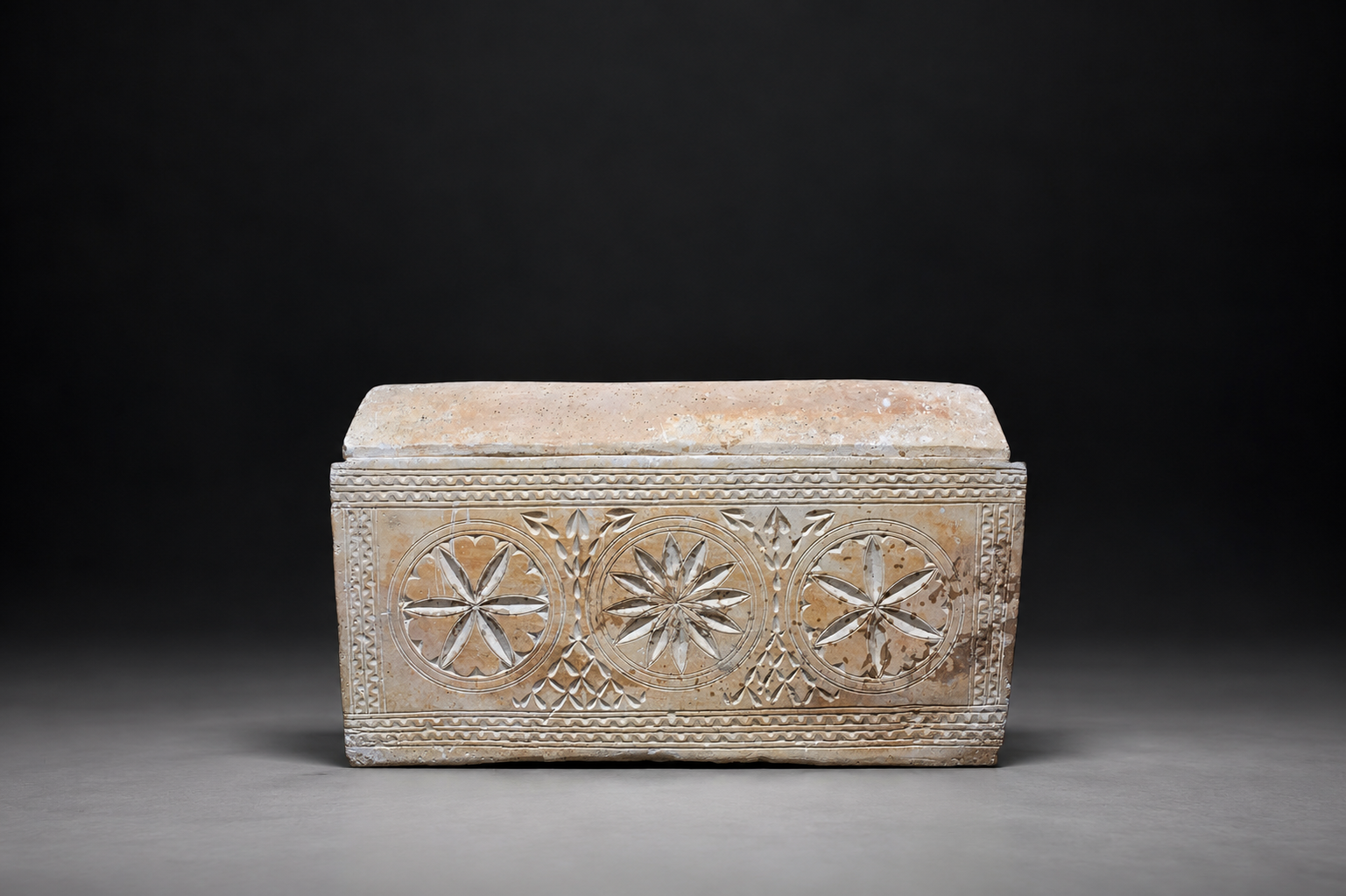
The rectangular chest is surmounted by its substantial fitted stone lid and is distinguished by an exceptionally decorative carved façade. The principal face is framed by multiple bands of repeating geometric ornament and dominated by three large circular medallions containing deeply carved rosettes. The central medallion contains a particularly elaborate multi-petalled rosette, while the two flanking medallions contain six-petalled examples.
Between the medallions are additional incised and carved geometric and vegetal elements, including angular, leaf-like and upward-pointing forms, producing a dense and carefully balanced composition. The combination of rosettes, concentric circles, geometric borders and stylized vegetal ornament belongs to the characteristic decorative vocabulary of Jewish ossuaries produced in Judea during the late Second Temple period.
The rosette was among the most frequently employed motifs on Jerusalem-area ossuaries. Although its precise symbolic significance remains uncertain, its widespread appearance on contemporary funerary monuments makes it one of the most recognizable elements of Jewish stone-carving traditions of the period.
A particularly attractive and well-preserved example of Jewish funerary art from the Jerusalem region, illustrating both the burial practices and the highly developed ornamental stone-carving tradition of Judea during the final centuries of the Second Temple era.
This piece is not exportable outside Israel
REFERENCE #
SW_IL_1002
CIVILIZATION
Roman Period, time of King Herrod, 100 C.E.
SIZE
L. 70 cm, H. 50 cm
CONDITION
The limestone retains its natural pale coloration together with areas of warm ochre surface weathering, mineral deposits, staining and age-related wear. The substantial chest and heavy lid survive in notably good overall condition, while the carved decoration remains exceptionally clear and visually striking.
PRICE
SOLD