Description
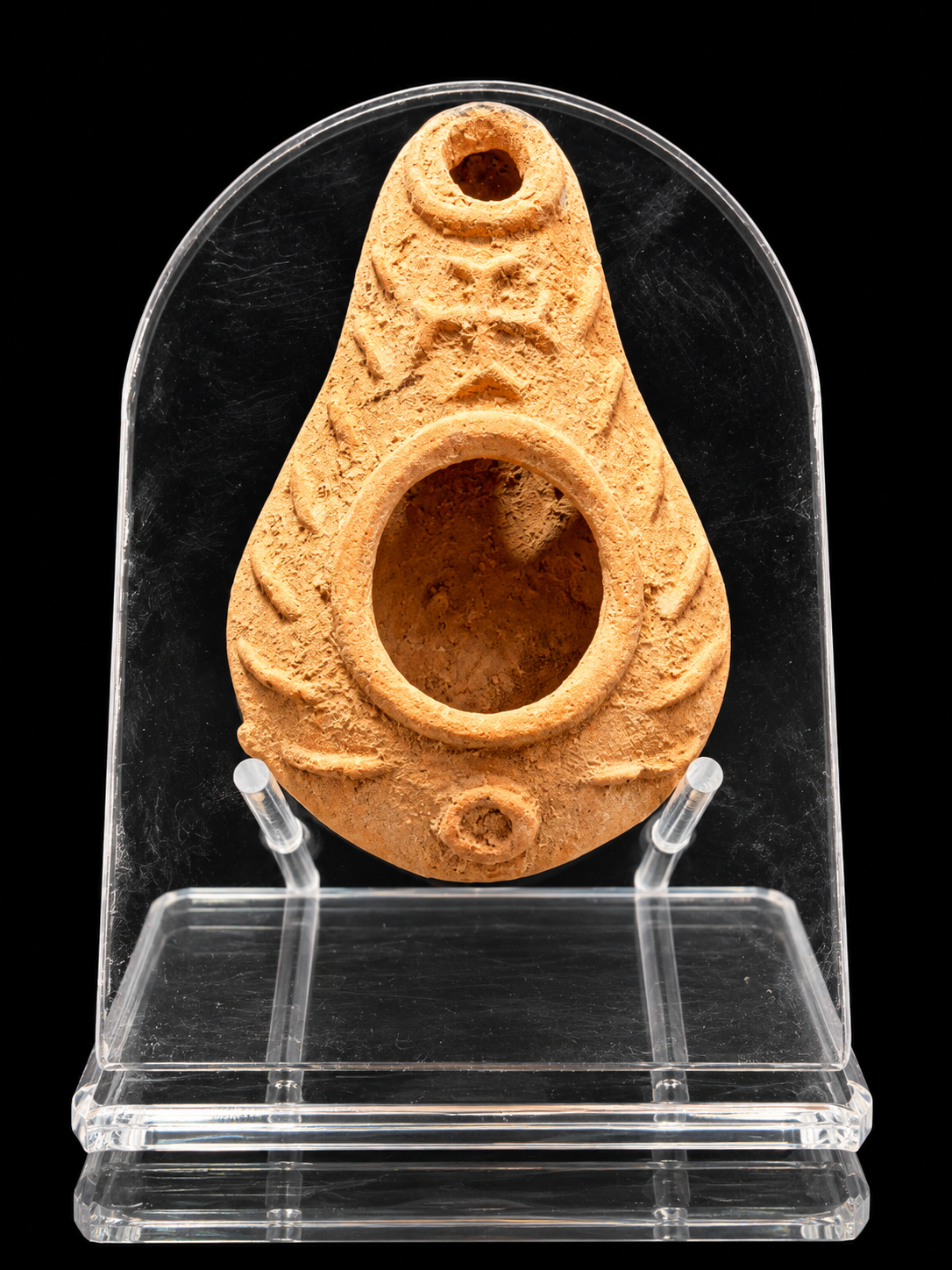
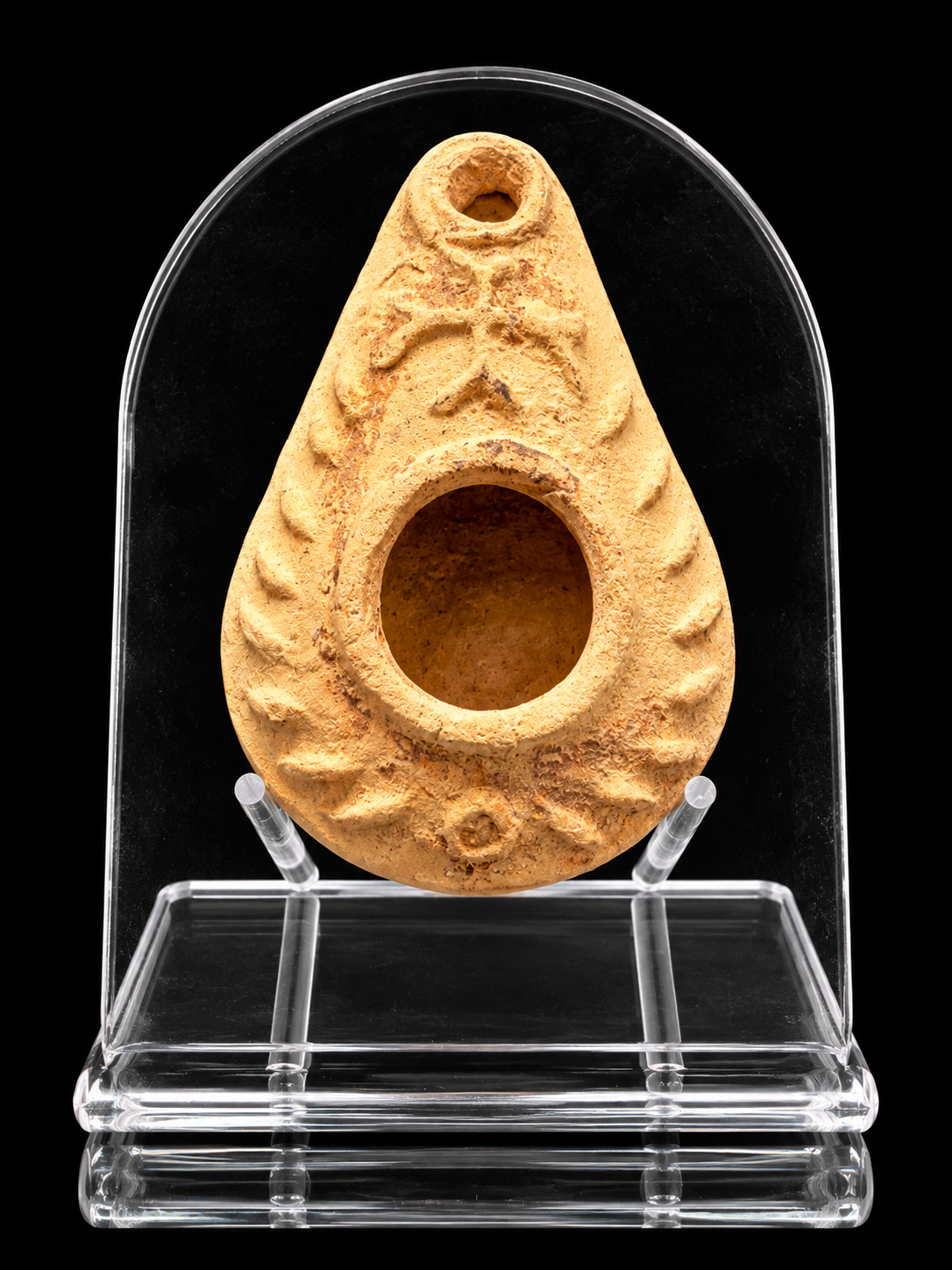
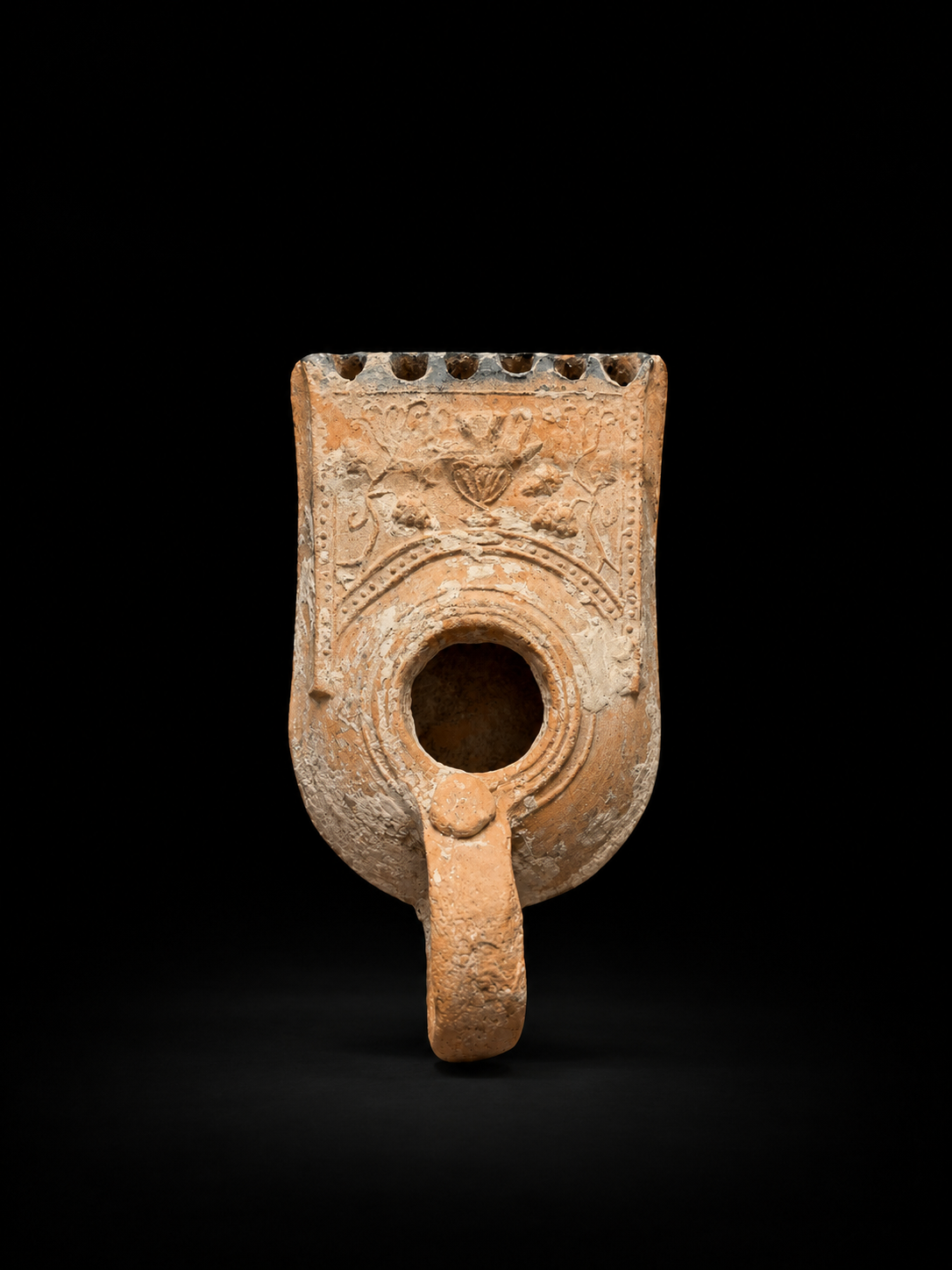
An exceptionally decorative Judean mold-made terracotta oil lamp of the Beit Nattif tradition, distinguished by its elaborate relief ornament and an unusual combination of an amphora motif with a seven-fold arrangement of circular elements, possibly alluding symbolically to the seven-branched menorah.
The lamp has the characteristic compact form associated with Late Roman Beit Nattif production, with a large central filling hole surrounded by multiple concentric molded rings and an elongated projecting nozzle. The upper surface is densely ornamented in the distinctive decorative manner for which Beit Nattif lamps are particularly celebrated.
Dominating the upper decorative field is a clearly recognizable two-handled amphora, carefully rendered in relief and framed by scrolling vegetal ornament. Amphorae and vessels were familiar decorative motifs throughout Roman and Late Antique art and could evoke abundance, wine and domestic prosperity, although no specific symbolic meaning can be established with certainty in the present context.
Of particular interest is the row of seven circular elements positioned across the upper edge. Their deliberate seven-fold arrangement permits an interpretation as an abstract reference to the seven-branched menorah, one of the principal symbols of Jewish identity in Late Antiquity. Unlike Beit Nattif lamps bearing an explicitly rendered menorah with curved branches and a tripod base, however, the present lamp employs no literal menorah image. If intentional, its symbolism is therefore considerably more subtle and schematic.
The Beit Nattif Tradition
The designation “Beit Nattif” derives from the important ceramic production center near modern Beit Shemesh in the Judean Shephelah, where molds, lamps and related terracottas were discovered. Archaeological evidence confirms the production of Beit Nattif lamps during the Late Roman period, particularly the 3rd and 4th centuries CE. Their characteristic features include large filling holes, bow-shaped or elongated nozzles and densely molded geometric, vegetal and occasionally figural decoration. FORVM Ancient Coins
The workshops served a culturally diverse population. Published material from Beit Nattif includes geometric and vegetal decoration, birds, human figures and explicitly Jewish imagery. Consequently, the Beit Nattif classification alone does not establish the religious identity of an individual lamp or its owner. ResearchGate
Jewish Context and the Menorah
Of particular importance are the comparatively rare Beit Nattif lamps carrying unmistakably Jewish symbols, especially the menorah. Scholarly examination of the original Beit Nattif material records lamps bearing menoroth, and additional examples are known from other sites in Palestine. These demonstrate that Jewish consumers formed at least part of the clientele for this class of lamp. ResearchGate
A particularly important archaeological parallel was discovered near the Mount of Olives in Jerusalem: a Beit Nattif-type lamp of the 3rd–5th centuries decorated with an unmistakable seven-branched menorah together with other Temple-associated symbols. The Israel Antiquities Authority emphasized the rarity of menorah-decorated examples and their importance as evidence for Jewish presence around Jerusalem during the Late Roman period. Ministry of Foreign Affairs
The present lamp differs significantly because its central image is an amphora rather than a conventional menorah. Nevertheless, the conspicuous sequence of seven circular elements along its upper edge offers an intriguing possible reference to the sacred number seven and, by extension, to the seven lamps of the menorah. This interpretation should remain probable or possible rather than definitive unless an exact published parallel with the same arrangement can be established.
Published Parallels
The most relevant comparative corpus is the material excavated at Beit Nattif itself, where lamps were manufactured in molds and decorated with the dense geometric, vegetal and symbolic ornament characteristic of the group. Varda Sussman’s study of Beit Nattif lamps specifically discusses their tendency to cover available surfaces with rich ornamentation. ResearchGate
Further parallels are published in Varda Sussman’s corpus, Late Roman to Late Byzantine/Early Islamic Period Lamps in the Holy Land: The Collection of the Israel Antiquities Authority, which includes Beit Nattif lamps and discusses their menorah imagery and related Late Antique lamp traditions. PagePlace
The recently excavated Mount of Olives lamp provides an especially significant comparison for the use of Jewish symbolism within the Beit Nattif tradition, although its menorah is represented explicitly rather than through the possible abstract symbolism seen here.
REFERENCE #
OL-JD-1001
CIVILIZATION
Roman Judea. ca. 3rd century AD – 5th century AD
SIZE
L. 12 cm, W. 8 cm
CONDITION
Very well preserved, retaining the principal form and extensive molded decoration. The amphora, scrolling ornament, concentric framing around the filling hole and seven circular elements remain clearly legible. Ancient surface wear, mineral deposits and earthen accretions are present, consistent with age and archaeological burial.
PRICE
$3,500
PROVENANCE
Jerusalem Private Collection
Frequently Asked Questions
The Beit Nattif type oil lamp is a mold-made, shield-shaped lamp produced in Roman-period Judaea, characterized by its shoulder decorated with a central menorah flanked by scrolling floral ornament and bordered by raised dot-and-ring decoration. It often features a row of small perforations along the top edge and a filling hole within concentric molded rings.
The menorah motif on the lamp reflects its strong association with Jewish communities in Roman-period Judaea. This design element makes these lamps important material evidence for understanding Jewish domestic and religious life after the destruction of the Temple.
This oil lamp dates from the Roman Judea period, approximately the 3rd to 5th centuries AD, a time following the destruction of the Jewish Temple.
The lamp measures 12 cm in length and 8 cm in width. It is noted to be in excellent condition, preserving its detailed decorations and structural integrity.
This particular lamp comes from a private collection in Jerusalem, indicating its origin and historical context within the region of Roman Judea.
The oil lamp is priced at 3500, reflecting its historical significance, condition, and provenance as a rare artifact from Roman-period Judaea.