Description
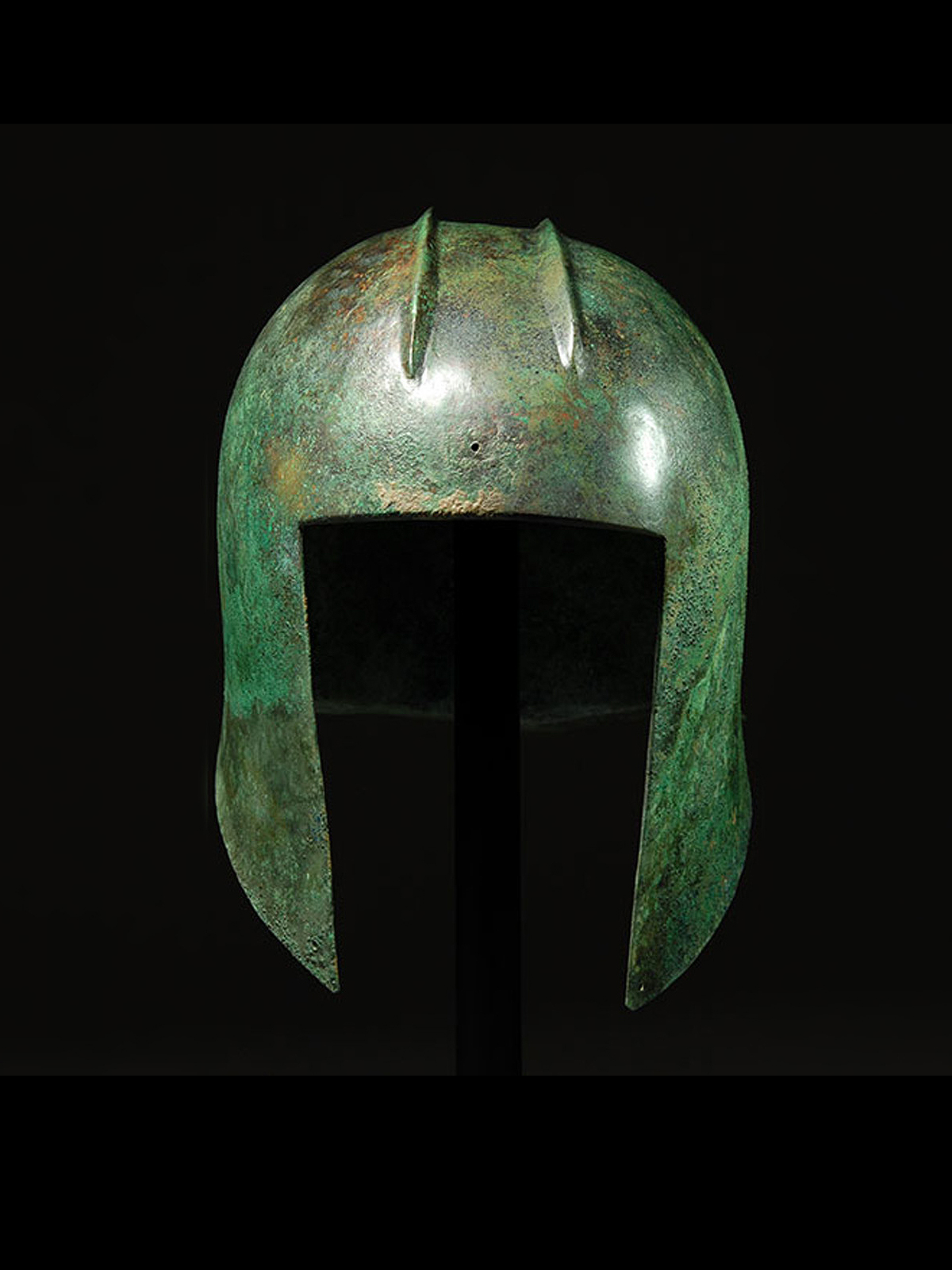
This bronze helmet is designed for combat rather than purely ceremonial purposes, with blade-like wings which slide forward under the jawline from a straight-edge forehead margin. The top of the helmet is fortified with two prominent structural ‘ribs’ designed to deflect sword blows, while the rear edge of the helmet – above the shoulders – is lipped outwards to provide a neck guard. There are faint marks indicating that the helmet was indeed struck, probably by a sword, on the left side.
The early date of this piece put it in the Illyrian (i.e. Macedonian and Albanian) kingdom of the Enchelei, an 8th and 7th century B.C.E. polity focused around Lake Ohrid in what is now Albania and Macedonia. Their economy appears to have been based mainly on fishing, and they had extensive trade networks with Greece. They also had an uneasy relationship with local tribes including Macedonians and the Dardani, among others, and the fact that they seem to have spent much of their time at war may explain why so much of their art and material culture is based around warrior-like iconography and accessories. A helmet such as this would have been worn by a lightly-armed foot-soldier (or Hoplite, in Greek terms), and was designed for skirmishing. This is an evocative and impressive piece of ancient art.
REFERENCE #
WP_GR_1007
CIVILIZATION
Greek, 700 B.C.E. – 500 B.C.E.
SIZE
H. 27 cm
CONDITION
Fine condition
PRICE
Sold
Frequently Asked Questions
This bronze helmet was designed primarily for combat rather than ceremonial use. Its features, such as blade-like wings and structural ribs, were intended to provide protection and deflect sword blows during battle.
The helmet includes blade-like wings that slide forward under the jawline, a straight-edge forehead margin, two prominent ribs on top to deflect sword blows, and an outward-lipped rear edge to protect the neck. These design elements emphasize its functional use in battle.
The helmet dates back to the Illyrian kingdom of the Enchelei, an 8th and 7th century B.C.E. polity located around Lake Ohrid in present-day Albania and Macedonia. This civilization had strong warrior traditions and extensive trade with Greece.
The helmet reflects the Enchelei's warrior culture, as they were frequently at war with neighboring tribes. Their material culture often featured warrior-like iconography, indicating the importance of combat and defense in their society.
This helmet would have been worn by a lightly-armed foot-soldier, comparable to a Greek hoplite, and was designed for skirmishing rather than heavy frontline combat.
Faint marks on the left side of the helmet indicate it was struck, likely by a sword, confirming its use in actual combat situations rather than just ceremonial display.
The helmet stands 27 cm tall and is in fine condition, preserving its structural and decorative features despite its age.