Description
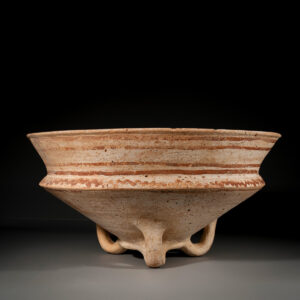
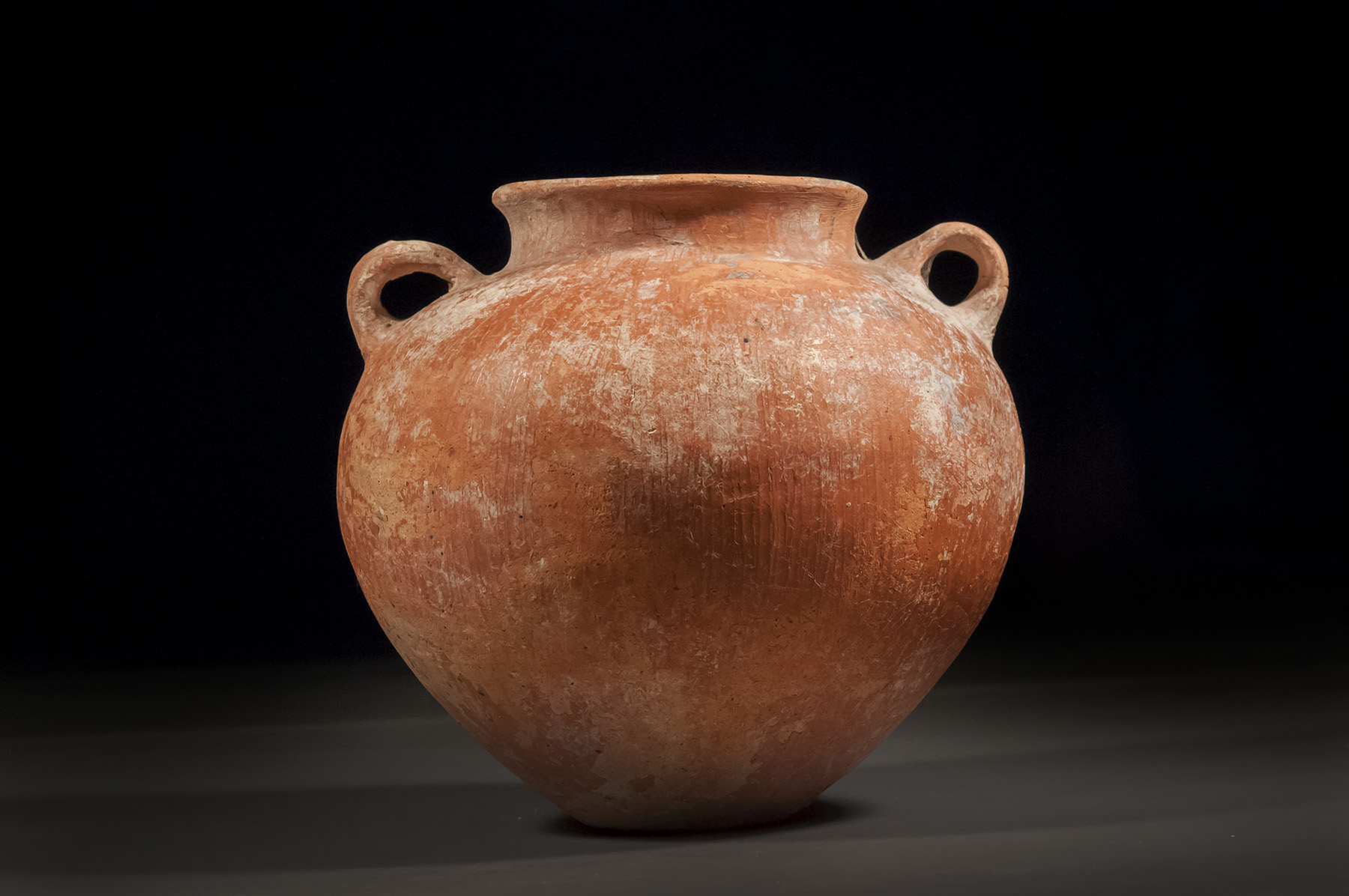
This elegant globular vessel was made in the ancient region of Canaan, almost five thousand years ago. The construction, finish and patination are a fascinating fusion of elegant practicality and aesthetics, as the piece was clearly designed for a specific use yet at the same time has been made in a fashion designed to make the best advantage of the materials at hand. The form is essentially globular, with a small base and widely flaring shoulders that cut short to a wide, constructed neck and upraised rim. The shoulders are adorned with a pair of small, round loop handles, and the entire piece has been red slipped and burnished. It has evidently been used for a prolonged period of time to judge from the secondary use-wear to the surface, which lends it a depth of tone which is highlighted by the calcareous patination which further complexifies the polytonal nature and texture of the piece. The size indicates that it may have been a personalised serving vessel, possible for drinking.
The Canaanites are renowned for pieces such as this: their artistic heritage is characterised by well-proportioned, harmonious and subtle compositions, and an evident enjoyment of aesthetic forms, even in everyday objects. They were one of the ‘tribal’ groups of what was to become Israel, Palestine and Jordan, who had their cultural roots in the Neolithic revolution when agriculture became the standard economy in the Near East. By the Bronze Age the stability of the area and their position between great trading powers – notably Egypt and Mesopotamia – made them prosperous and culturally diverse, and was a high point for artistic creation. The culture contracted with economic issues suffered by Egypt and the Mesopotamians, and went through a collapse at the end of the Bronze Age due to a combination of ‘Sea People’ invasions, environmental meltdown and internal troubles in Egypt leading to loss of infrastructure throughout the Near East. Their resurgence of power in the Iron Age was matched by that of the Ammonites and Moabites, among others, and the region eventually came under control of the Neo-Assyrians by the mid 8th century BC. This piece is typical in its functionalism, geometric simplicity and harmonious use of colour; it is a piece for a serious collector or a very sophisticated domestic interior.
Cf. Amiran, R., Ancient Pottery of the Holy Land, pp. 42-45
REFERENCE #
CR_CN_1014
CIVILIZATION
Canaanite, Early Bronze I 3100 B.C.E. – 2900 B.C.E.
SIZE
H. 15 cm
CONDITION
A chip on the rim.
PRICE
Price available upon request
Frequently Asked Questions
This elegant globular vessel was made in the ancient region of Canaan nearly five thousand years ago, dating back to the Early Bronze I period around 3100 to 2900 B.C.E. It reflects the artistic and cultural heritage of the Canaanite civilization during that era.
The vessel has a globular form with a small base, widely flaring shoulders, a constructed neck, and an upraised rim. It features a pair of small round loop handles on the shoulders and is finished with a red slip and burnishing. The surface shows secondary use-wear and calcareous patination, adding depth and texture to the piece.
Given its size and form, the vessel was probably a personalized serving vessel, possibly used for drinking. Its design balances practicality with aesthetic appeal, indicating it was both functional and decorative in use.
This piece exemplifies the Canaanite artistic heritage characterized by well-proportioned, harmonious, and subtle compositions. Even everyday objects like this vessel show an enjoyment of aesthetic forms, combining functionalism with geometric simplicity and harmonious use of color.
The vessel was created during a prosperous period in Canaan's history when the region was stable and culturally diverse due to its position between major trading powers like Egypt and Mesopotamia. This era was a high point for artistic creation before the Bronze Age collapse caused by invasions and environmental issues.
The vessel is generally well-preserved but has a chip on the rim. The surface shows signs of prolonged use, including secondary wear and patination, which contribute to its unique texture and appearance.
This piece is ideal for serious collectors or those with sophisticated domestic interiors who appreciate ancient functional art with aesthetic value. Its historical significance and elegant design make it a valuable addition to specialized collections.