Description
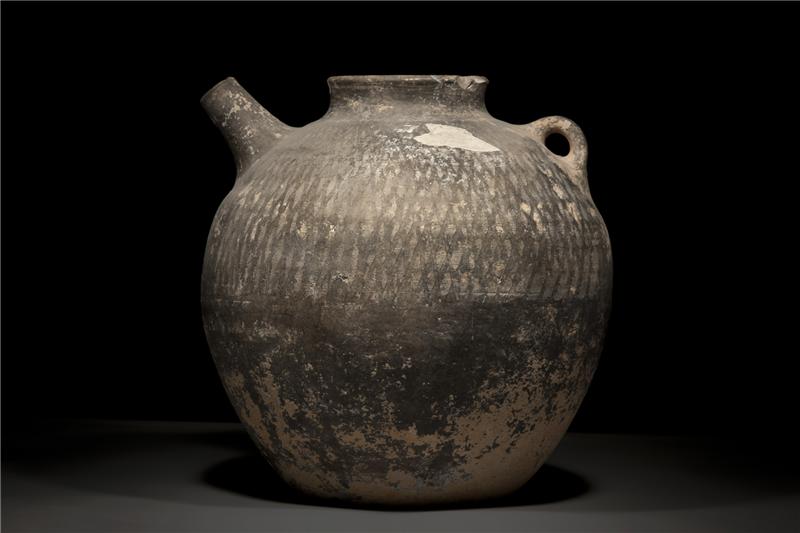
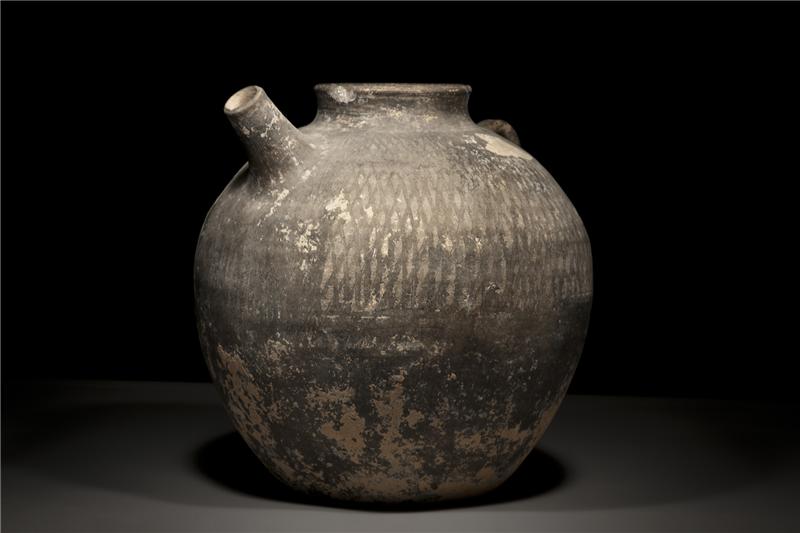
This striking ceramic vessel is a superb example of Canaanite domestic pottery traditions. Shaped in a globular form, the vessel has a wide base and a narrow, constricted neck with a flared rim. One side bears a small lug handle, directly opposite a long, cylindrical pouring spout. The ground is intermittently dark brown and grey with hatched detailing on the upper half, along with calcareous concretions testifying to a long period of interment. The precise role of the vessel is difficult to determine without XRF or sedimentary analysis, although the size, shape and level of adornment makes it likely to be a domestic dispensing vessel, for serving wine, oil or water to small-medium sized groups. The Canaanites are renowned for pieces such as this: their artistic heritage is characterised by well-proportioned, harmonious and subtle compositions, and an evident enjoyment of aesthetic forms, even in everyday objects.
The Canaanites were one of the ‘tribal’ groups of what was to become Israel, Palestine and Jordan, who had their cultural roots in the Neolithic revolution when agriculture became the standard economy in the Near East. By the Bronze Age the stability of the area and their position between great trading powers – notably Egypt and Mesopotamia – made them prosperous and culturally diverse, and was a high point for artistic creation. The culture contracted with economic issues suffered by Egypt and the Mesopotamians, and went through a collapse at the end of the Bronze Age due to a combination of ‘Sea People’ invasions, environmental meltdown and internal troubles in Egypt leading to loss of infrastructure throughout the Near East. Their resurgence of power in the Iron Age was matched by that of the Ammonites and Moabites, among others, and the region eventually came under control of the Neo-Assyrians by the mid 8th century B.C.E.. This piece is typical in its geometric simplicity and harmonious use of colour – it is a mature and impressive piece of ancient art.
Cf. Amiran, R., Ancient Pottery of the Holy Land, pp. 47-49
REFERENCE #
CR_CN_1007
CIVILIZATION
Canaanite, Early Bronze I 3100 B.C.E. – 2900 B.C.E.
SIZE
H. 28cm
CONDITION
Chips on the rim, and some repair to the neck.
PRICE
$8500
PROVENANCE
The Baidun Collection
Frequently Asked Questions
The vessel's size, shape, and adornment suggest it was likely used as a domestic dispensing vessel for serving liquids such as wine, oil, or water to small to medium-sized groups. However, without scientific analysis like XRF or sedimentary testing, its precise role remains uncertain.
This ceramic vessel has a globular form with a wide base and a narrow, constricted neck topped by a flared rim. It features a small lug handle on one side and a long cylindrical pouring spout on the opposite side. The surface shows dark brown and grey coloring with hatched detailing on the upper half.
The vessel shows chips on the rim and some repair to the neck, indicating it has undergone wear and restoration. Additionally, calcareous concretions on its surface suggest it was buried for a long period, reflecting its archaeological provenance.
The vessel exemplifies Canaanite pottery traditions through its well-proportioned, harmonious, and subtle design. The culture valued aesthetic forms even in everyday objects, and this piece's geometric simplicity and balanced use of color highlight their mature artistic heritage.
During the Early Bronze Age (3100-2900 B.C.E.), the Canaanites prospered due to their strategic location between Egypt and Mesopotamia, fostering cultural diversity and artistic achievement. Their society was rooted in Neolithic agricultural developments and later faced decline due to invasions and environmental challenges at the end of the Bronze Age.
The vessel comes from the Baidun Collection and is currently priced at $8,500. Its provenance and condition contribute to its value as a significant example of ancient Canaanite pottery.
Calcareous concretions are mineral deposits that form on objects buried underground over long periods. Their presence on this vessel indicates it was interred for an extended time, providing evidence of its archaeological authenticity and age.