Description
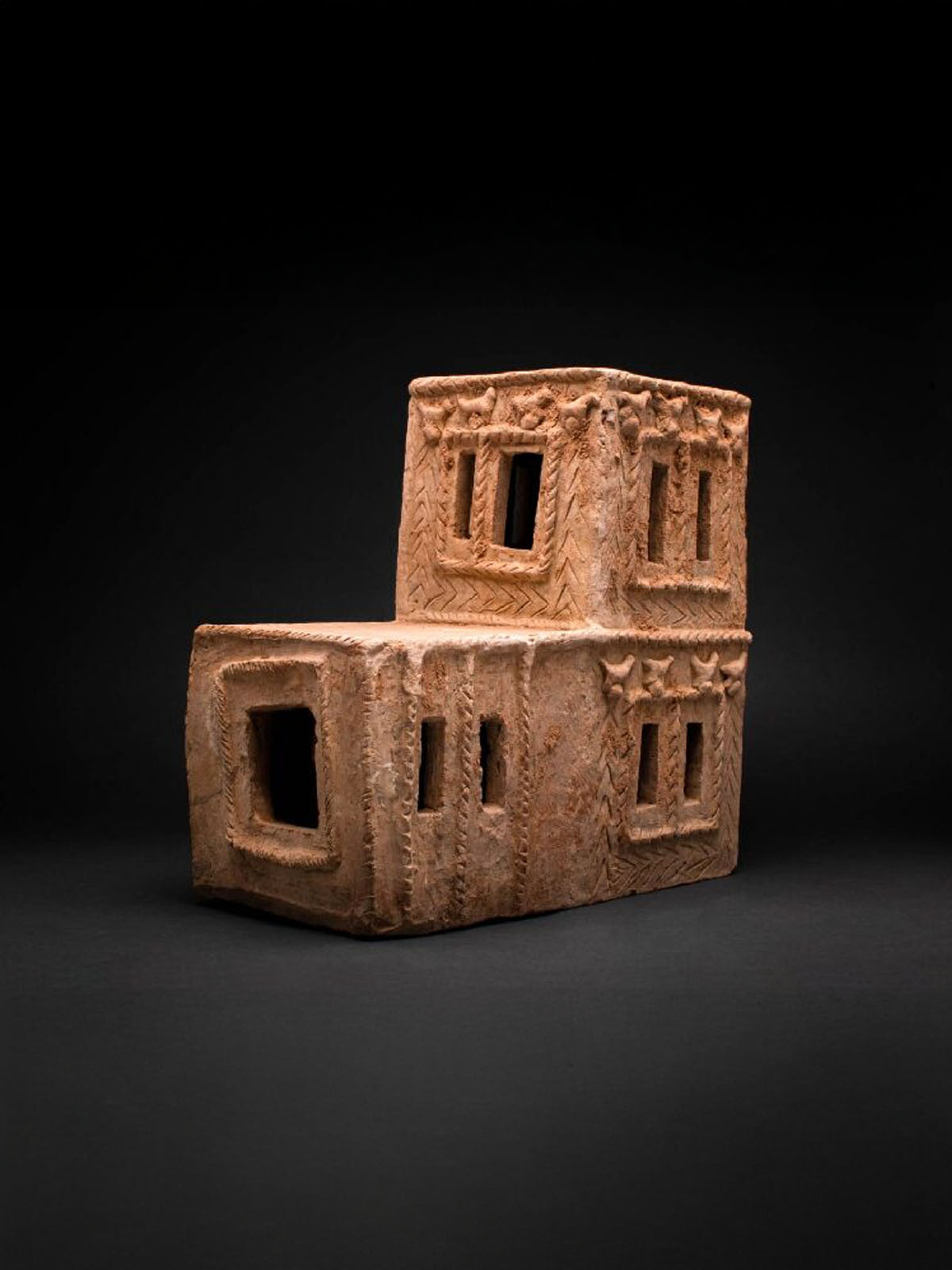
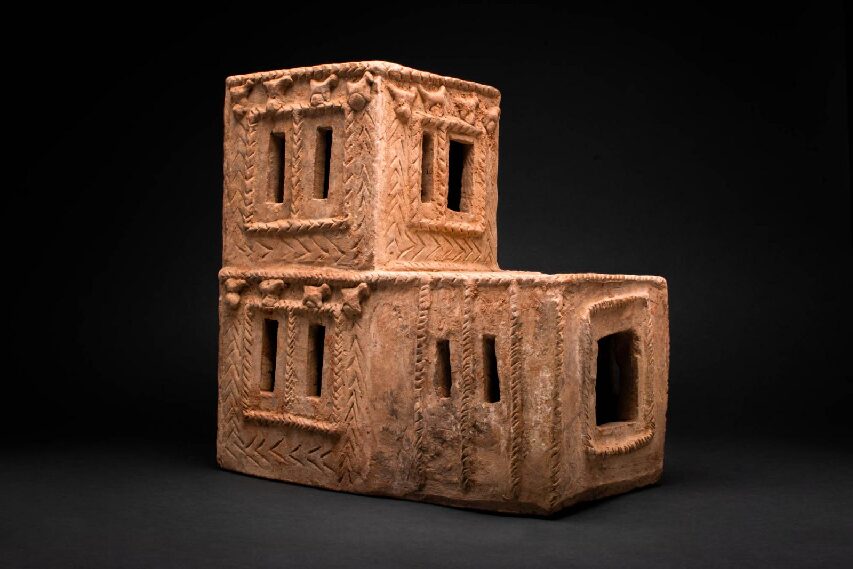
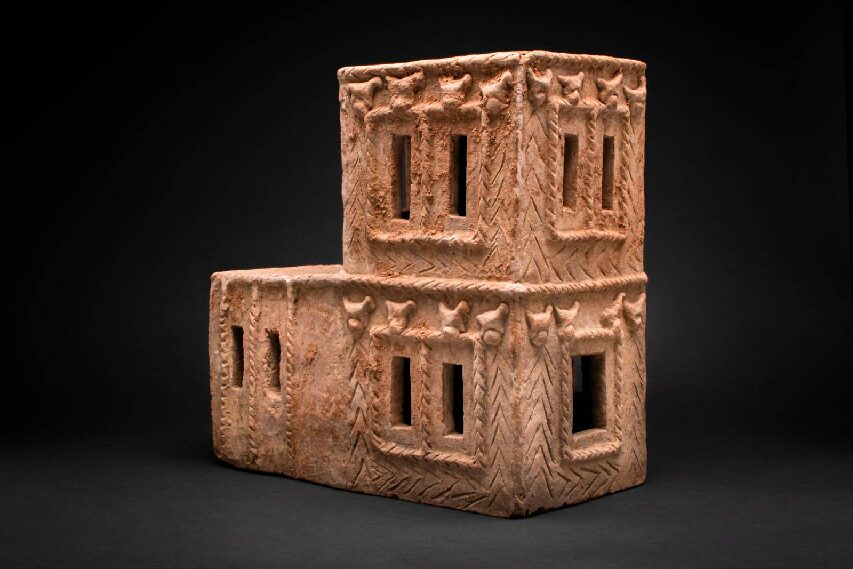
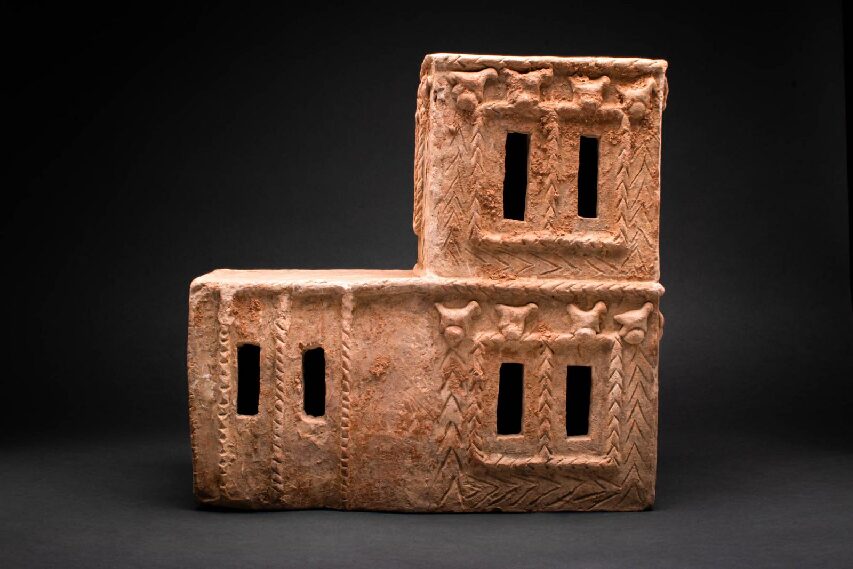
An exceptionally large and elaborate terracotta architectural model representing a monumental two-storeyed building, belonging to the architectural-model tradition of the Late Bronze Age Middle Euphrates and Upper Mesopotamian cultural sphere.
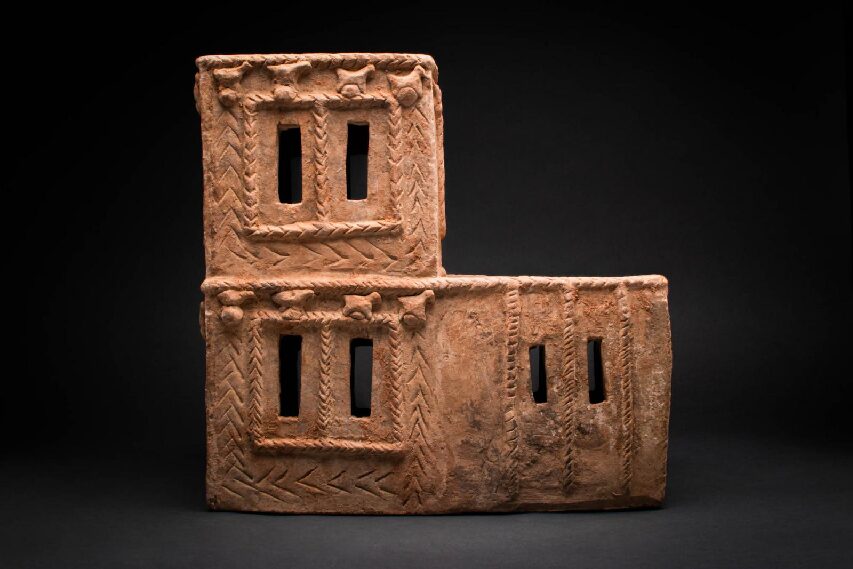
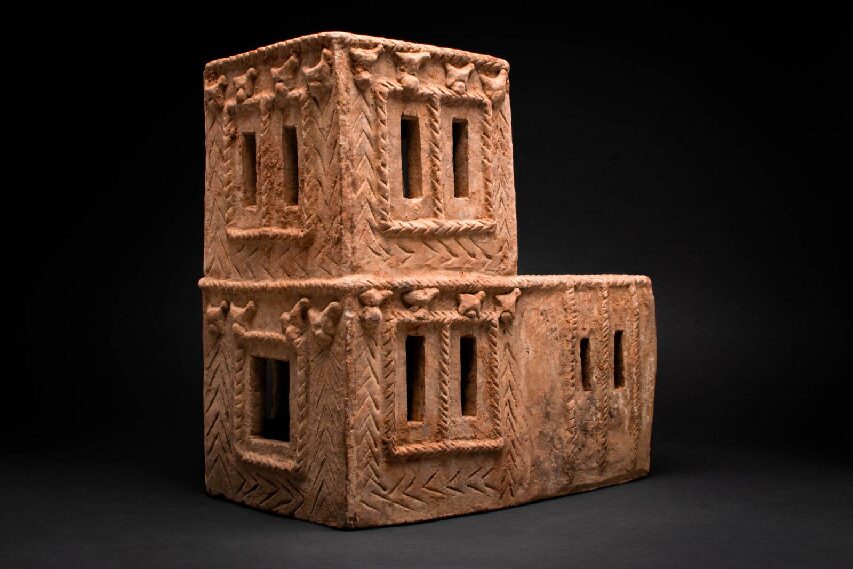
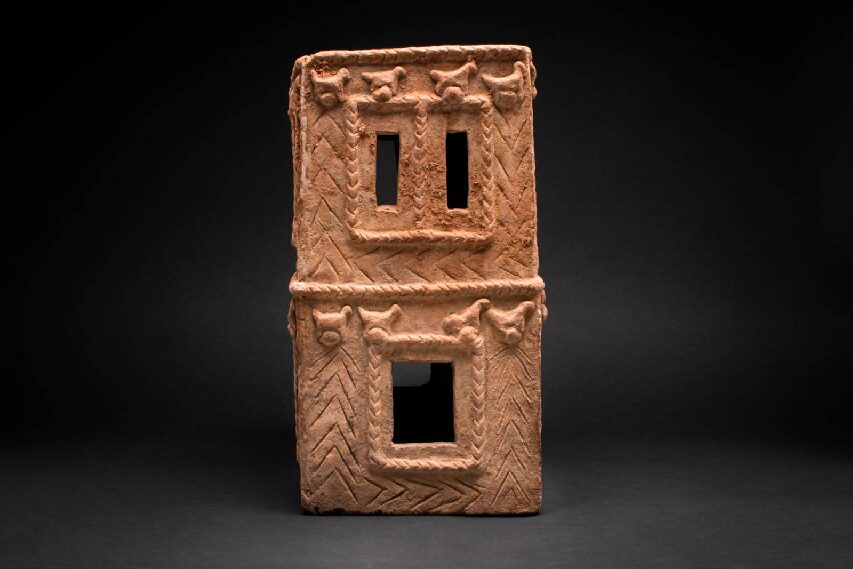
The rectangular structure is carefully conceived on two distinct levels, with the upper storey rising above one side of the lower building. All four façades are articulated by deeply recessed openings, including larger doorways and numerous pairs of tall, narrow windows. The repetition of these architectural elements around the structure creates a remarkably complete three-dimensional representation of an ancient Near Eastern building.
The façades are richly ornamented with incised chevron and herringbone patterns, which frame the windows, emphasize the corners and define individual architectural zones. Particularly noteworthy are the modeled projections arranged above many of the window openings and immediately beneath the rooflines. Comparable features on Late Bronze Age architectural models excavated at Emar and Tell Mumbaqa have been interpreted as representations of the projecting ends of wooden roof beams used in mud-brick construction.
The narrow vertical windows are likewise consistent with the practical requirements of Near Eastern earthen architecture, where relatively restricted exterior openings helped limit exposure to intense sunlight while permitting ventilation and illumination of the interior.
Archaeological Context and Significance
Terracotta architectural models are an important but comparatively rare category of ancient Near Eastern material culture. Examples representing houses, towers and sacred buildings are particularly well documented along the Middle Euphrates during the Late Bronze Age. Their exact purpose remains uncertain and may have varied: some appear to have served votive, ritual or cultic functions, while others may have represented domestic architecture or idealized buildings.
Especially significant comparisons come from Emar (ancient Meskene) in modern Syria, where monumental architectural models dating to the Late Bronze Age have been excavated. Surviving fragments preserve geometric façade decoration and architectural details comparable in concept to those displayed on the present example.
A particularly relevant comparison is the two-storey terracotta house model, Louvre AO 27617, attributed to the Euphrates Valley and dated approximately 1200–1100 B.C. The Louvre relates this group of models to domestic architecture documented archaeologically in the Middle Euphrates region.
Further comparison may be made with architectural-model fragments from Emar, including Louvre AO 27178, which preserves characteristic incised chevron decoration and belongs to the Late Bronze Age architectural-model tradition.
The monumental dimensions of the present example—43 × 39 cm and approximately 14 kg—combined with its two-storeyed construction, extensive façade decoration, numerous openings and preservation on multiple sides make it an unusually impressive representative of this ancient Near Eastern architectural tradition.
Attribution
On stylistic and architectural grounds, and particularly in comparison with excavated architectural models from the Middle Euphrates region, the piece is most appropriately attributed to the Late Bronze Age, circa 1400–1200 B.C., within the Middle Euphrates / Upper Mesopotamian cultural sphere.
Although the building may have represented a shrine or sacred structure, its precise ancient function cannot presently be established. Accordingly, the more archaeologically cautious designation “architectural model of a two-storey house/building” is preferred over a definitive identification as a temple.
Published & Museum Comparanda
For related Late Bronze Age architectural models, see examples excavated at Emar (Meskene) and preserved in the Musée du Louvre, including AO 27178, as well as the Louvre AO 27617, a terracotta model of a two-storey house from the Euphrates Valley, ca. 1200–1100 B.C. Monumental architectural models from Emar and related Middle Euphrates sites provide important archaeological context for the present example.
For the broader ancient Near Eastern tradition of multi-storeyed architectural models and cult vessels, compare also The Metropolitan Museum of Art, New York, Accession No. 68.155, a Middle Bronze Age Syrian cult vessel in the form of a two-storey tower, ca. 19th century B.C. This earlier example should be regarded as a general typological comparison rather than a direct chronological parallel.
REFERENCE
#CR_MS_1017
CIVILIZATION
Ancient Near East, Middle Euphrates / Upper Mesopotamian Cultural Sphere, Late bronze age 1400 B.C.E. – 1200 B.C.E.
SIZE
43cm x 39cm
CONDITION
Top storey was rejoined otherwise in fine condition, considering the object’s considerable age and substantial size. The principal architectural structure is preserved, together with the majority of its modeled and incised decorative details. Surface wear, earthen deposits, minor abrasions and localized losses are consistent with antiquity. The extensive survival of the architectural façades and decorative scheme allows the original conception of the building to be clearly understood.
PRICE
P.O.R
PROVINANCE
Private royal collection, 1990s
Frequently Asked Questions
The terracotta model represents an ancient Mesopotamian house from the Babylonian period, showcasing architectural features such as two stories and narrow windows designed to protect interiors from the sun. It provides valuable insight into residential construction and living conditions between 1600 B.C.E. and 1200 B.C.E.
The terracotta model measures 43 cm by 39 cm and is reported to be in fine condition, indicating it has been well-preserved over time.
The historical report accompanying the terracotta model was prepared by Alessandro Neri, an international Cultural Heritage expert based in Florence, Italy, adding scholarly context to the piece.
Notable features include two stories with little and narrow windows designed to shield the internal rooms from the hot sun, reflecting practical design considerations in ancient Mesopotamian architecture.
The terracotta model comes from a private royal collection acquired in the 1990s, indicating its historical value and careful preservation within a prestigious collection.
Yes, a similar piece can be found at the MET Museum under Accession Number 68.155, which provides a comparative example of Mesopotamian architectural terracotta models.