Description
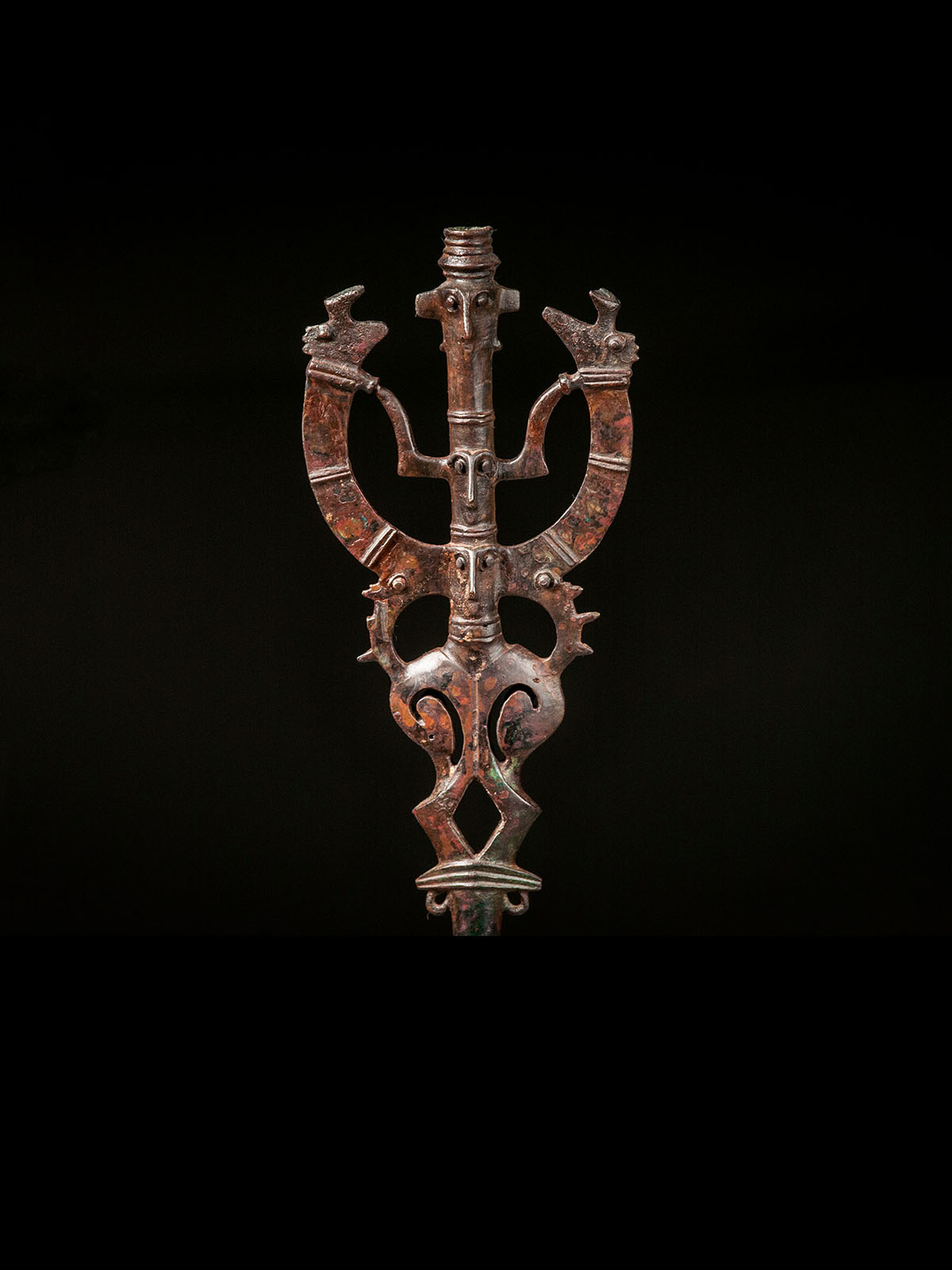
The area of Luristan, in western Iran, was home to a rich tradition of bronze-working in the early part of the first millennium B.C.E., producing an array of finely-crafted and distinctive objects unique to the region. This intricately-cast standard finial was originally intended to sit atop a ceremonial staff to be carried in a procession; the bell-shaped socket at the lower end was designed to enable attachment.
The finial represents, in highly stylized form, the ‘Master of Animals’, a deity considered ancient even at the time this piece was made, and who probably had origins in Stone Age hunters’ cults. The figure has a cylindrical body, with three faces along its length. With a pair of slender arms, it fends off two serpent-like creatures. The lowest part of the figure has an exaggerated, oval-shaped torso and stands on a pair of short, bowed legs.
REFERENCE #
SI_PR_1016
CIVILIZATION
Persian, 1st millennium B.C.E.
SIZE
H. 35cm
CONDITION
Fine Condition
PRICE
SOLD
PROVENANCE
Private UK collection, late 1970’s.
Frequently Asked Questions
The bronze finial originates from Luristan, a region in western Iran known for its rich tradition of bronze-working during the early first millennium B.C.E. This area produced unique and finely-crafted bronze objects distinctive to the region.
The bronze finial was designed to be mounted atop a ceremonial staff carried in processions. Its bell-shaped socket at the lower end allowed it to be securely attached to the staff, serving both decorative and symbolic functions during ceremonies.
The figure represents the ‘Master of Animals,’ an ancient deity likely rooted in Stone Age hunters’ cults. It is depicted in a highly stylized form with three faces, slender arms fending off serpent-like creatures, and an exaggerated torso standing on bowed legs.
The finial features a cylindrical body with three faces along its length, slender arms defending against two serpent-like creatures, an exaggerated oval-shaped torso, and short bowed legs. These elements combine to create a highly stylized and symbolic representation.
The bronze finial measures 35 centimeters in height and is reported to be in fine condition, indicating it has been well-preserved since its creation in the first millennium B.C.E.
The finial was part of a private UK collection acquired in the late 1970s. Its provenance traces back to this collection before it was sold, ensuring its documented history and authenticity.