

Description
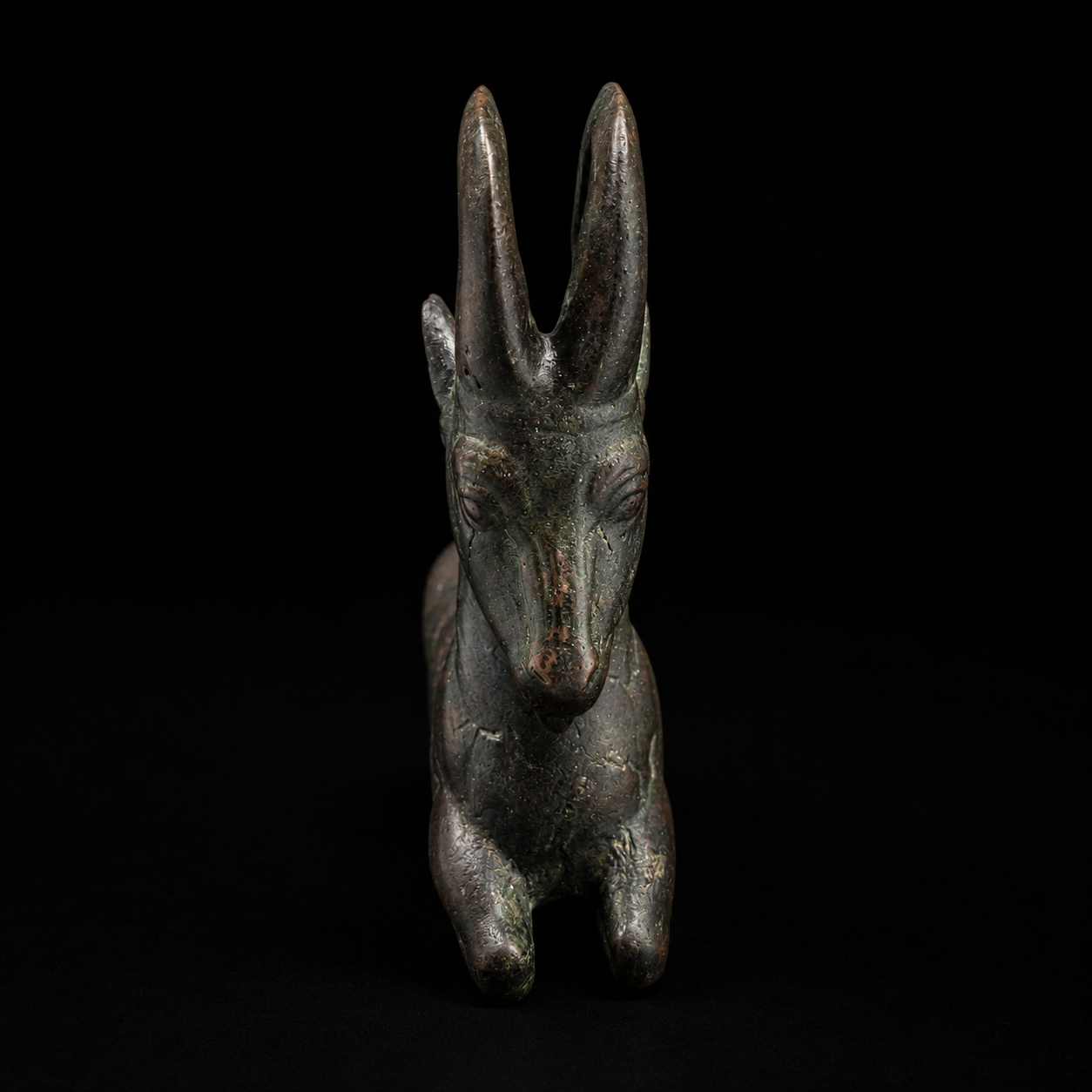
An impressive and substantial ancient bronze figure of a recumbent male ibex, attributed to the Elamite cultural sphere of ancient Iran and dating to the Early Bronze Age, circa 3000–2500 BC.
The animal is depicted at rest, with its legs folded beneath the body and its rounded hindquarters rising into a long, powerful neck. The narrow head is modeled with upright pointed ears, an elongated muzzle, carefully indicated facial features and a distinctive pointed beard beneath the chin.
The composition is dominated by the ibex’s magnificent sweeping horns, which rise dramatically above the head before curving inward in deep arcs. Their exaggerated scale creates a commanding silhouette and emphasizes the animal’s most recognizable characteristic. The sculptor has reduced the anatomy to strong, flowing forms, combining natural observation with the highly stylized aesthetic characteristic of early Iranian animal representation.
The ibex was one of the most important and enduring animal motifs of ancient Iran, particularly in the mountainous regions of the Iranian plateau. Early Bronze Age representations frequently emphasize the animal’s enormous curving horns. A particularly relevant comparison is the celebrated Jar with Ibexes, western Iran, circa 2600–2500 BC, in the Metropolitan Museum of Art, New York, whose animals are similarly distinguished by dramatically enlarged horns and prominent beards.
At 18 cm in length and weighing 884 grams, the present figure is a substantial example of ancient Near Eastern bronze animal sculpture. The surface preserves a rich dark brown to near-black patina with areas of green and reddish mineralization, lending considerable character to the bronze.
REFERENCE #
| SI-PR-1025 |
CIVILIZATION
Elamite, ca. 3000 BC – 2500 BC
SIZE
L. 18 cm, W. 18 cm
CONDITION
Very good overall condition considering its considerable antiquity. The body and principal features are well preserved. The horns have been professionally restored, incorporating the surviving ancient portions. Areas of surface wear, mineralization and age-related irregularities throughout.
PRICE
$18,000
PROVENANCE
Jerusalem Private Collection
Frequently Asked Questions
The recumbent ibex figure is a recognized subject in Elamite and Luristan bronze traditions, often serving as a votive or decorative object. It is linked to mountain wildlife and fertility symbolism, reflecting cultural beliefs from around 3000 BC to 2500 BC.
The ibex figure is made of solid-cast bronze, featuring a dark brown-black patina with reddish corrosion that indicates its age. The craftsmanship includes naturalistic modeling of the head and muzzle, with large ridged horns cast in a dramatic arc.
The figure measures 18 cm in length and 18 cm in width. It is in fine condition overall, with the exception of repaired horns, which have been restored to maintain the figure's integrity.
The ibex figure originates from the Elamite civilization, dating approximately between 3000 BC and 2500 BC. This places it in an ancient historical context associated with early Bronze Age cultures in the region.
The dark brown-black patina with reddish corrosion on the bronze figure is consistent with its age, indicating natural oxidation and aging processes. This patina helps authenticate the figure as an ancient artifact and adds to its aesthetic and historical value.
The recumbent ibex figure comes from a private collection in Jerusalem, which provides a documented history of ownership and adds to its provenance and collectible value.
The recumbent ibex bronze figure is priced at $15,000, reflecting its historical significance, condition, and provenance as an ancient Elamite artifact.