Description
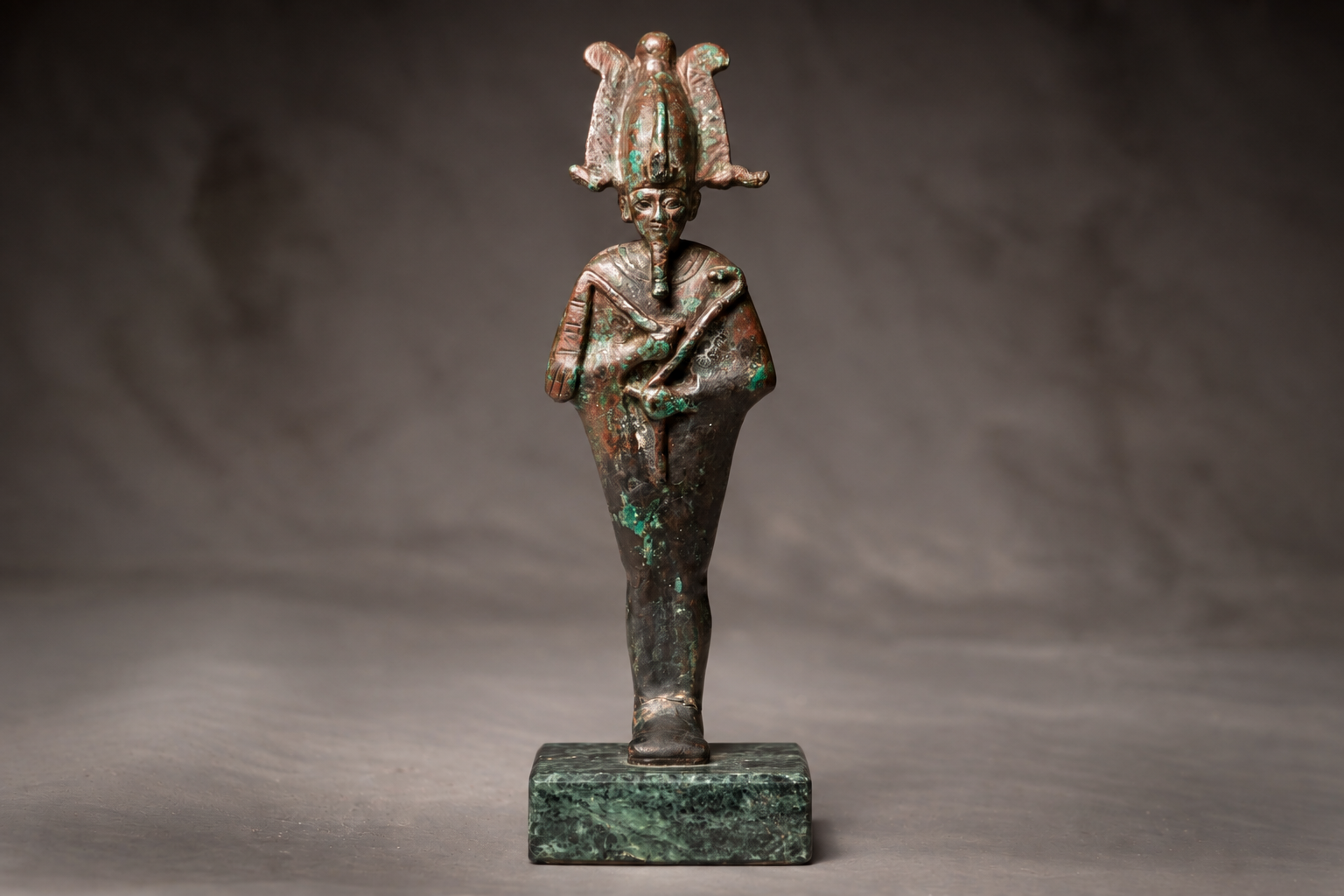
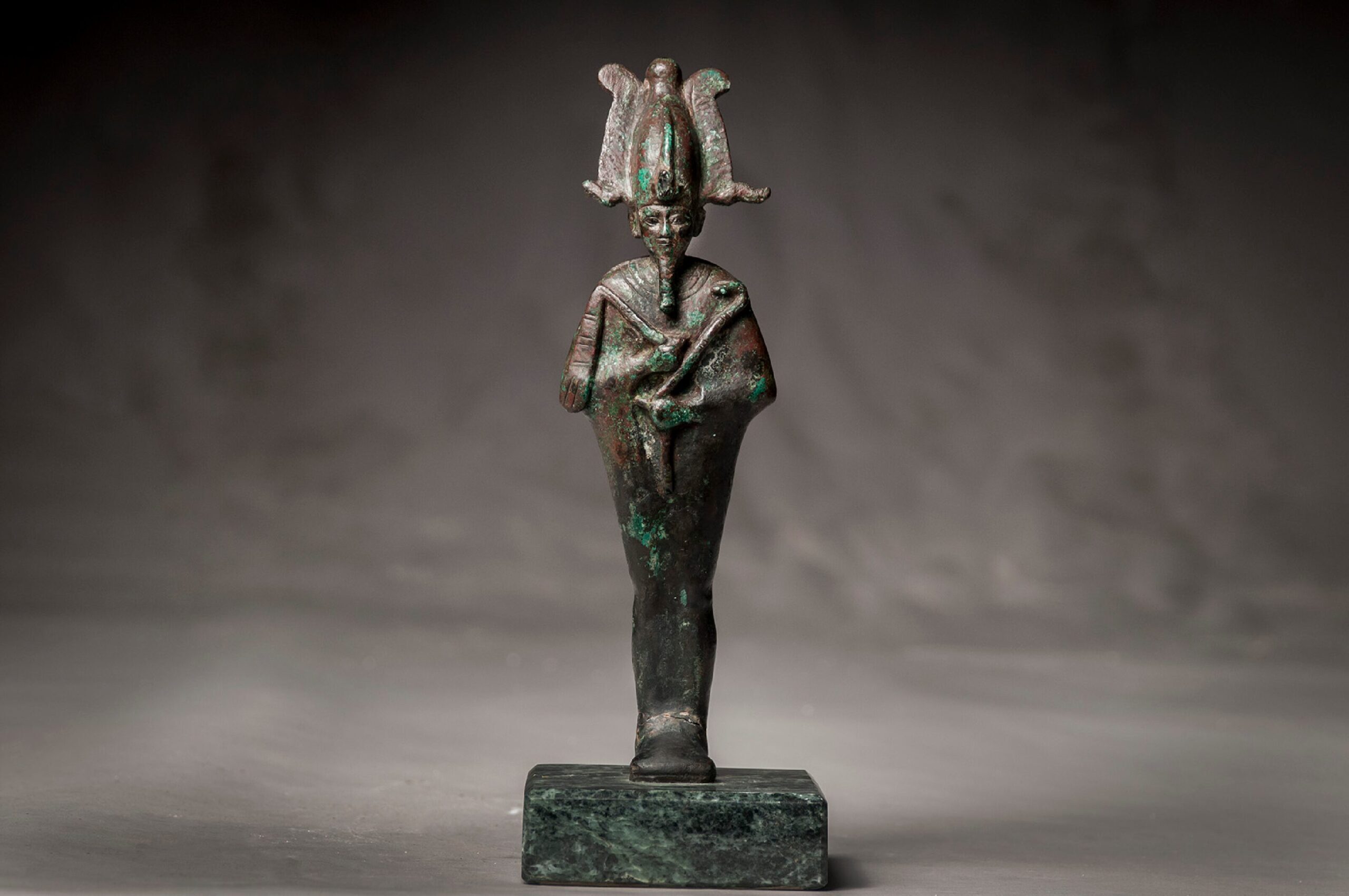
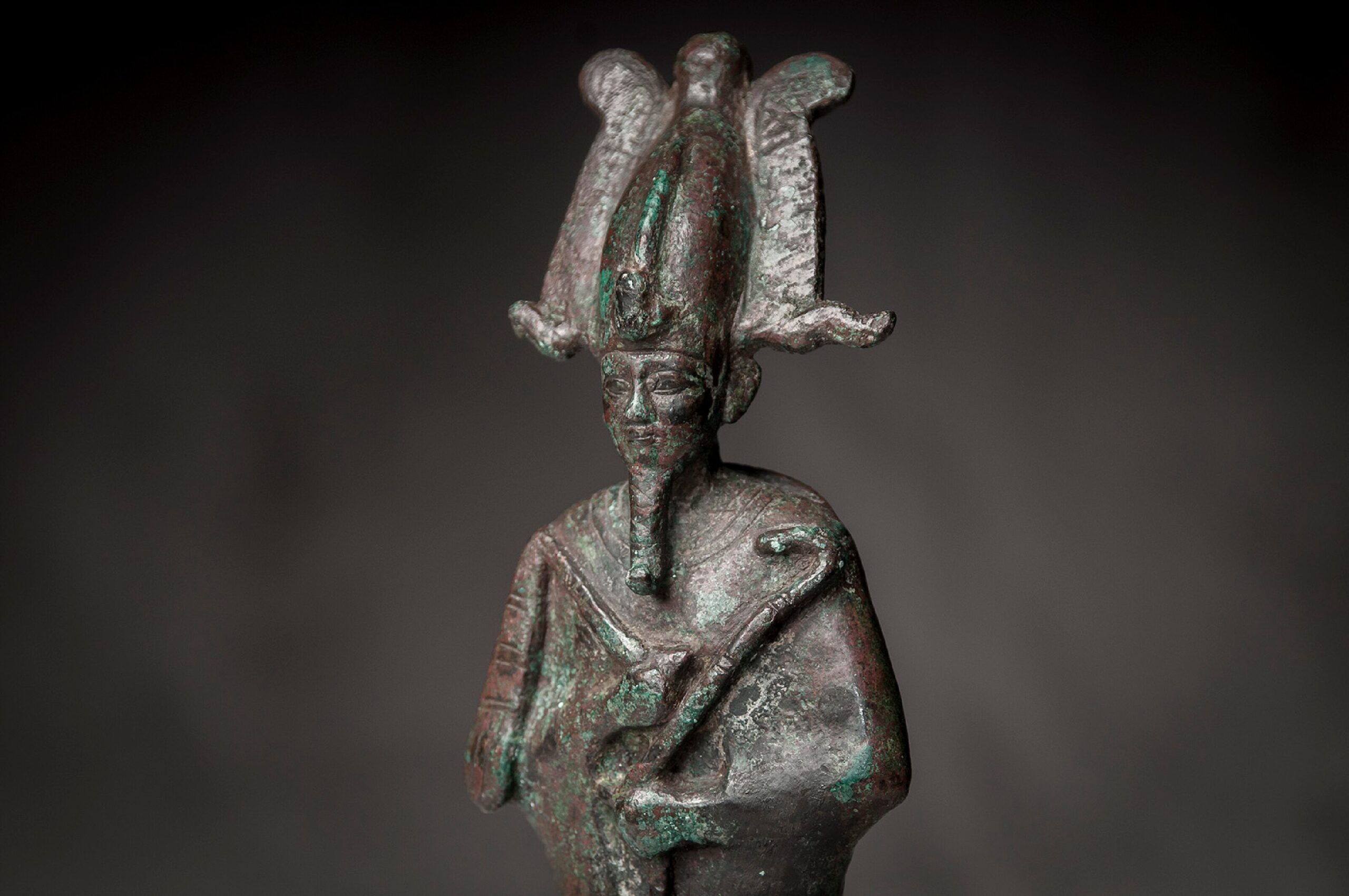
An exceptionally detailed bronze statuette of Osiris, God of resurrection, regeneration and ruler of the Egyptian underworld, represented in his canonical mummiform guise.
The deity stands rigidly frontal, his elongated body enveloped within a close-fitting funerary shroud. Emerging prominently across the chest are the crossed arms holding the royal heka-crook and nekhakha-flail, ancient insignia of kingship that became among the principal identifying attributes of Osiris. This combination of mummiform body, crook and flail is closely paralleled by securely attributed Late Period representations in major museum collections. The Metropolitan Museum of Art
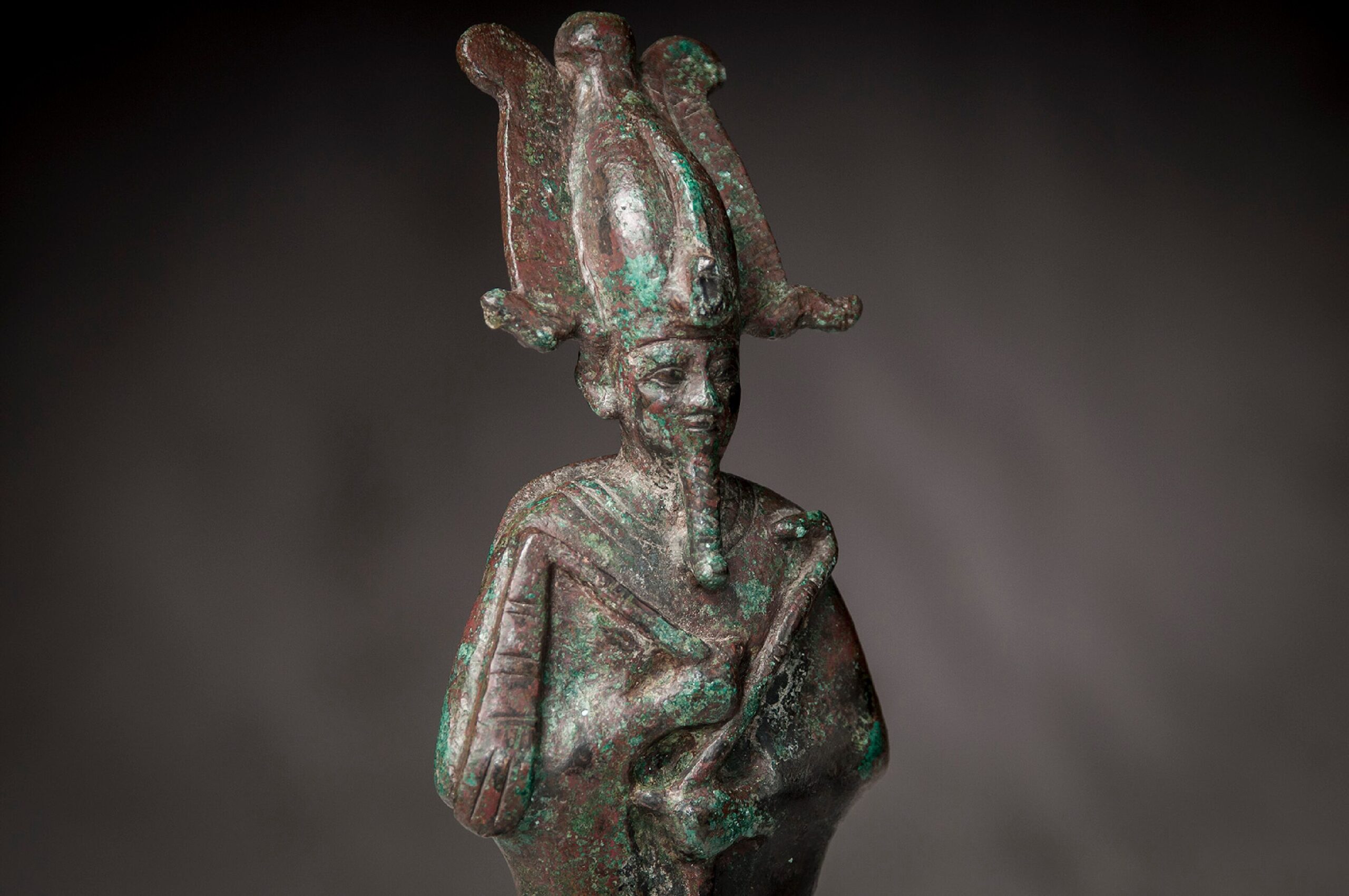
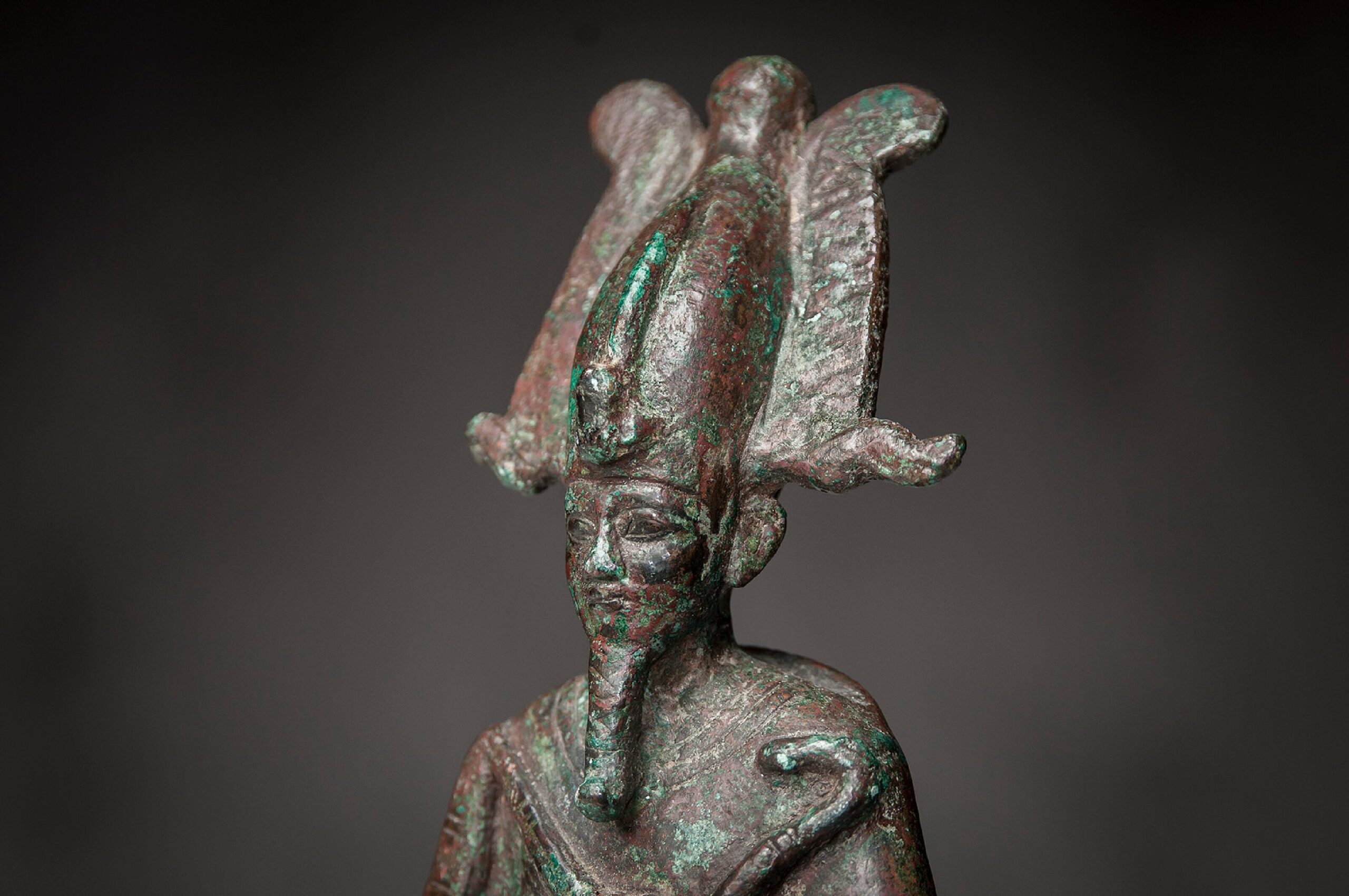
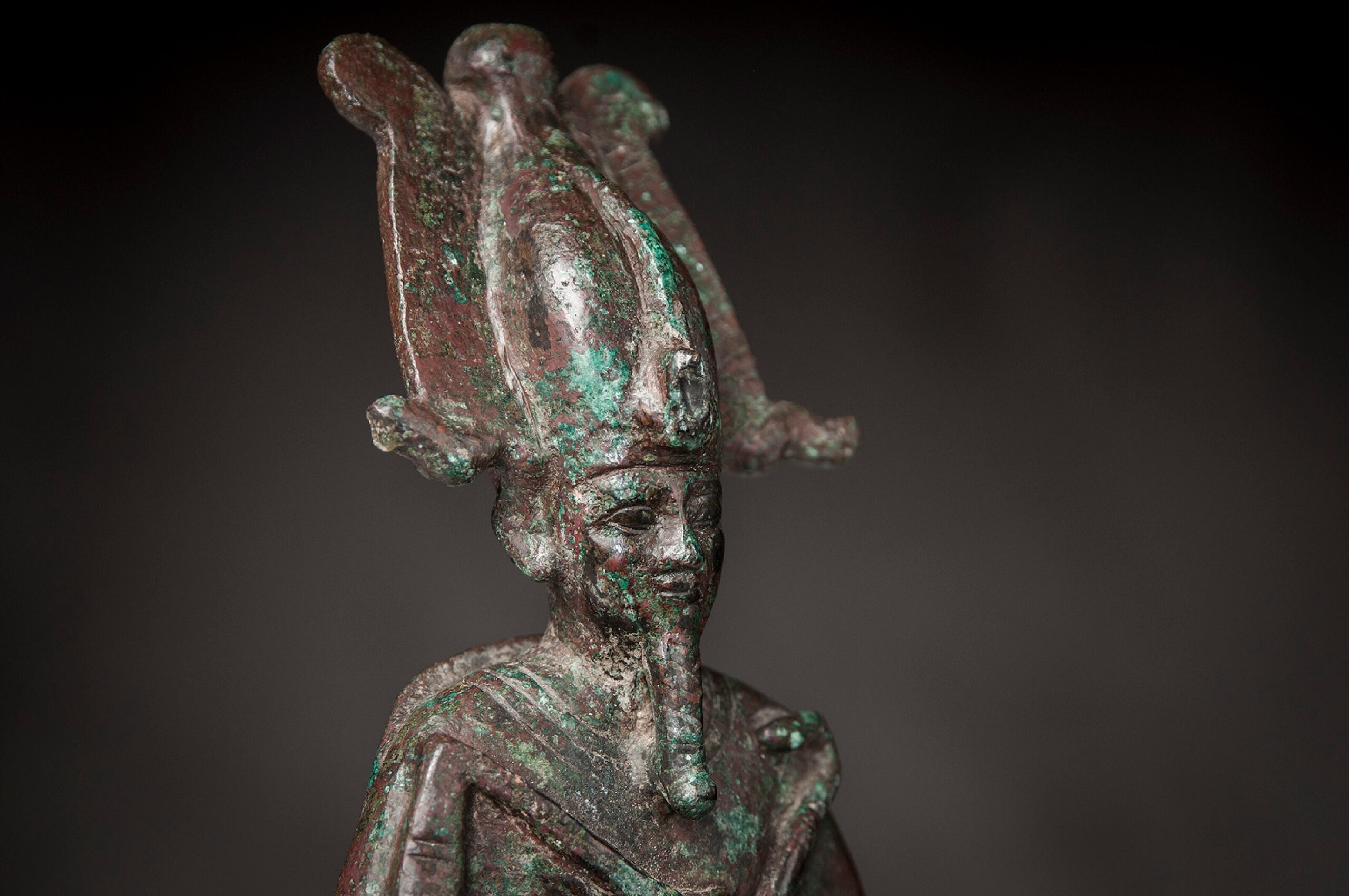
Particularly impressive is the elaborate Atef crown. The tall central crown is flanked by two large feathers with outward-curving terminals, while the forehead bears the uraeus cobra, the emblem of divine and royal protection. The crown retains extensive incised detailing, particularly along the feathers.
The face is unusually well defined, with clearly delineated almond-shaped eyes, eyebrows, nose and mouth. A long ceremonial divine beard descends from the chin. The careful modeling of the face, crown and regalia gives the statuette a refinement that distinguishes it from more schematic votive bronzes of Osiris.
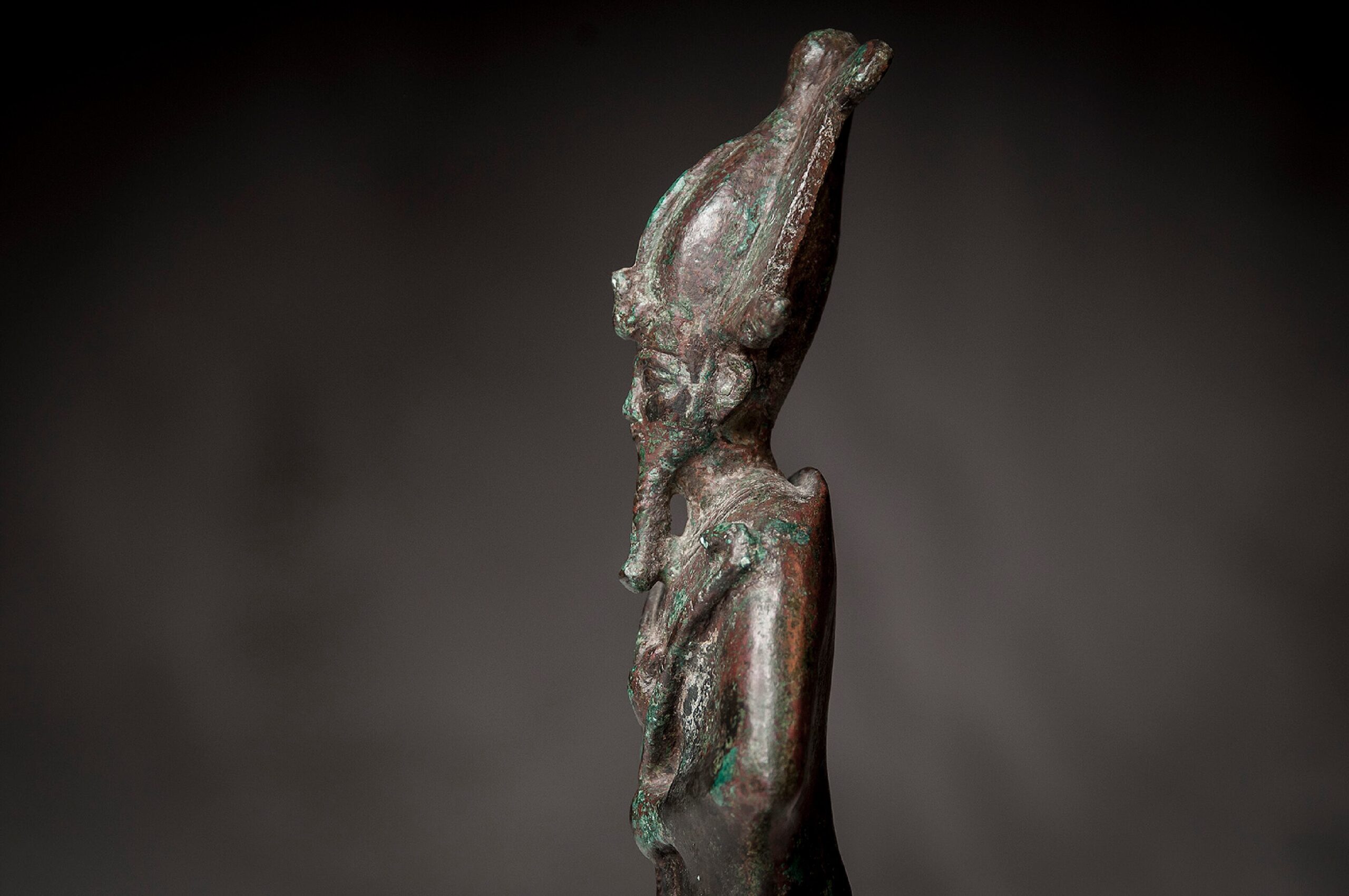
The upper body is especially accomplished. The crook and flail are modeled independently from the surrounding shroud and cross diagonally over the torso, producing a strongly three-dimensional composition. Incised decoration remains visible upon the regalia and crown.
The bronze preserves an attractive ancient surface characterized by deep brown and reddish-brown tones together with localized areas of green copper mineralization.
The figure is presently mounted upon a modern stone display base.
Osiris and the Afterlife
Osiris occupied a central position in Egyptian religion as the divine ruler of the dead and embodiment of renewed existence. His mythology—death followed by restoration—made him the supreme symbol of resurrection and regeneration.
The deceased hoped to become identified with Osiris and thereby participate in the god’s victory over death. Consequently, his image became one of the most important devotional forms of later Egyptian religion.
The Atef crown, uraeus, divine beard, mummiform body, crook and flail together form the characteristic iconographic vocabulary of Osiris. The Metropolitan Museum specifically identifies the crook and flail as symbols of kingship and the uraeus as the protective royal cobra, while comparable Late Period figures show the same tall feathered Atef crown and enveloping garment. The Metropolitan Museum of Art
Function
During the first millennium B.C., bronze statuettes of Osiris became particularly important as votive offerings. They were dedicated in temples, shrines and other sacred contexts as tangible expressions of devotion to the god.
The Metropolitan Museum notes that Osiris statuettes became some of the most abundant temple offerings in Egypt during the first millennium B.C., reflecting both the importance of his cult and changes in Egyptian devotional practices. The Metropolitan Museum of Art
Museum Parallels
A particularly useful parallel is a Late Period bronze Osiris in the Metropolitan Museum of Art, accession no. 04.2.578, dated to Dynasties 26–30 (664–332 B.C.). Like the present statuette, the god is mummiform and holds the crook and flail. The Metropolitan Museum of Art
Another close iconographic comparison is the British Museum’s EA49135, a solid-cast Late Period copper-alloy Osiris from Naukratis, dated 664–332 B.C. It similarly combines the mummiform body, heka-scepter, nekhakha-flail, Atef crown, frontal uraeus and detailed feather decoration. British Museum
The Brooklyn Museum’s 08.480.27, dated to Dynasty 26, 664–525 B.C. or slightly later, provides another important comparison. It depicts Osiris mummiform and carrying the crook and flail and demonstrates the established use of this iconography during the Saite period. Open Collection
A further useful parallel is a solid-cast Osiris in the Louvre collections, dated stylistically to the Late Period, 664–332 B.C. The Louvre describes the figure with the Atef crown, false divine beard, heqa-scepter and flail—the same principal attributes preserved on the present example. Louvre Collections
References: Metropolitan Museum of Art, accession nos. 04.2.578 and 2016.9.14; British Museum, EA49135; Brooklyn Museum, 08.480.27; Musée du Louvre, D.961.2.178. The Metropolitan Museum of Art
REFERENCE #
SI_EG_1013
CIVILIZATION
Egypt, Late Period, 26th -30th Dynasty
SIZE
H. 22 cm
CONDITION
Very good condition. The principal iconographic elements are remarkably well preserved, including the Atef crown and its lateral feathers, frontal uraeus, divine beard, crossed arms, crook and flail. The facial features and extensive incised details remain clearly visible.
Ancient surface wear and localized oxidation are present, together with areas of green mineral patination consistent with the bronze’s age. Mounted on a modern stone display base.
PRICE
$13,500
PROVENANCE
Private Jerusalem Collection, 1990s
Frequently Asked Questions
The bronze statuette of Osiris dates back to the Late Period of ancient Egypt, specifically from the 26th to the 30th Dynasty. This period is known for its artistic revival and cultural richness.
The statuette stands at a height of 22 centimeters, making it a relatively small and detailed bronze artifact suitable for display or collection.
The statuette is described as being in fine condition, indicating that it has been well-preserved with minimal damage or wear despite its age.
The bronze statuette of Osiris is priced at $13,500, reflecting its historical significance, condition, and provenance.
The statuette comes from a private collection in Jerusalem, acquired in the 1990s, which adds to its authenticity and historical value.
The statuette shows Osiris in his traditional pose with arms crossed, holding a crook, which is symbolic of his role as a god of the afterlife and resurrection in ancient Egyptian mythology.