Description
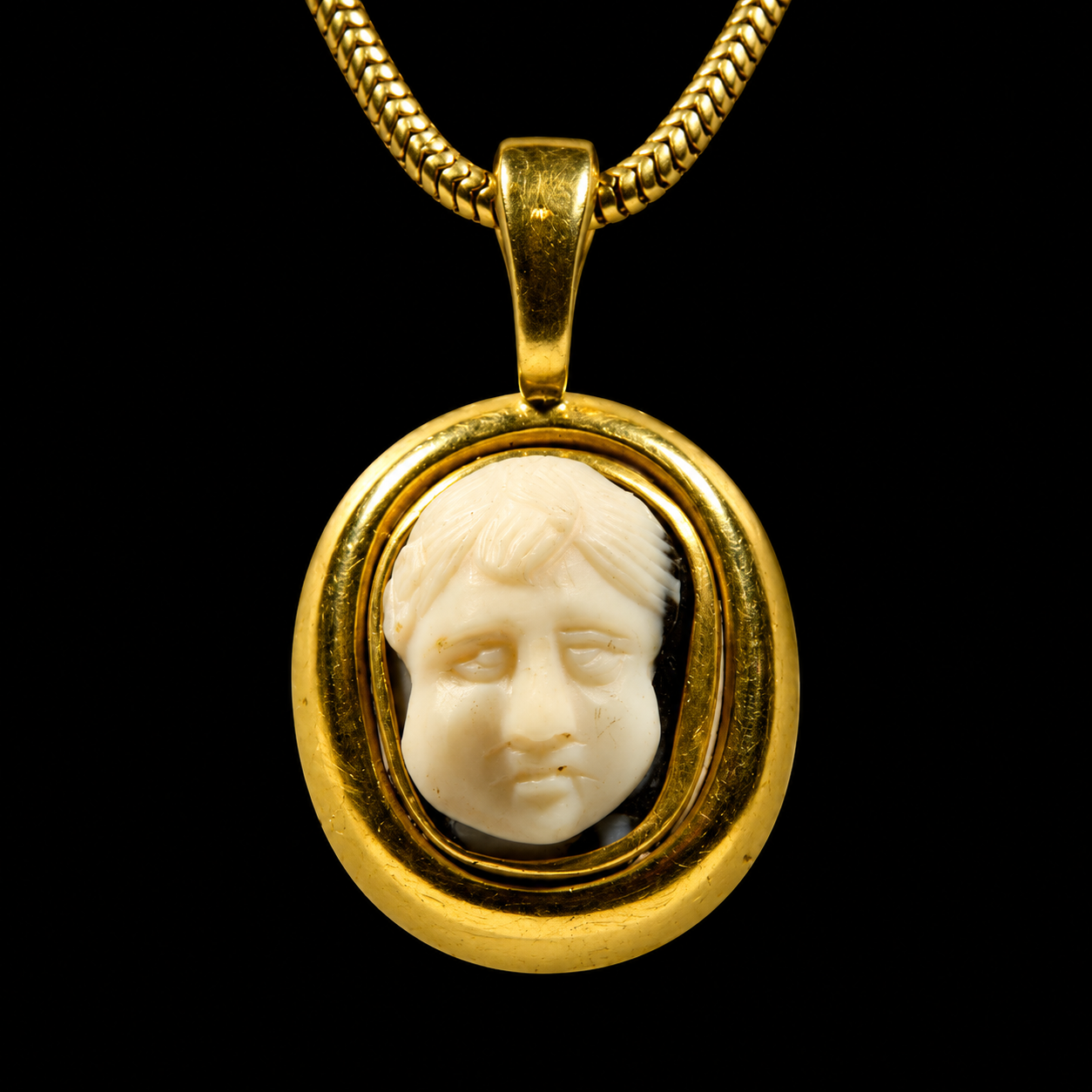
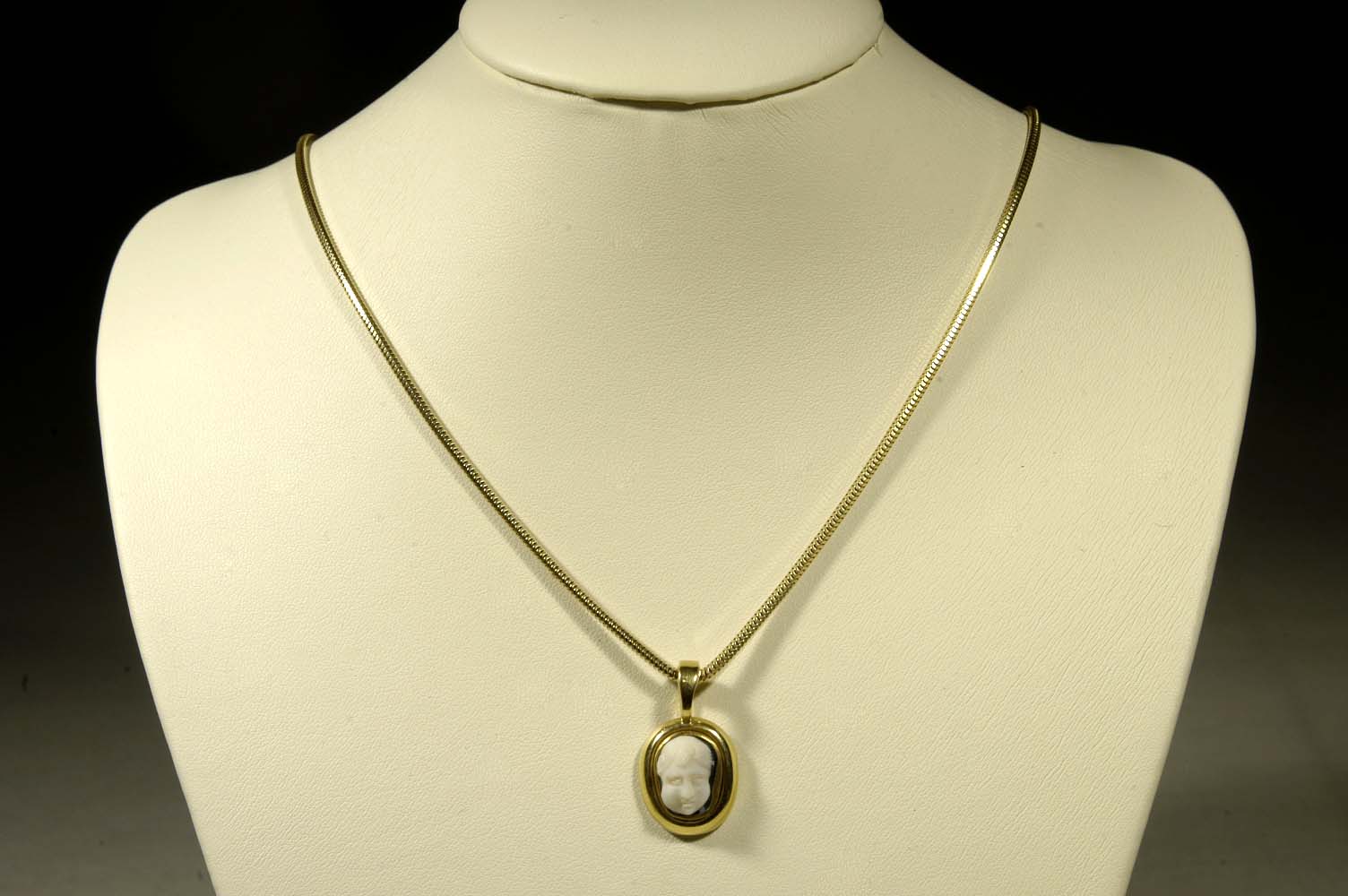
An elegant Roman cameo finely carved from layered onyx, preserving a striking frontal portrait in creamy white relief against the naturally contrasting dark ground of the stone. The face is sensitively modeled with softly rounded cheeks, almond-shaped eyes, a straight nose and small, carefully articulated lips. Above the forehead, the hair is arranged in gently curving locks, giving the diminutive image a remarkably sculptural presence.
The use of contrasting layers within the stone is characteristic of the sophisticated glyptic tradition that flourished during the late Hellenistic and early Roman periods. Skilled gem engravers deliberately exploited the differently colored strata of stones such as onyx, sardonyx and agate, cutting away the upper layer to create a pale figure dramatically silhouetted against a darker background.
The frontal head has traditionally been identified as Medusa, one of the most enduring protective images of the Greco-Roman world. Known as the Gorgoneion, the head of Medusa was employed on sculpture, armor, jewelry, gems and architectural decoration as an apotropaic emblem, intended to repel evil and protect its owner. On Roman gems, however, Medusa could be represented in an increasingly youthful and idealized manner, far removed from the terrifying Gorgon imagery of earlier Greek art.
Cameos and engraved gems occupied a special place in Roman society. Worn as rings, pendants and personal ornaments, they could function simultaneously as objects of luxury, expressions of cultural refinement and, when bearing protective imagery, personal amulets.
The ancient cameo has been mounted in a modern gold pendant setting, allowing the Roman carving to be worn while emphasizing the dramatic contrast between its ivory-white relief and deep black ground.
REFERENCE #
JW_RM_1022
CIVILIZATION
Roman, 100 B.C.E. – 100 C.E.
SIZE
H. 2 cm
CONDITION
Ancient cameo preserved with minor surface wear consistent with age. Modern gold mount and chain.
PRICE
$2500
Frequently Asked Questions
The background stone of the Roman cameo is onyx, known for its deep black color and solid lustre, which provides a striking contrast to the carved image of Medusa.
The cameo depicts the facing head of Medusa, the mythical snake-headed gorgon from Greek mythology. Medusa was admired by the Romans and featured in their literature, symbolizing protection and warding off evil.
In Roman times, cameos were popular as seals and jewelry. They elevated cameo carving from a marginal art form to a major sculptural technique, with masterpieces like the Portland Vase exemplifying their artistic importance.
This Roman cameo measures 2 cm in height and is described as being in excellent condition, making it a well-preserved example of ancient art.
The Roman cameo mounted in a modern gold setting is priced at $2500, reflecting its historical value and craftsmanship.
The cameo dates from the Roman period between 100 B.C.E. and 100 C.E., a time when Roman art was heavily influenced by Greek culture.