Description
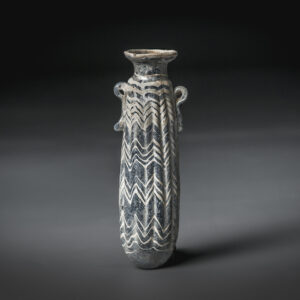
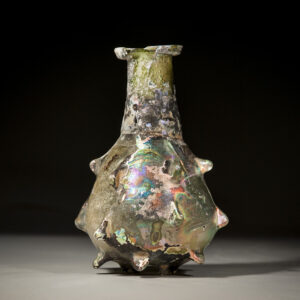
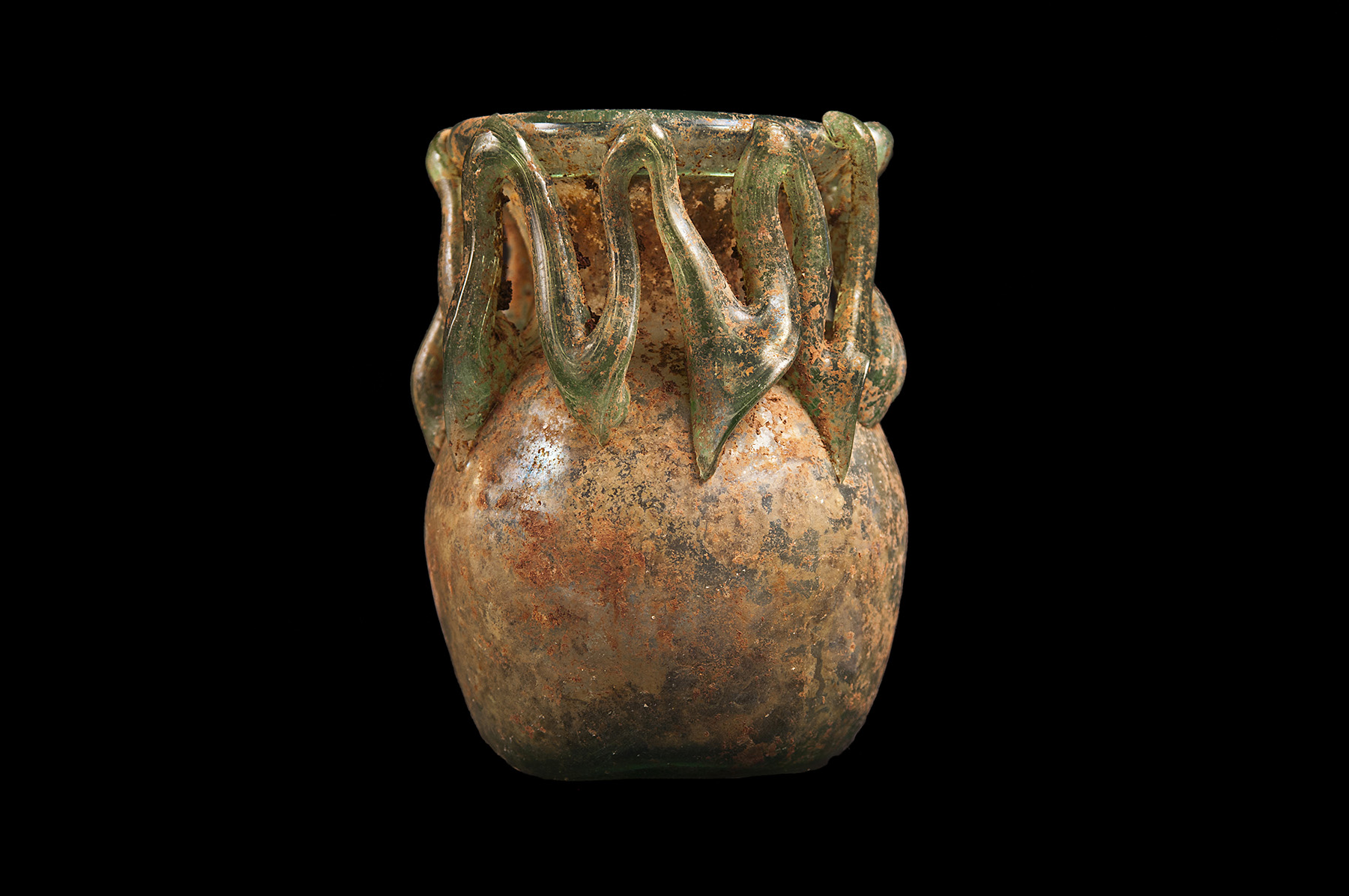
An attractive and unusually decorative Roman glass jar, distinguished by an elaborate series of applied glass trails arranged around the upper body.
The vessel is free-blown with a compact, slightly irregular ovoid body rising to a broad mouth. Its most striking feature is the applied decoration: thick trails of molten glass descend from the rim in a rhythmic series of deep loops and elongated festoons, creating a bold three-dimensional pattern around the circumference. The trails project prominently from the vessel’s surface, giving the otherwise simple form considerable sculptural character.
The decoration demonstrates the technical freedom available to Roman glassworkers. While the vessel itself could be formed rapidly by blowing, the applied trails required the glassmaker to manipulate additional strands of hot glass while the body remained workable. The slight variations between the individual loops preserve the immediacy of this hand-worked process and give the vessel its distinctive character.
The glass has developed an attractive ancient surface with areas of iridescence, mineral accretion and warm reddish-brown and greenish weathering, particularly across the body and within the recessed areas between the applied trails.
Roman Glassmaking
By the Roman Imperial period, glass vessels had become widely available throughout the Mediterranean world. Roman craftsmen nevertheless continued to produce more elaborate vessels through techniques such as mold-blowing, tooling and the application of decorative glass trails.
Applied trailing was particularly effective because it allowed the glassmaker to transform a relatively simple blown vessel into a richly textured object. On the present example, the unusually substantial looping trails dominate the design and create a strong interplay of light, shadow and color.
Small jars of this general type could have been used for cosmetics, ointments, perfumes or other valued substances, although the precise original contents of this vessel cannot now be determined.
REFERENCE #
GL_RM_1102
CIVILIZATION
Roman, 100 C.E. – 300 C.E.
SIZE
H. 8.5 cm
CONDITION
Condition
Exceptionally well preserved, with the body and extensive applied glass decoration surviving substantially intact. Surface weathering, mineral deposits and areas of iridescence are consistent with prolonged burial and age.
PRICE
$2500
Frequently Asked Questions
This Roman glass jar dates back to approximately 100 C.E. to 300 C.E., placing it in the early Roman Empire period. It reflects the craftsmanship of Roman glassblowers from nearly 2000 years ago.
The Roman glass jar stands 8.5 cm in height, making it a modestly sized piece suitable for display or collection. Its size contributes to its aesthetic appeal and versatility.
The applied glass threading showcases the individuality and creativity of early Roman glassblowers. This decorative technique highlights the skill and artistic expression involved in Roman glassmaking nearly two millennia ago.
This particular Roman glass jar is in fine condition, which is notable given its age of nearly 2000 years. Few pieces from this era remain as well preserved and visually appealing as this one.
Glass jars like this one would have been found throughout the Roman Empire, indicating their widespread use and popularity during that time. They were common household or decorative items across Roman territories.
Yes, this Roman glass jar is highly desirable both for established collectors of ancient artifacts and for individuals seeking a unique decorative piece for their home. Its aesthetic strength and historical significance make it a valuable addition to any collection or interior.
The Roman glass jar is priced at $2500, reflecting its fine condition, historical value, and artistic craftsmanship from the early Roman period.