Description
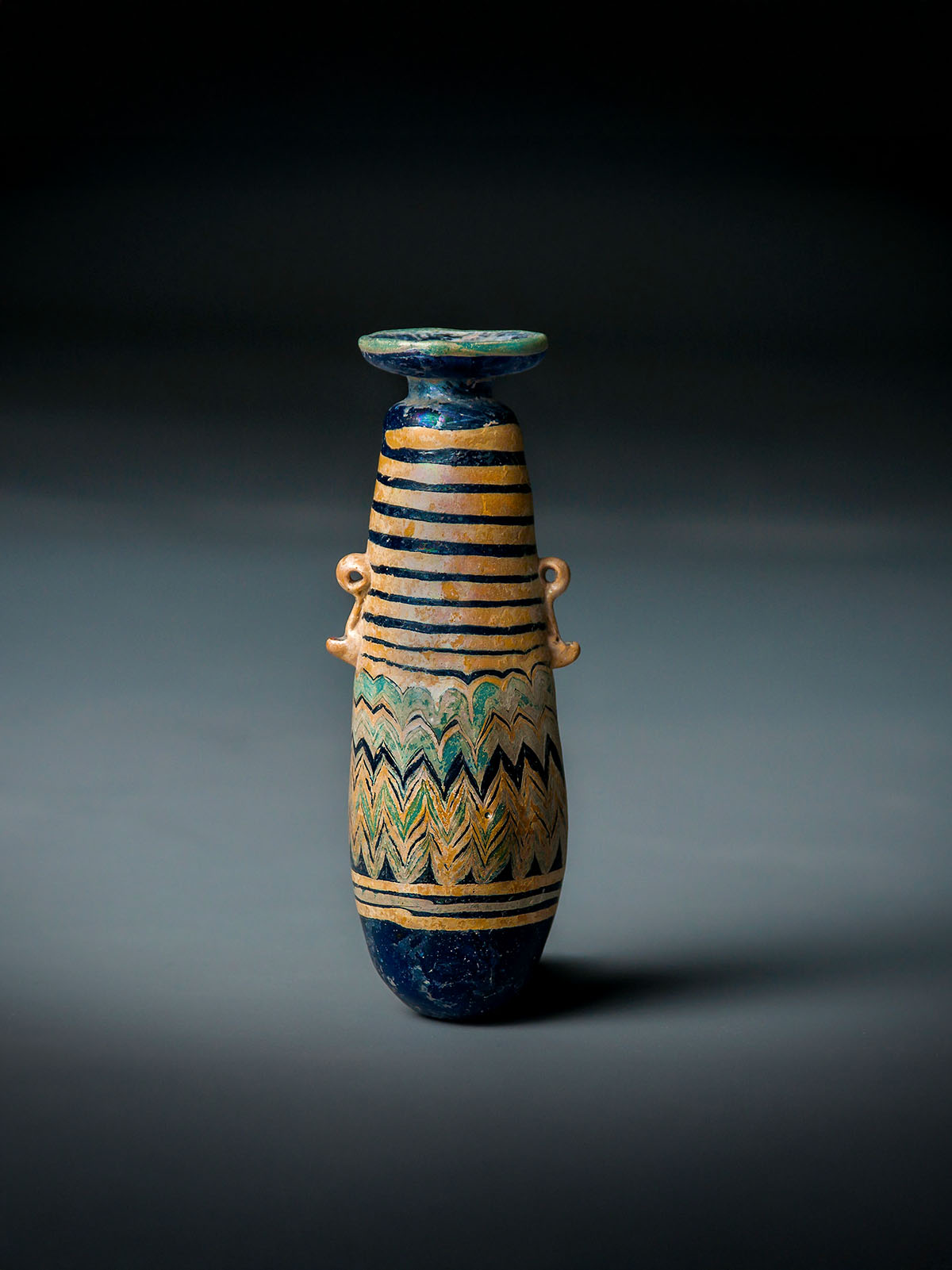
In translucent deep blue glass with opaque yellow and turquoise threads. The vessel has a wide everted rim edged in turquoise, a short neck and a long tubular body widening at the rounded base. A trail of yellow spirals around the upper half of the body in an anticlockwise direction. The lower half is decorated with rows of turquoise and yellow threads tooled into a zigzag pattern, three trails of yellow below. Two handles in yellow are applied towards the middle of the body.
Exhibited: San Diego Museum of Man, c. 1956
Literature: A less elegant example is illustrated in E. Marianne Stern, Birgit Schlick-Nolte, ‘Early Glass of the Ancient World, 1600 BC-AD 50. The Ernesto Wolf Collection’, (Germany, 1994) pp. 204-205.
REFERENCE #
GL_GR_1005
CIVILIZATION
Greco-Phoenician, 500 B.C.E. – 400 B.C.E.
SIZE
H. 12.4 cm
CONDITION
Intact
PRICE
Sold
PROVENANCE
Collection of the Dubois family, USA, acquired c.1920 and thence by descent.
Frequently Asked Questions
The vessel is made of translucent deep blue glass with opaque yellow and turquoise threads. It features a wide everted rim edged in turquoise, a short neck, and a long tubular body that widens at the rounded base, decorated with yellow spirals and zigzag patterns.
The vessel measures 12.4 cm in height and is in intact condition, showing no signs of damage or restoration.
The vessel originates from the Greco-Phoenician civilization, dating between 500 B.C.E. and 400 B.C.E.
The vessel was exhibited at the San Diego Museum of Man around 1956, showcasing its historical and artistic significance.
The vessel was part of the Dubois family collection in the USA, acquired around 1920 and passed down by descent, indicating a well-documented ownership history.
Yes, a less elegant example of this type of vessel is illustrated in the book 'Early Glass of the Ancient World, 1600 BC-AD 50. The Ernesto Wolf Collection' by E. Marianne Stern and Birgit Schlick-Nolte, published in Germany in 1994, pages 204-205.
The vessel features opaque yellow and turquoise threads tooled into spiral and zigzag patterns, with applied yellow handles, demonstrating advanced glassworking techniques of the period.