Lysimachus Silver Tetradrachm with Alexander the Great and Athena
An impressive ancient Greek silver tetradrachm issued in the name of Lysimachus, King of Thrace (305–281 B.C.), one of the most powerful generals and successors of Alexander the Great. The coin features the celebrated portrait of the deified Alexander adorned with the distinctive ram’s horn of Zeus-Ammon, a powerful symbol of divine kingship and royal legitimacy.
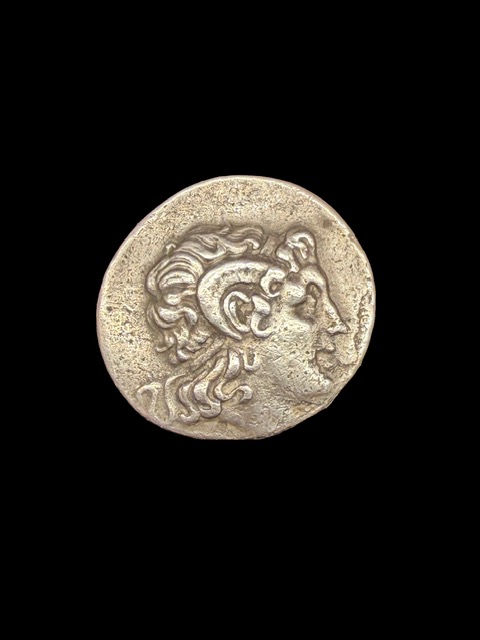
Obverse: A finely executed portrait of Alexander the Great facing right, his youthful features crowned with the characteristic ram’s horn of Zeus-Ammon emerging above the ear. The expressive facial modelling, prominent brow, and carefully rendered flowing hair reflect the exceptional artistic traditions of Hellenistic royal portraiture. The horn symbolizes Alexander’s association with the Egyptian god Ammon, identified by the Greeks with Zeus, and his elevation to divine status following his extraordinary conquests.
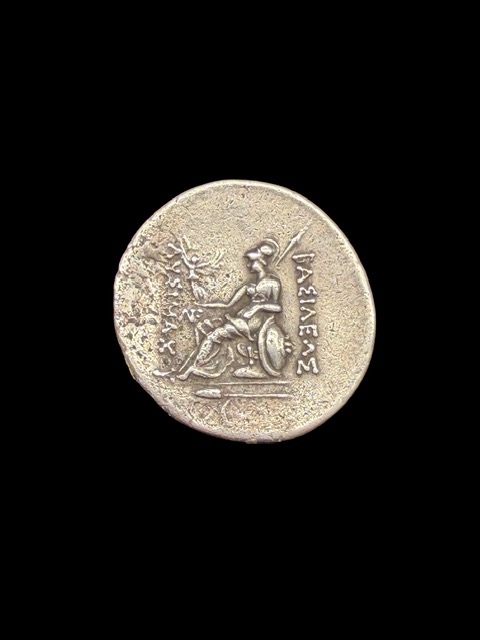
Reverse: Athena Nikephoros, goddess of wisdom, warfare, and victory, seated left upon an elaborate throne, holding a miniature figure of Nike, the winged goddess of Victory, upon her extended right hand. Her left arm rests upon a shield, while a spear appears behind her. The Greek inscription ΒΑΣΙΛΕΩΣ ΛΥΣΙΜΑΧΟΥ, meaning Of King Lysimachus, identifies the issuing royal authority. A distinctive monogram appears beneath Athena’s extended hand, with additional lettering or control markings associated with the issuing series.
Historical and Artistic Significance
Lysimachus was among the distinguished commanders who served Alexander the Great during his campaigns across the Persian Empire. Following Alexander’s death in 323 B.C., he established himself as ruler of Thrace and subsequently controlled substantial territories in Macedonia and Asia Minor.
His silver tetradrachms are among the most celebrated portrait coins of the Hellenistic world. The representation of Alexander with the horn of Zeus-Ammon transformed the conqueror’s image into an enduring symbol of divine authority, military achievement, and universal kingship.
The reverse depiction of Athena holding Nike reinforces the themes of victory, political legitimacy, and divine protection. This combination of Alexander’s idealized portrait and Athena’s victorious imagery became one of the most recognizable coin designs of the Hellenistic period, continuing to be issued by various Greek cities long after Lysimachus’s death.
The present example is distinguished by its expressive portrait of Alexander, elaborate throne details, and identifiable reverse monogram, reflecting the sophisticated artistry and enduring influence of Lysimachus’s royal coinage.
REFERENCE #
CS603
CIVILIZATION
Ancient Greek, Hellenistic Period, Kingdom of Thrace, Posthumous Issue, circa 3rd–2nd Century B.C.
CONDITION
Well-preserved principal designs with attractive ancient silver toning and evidence of circulation. The portrait of Alexander, seated Athena, and major elements of the royal inscription remain clearly recognizable.
PRICE
$1800
PROVENANCE
Found in Judea
Related products
-
Ancient Egyptian Silver Tetradrachm of Ptolemy I Soter Set in 18K Gold
-
The Jewish Silver Full Shekel
-
A Roman Silver Denarius of Emperor Augustus
-
THE WIDOW’S MITE BRONZE PRUTAH