Description
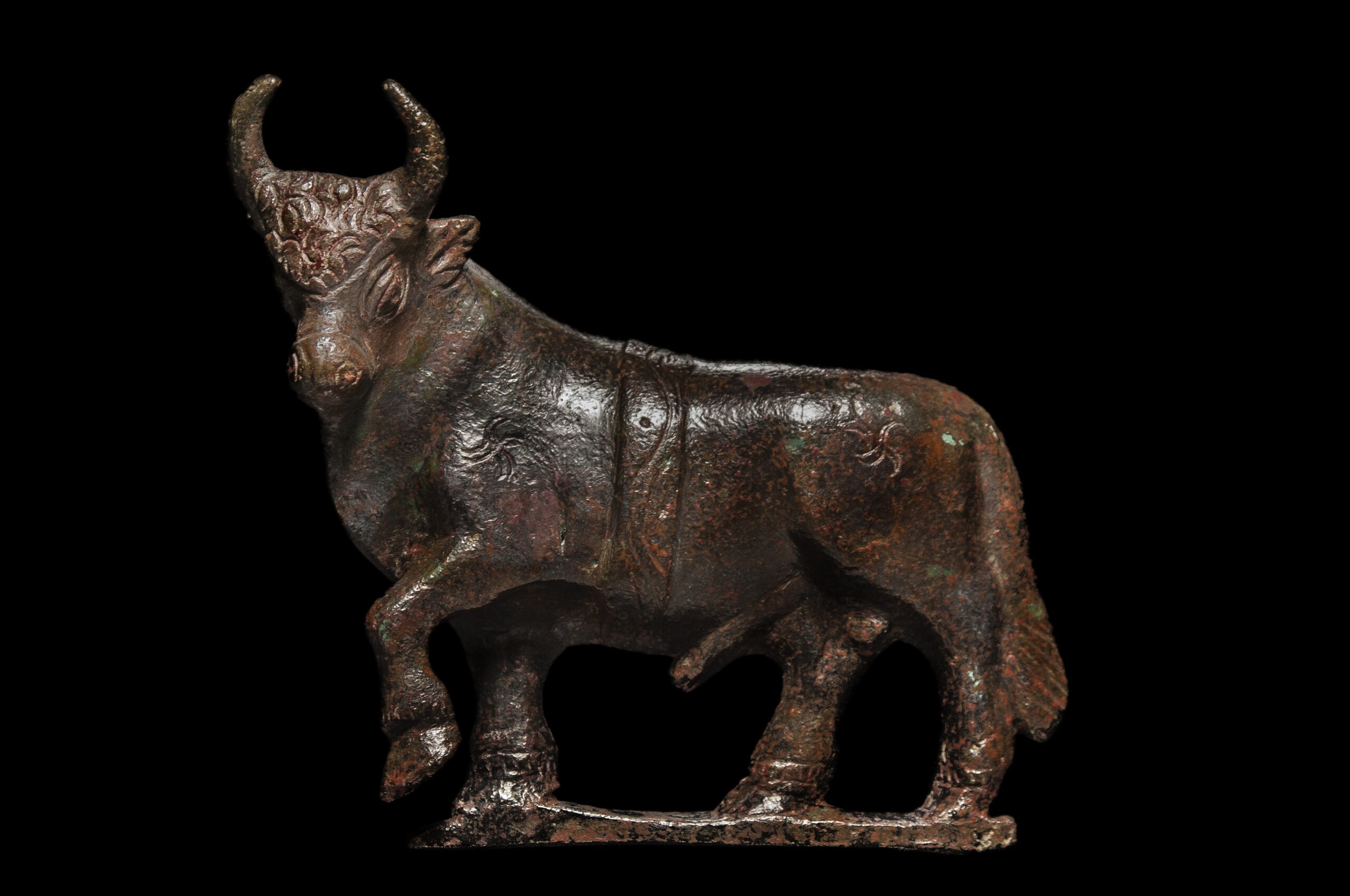
Bronze Imperial Roman Bull Stomping Hoof
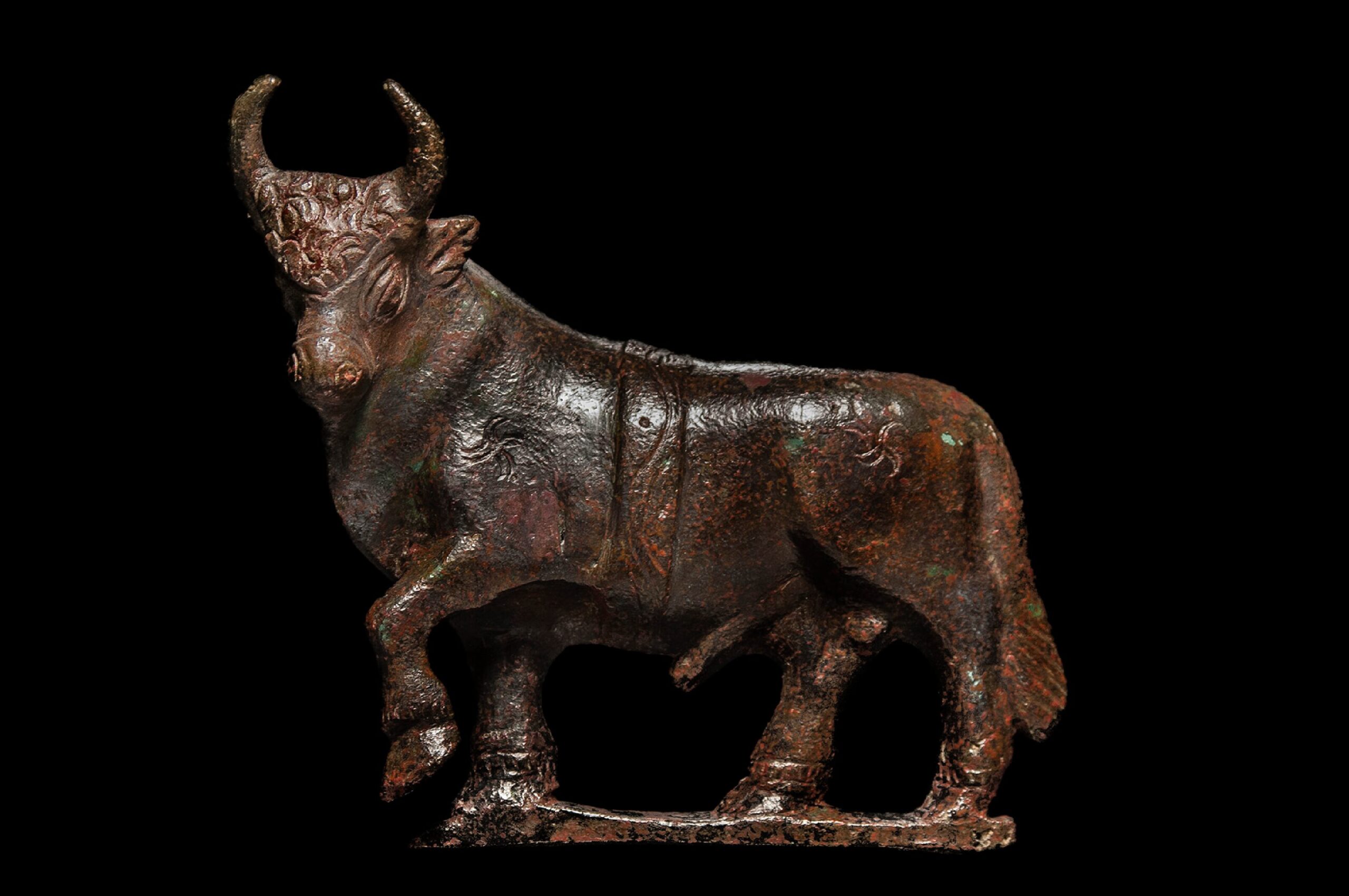
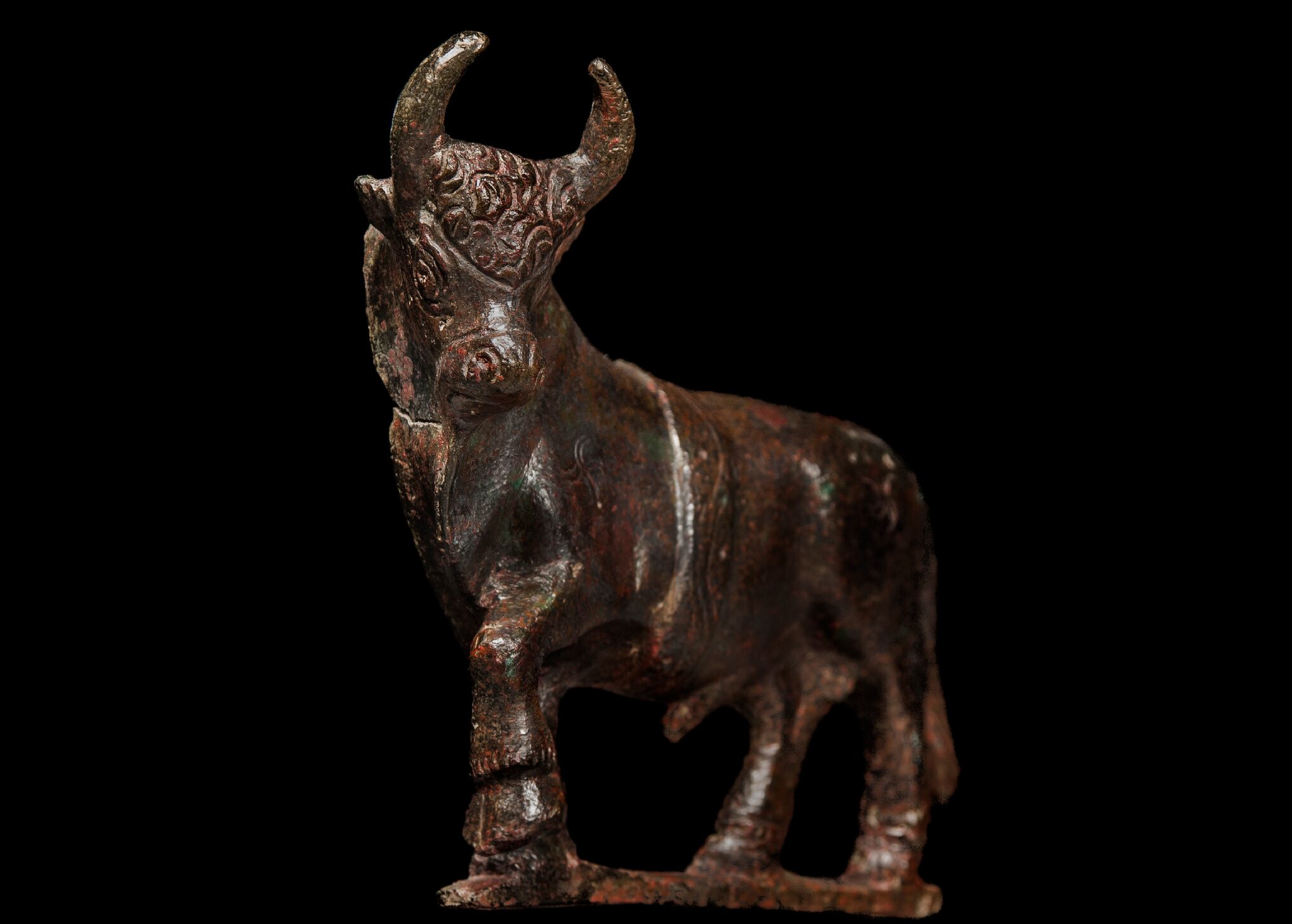
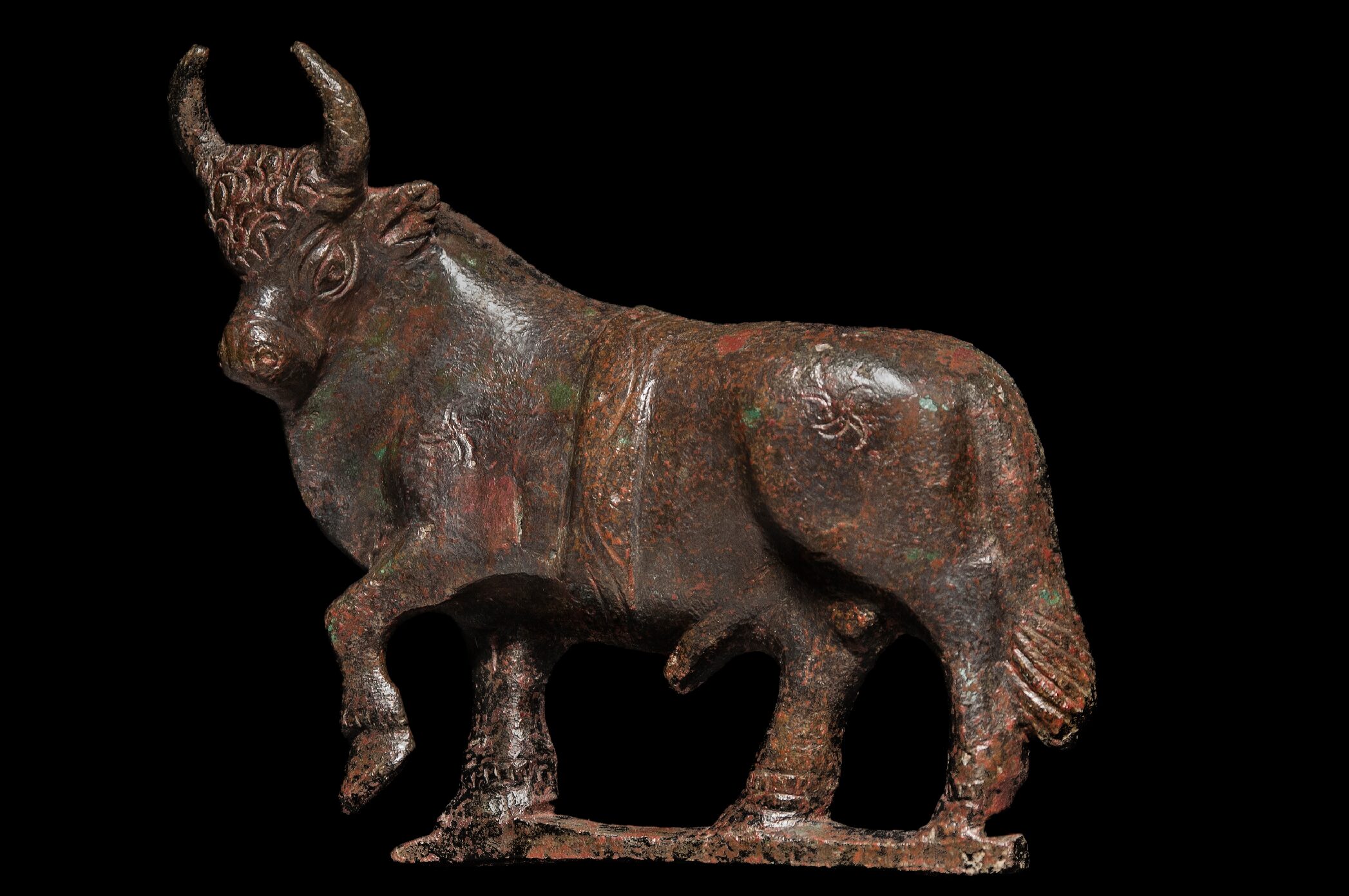
This incredible Bronze Imperial Roman Bull statuette dating from 200 – 300 C.E. is decorated with two stylized markings on its flanks and one large ribbon across its torso. The bull’s powerful stance is accentuated by his head that is turned, as well as his front left leg that is raised in an aggressive stomping motion. Additional decorations are present on the bull’s head in the form of decorous curls. This Bronze Imperial Roman Bull statuette was part of a composed relief depicting a procession that leads to the sacrifice of the bull which was performed for the welfare of the Roman empire.
For more than 5,000 years, bronze and other copper alloys have been essential materials used to create everything from life-size sculptures to objects of daily life such as weapons, jewelry, tableware, and as featured here: This incredible Bronze Imperial Roman Bull statuette. Similar pieces are found in museums such as the Met Museum in New York City, but few found are as majestic and powerful as this piece.
Roman Bull in Cult of Magna Mater (Great Mother of the gods) Cybele
After 159 CE all private taurobolia inscriptions mention Magna Mater. Public taurobolia enlisting the benevolence of Magna Mater on behalf of the emperor became common in Italy, Gaul, Hispania, and Africa. The last public taurobolium for which there is an inscription was carried out at Mactar in Numidia at the close of the 3rd century C.E. It was performed in honor of the emperors Diocletian and Maximian.
Roman Bull in Eastern Cult of Mithras
Another Roman mystery cult in which a sacrificial bull played a role was that of the 1st-4th century C.E. Mithraic Mysteries. The cult of Mithras was very popular throughout the Roman Empire and was followed especially by soldiers. It was one of several eastern cults that spread rapidly as a result of the Pax Romana (Roman peace) – others included the worship of Jupiter Dolichenus, Manichaeism, and of course Christianity.
Shrouded in secrecy, ancient mystery cults fascinate and capture the imagination. Like all Greco-Roman mysteries, the cult of Mithraic Mysteries was limited to initiates, and there is very little known about the cult’s beliefs or practices. In the so-called “tauroctony” artwork of that cult (cultus) – and which appears in all its temples – the god Mithras is seen to slay a sacrificial bull. The tauroctony should not be confused with a “taurobolium”, which was an actual bull-killing cult act performed by initiates of the Mysteries of Magna Mater, and has nothing to do with the Mithraic Mysteries.
Although there has been a great deal of speculation on the subject, the mystery that the tauroctony scene was intended to represent remains unknown. Like the other ancient “mystery religions” such as the Eleusinian mysteries and the mysteries of Isis, Mithraism maintained strict secrecy about its teachings and practices, revealing them only to initiates. As a result, reconstructing the beliefs of the Mithraic devotees has posed an enormously intriguing challenge to scholarly ingenuity.
Owing to the Mithraic cult’s secrecy, we possess almost no literary evidence about the beliefs of Mithraism. The few texts that do refer to the cult come not from Mithraic devotees themselves, but rather from outsiders such as early Church fathers who mentioned Mithraism in order to attack it, as well as from Platonic philosophers who attempted to find support in Mithraic symbolism for their own philosophical ideas.
However, although our literary sources for Mithraism are extremely sparse, an abundance of material evidence for the cult exists in the many Mithraic temples and artifacts that archaeologists have found scattered throughout the Roman empire – from England in the north and west to Palestine in the south and east. The temples – called mithraea by scholars – were usually built underground in imitation of caves. These subterranean temples were filled with an extremely elaborate iconography: carved reliefs, statues, and paintings – depicting a variety of enigmatic figures and scenes. This iconography is our primary source of knowledge about Mithraic beliefs, but because we do not have any written accounts of its meaning the ideas that it expresses have proven extraordinarily difficult to decipher.
Sources:
1.) Met Museum – Bronze Statuette of Bull
2.) Met Museum – Bronze Plaque of Mithras slaying the bull
3.) Met Museum – Mystery Cults in the Greek and Roman World
4.) Harvard Art Museums – Ancient Mediterranean and Near Eastern Bronzes
5.) Wikipedia – Sacred Bull Roman Empire
6.) Wikipedia – Taurobolium
7.) Wikipedia – Magna Mater, Cybele
8.) Wikipedia – Tauroctony
9.) Wikipedia – Pax Romana
10.) Ulansey, D., “The Origin of Mithraic Mysteries”, 1991; and
Ulansey, D., “Solving the Mithraic Mysteries” within: Biblical Archaeology Review, vol. 20, #5 (September/October 1994) pp. 40-53
11.) The Tertullian Project – The Roman Cult of Mithras
REFERENCE #
SI_RM_1085
CIVILIZATION
Roman, 200 C.E. – 300 C.E.
SIZE
H. 16 cm
CONDITION
Fine condition
PRICE
Price available upon request
PROVENANCE
The Baidun Collection, Ex German Private Collection, acquired in the 1980’s
Frequently Asked Questions
The Bronze Imperial Roman Bull statuette dates from 200 - 300 C.E. and features a powerful bull in a stomping pose with decorative markings. It was part of a relief depicting a procession leading to the taurobolium, a bull sacrifice performed for the welfare of the Roman Empire, highlighting its religious and cultural importance.
The taurobolium was a ritual bull sacrifice performed in the Roman Empire from the 2nd to 4th centuries C.E. Initially a general practice, it became closely associated with the cult of Magna Mater (Great Mother of the gods, Cybele) after 159 C.E. This ritual was believed to promote the well-being of the people and the state, often performed publicly in honor of emperors.
The bull was central to the cult of Magna Mater, where the taurobolium sacrifice was performed to invoke the goddess's protection and blessings for the empire. After 159 C.E., all private taurobolium inscriptions mention Magna Mater, and public sacrifices were common across the empire, emphasizing the bull's religious symbolism in this cult.
In the Mithraic Mysteries, a Roman mystery cult popular among soldiers, the bull appears in the tauroctony scene where the god Mithras slays a bull. This symbolic act is central to Mithraic iconography but differs from the taurobolium sacrifice. The exact meaning of the tauroctony remains unknown due to the cult's secrecy and limited literary evidence.
The tauroctony is an artistic depiction of the god Mithras killing a bull, found in Mithraic temples, representing a symbolic or mythological act. In contrast, the taurobolium was an actual bull sacrifice performed in the cult of Magna Mater. These two practices are unrelated despite both involving bulls.
The Mithraic Mysteries were secretive, with teachings and rituals revealed only to initiates. There are almost no literary sources from followers, and most information comes from outsiders or archaeological findings. The cult's underground temples and iconography provide clues, but the exact meanings remain largely speculative.
Similar bronze bull statuettes and plaques have been found in various collections and museums, including the Metropolitan Museum of Art in New York City. These artifacts demonstrate the widespread use of bronze in Roman art and religious iconography, though few pieces match the majesty of the featured statuette.