Description
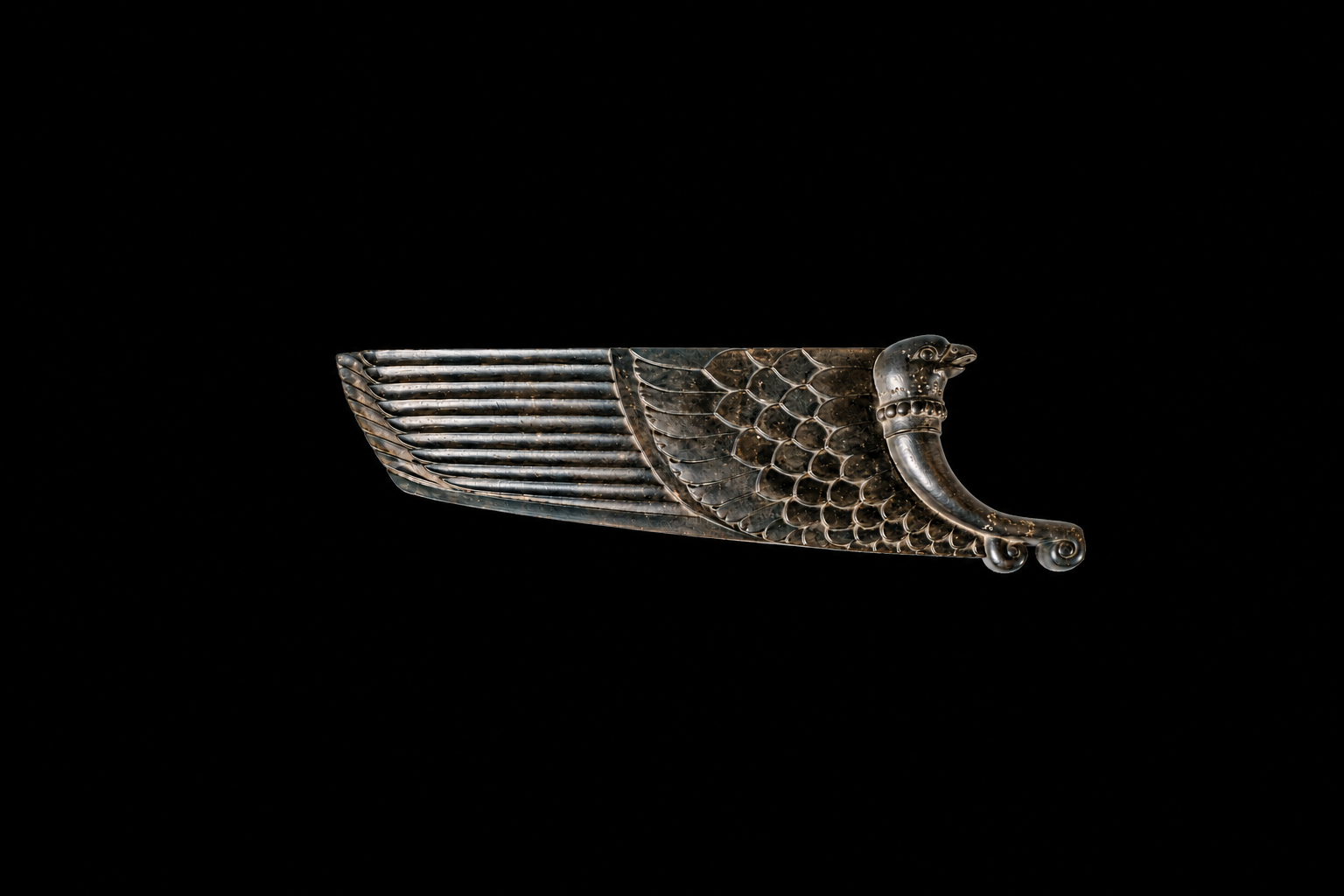
An exceptionally finely carved Achaemenid Persian schist element depicting a winged mythical or sacred bird, interpreted within the broader Persian tradition of the Shahbaz—the majestic royal bird associated with kingship, sovereignty, strength and divine favor, and, within the wider symbolism of the Persian mythical bird, with concepts of renewal, transcendence and rebirth.
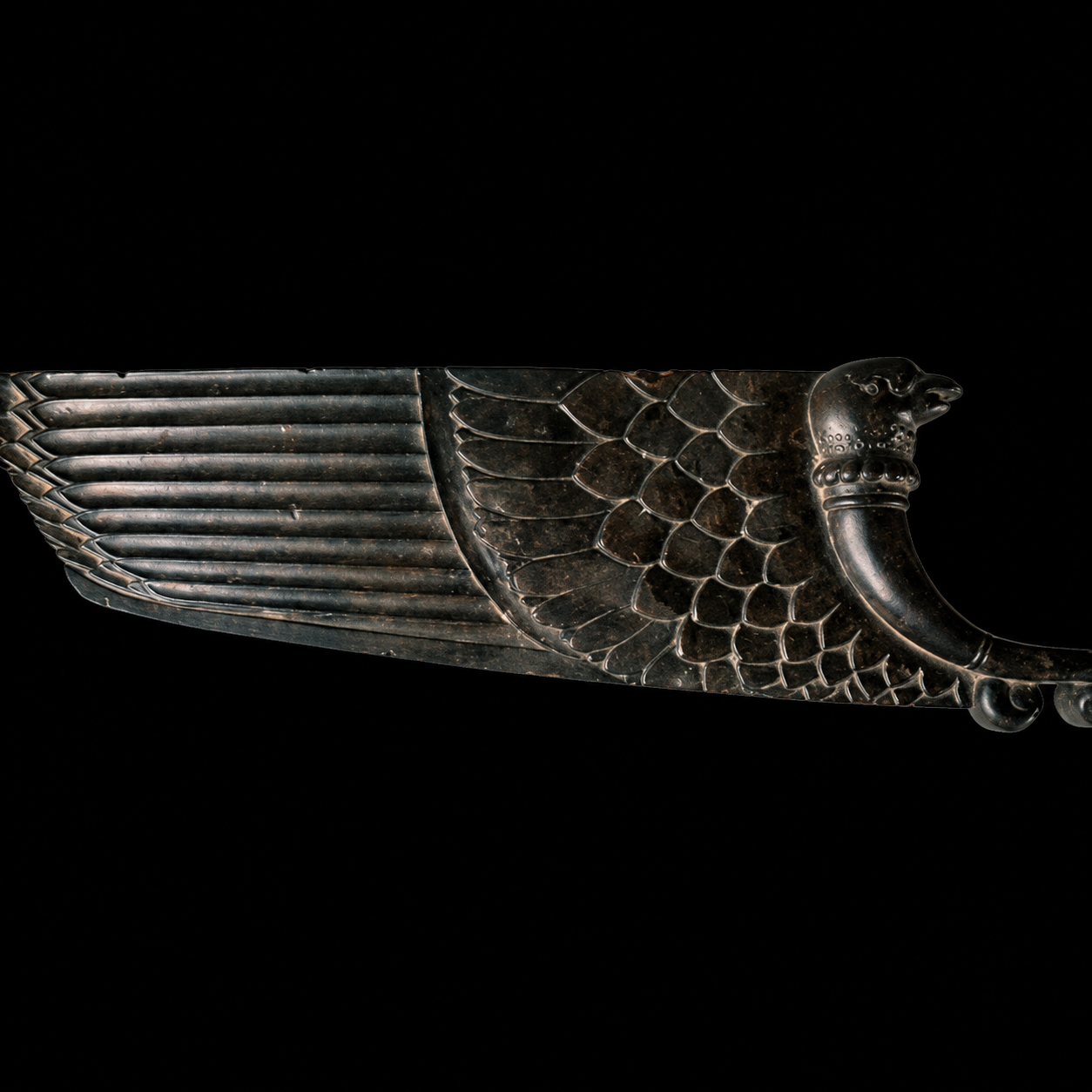
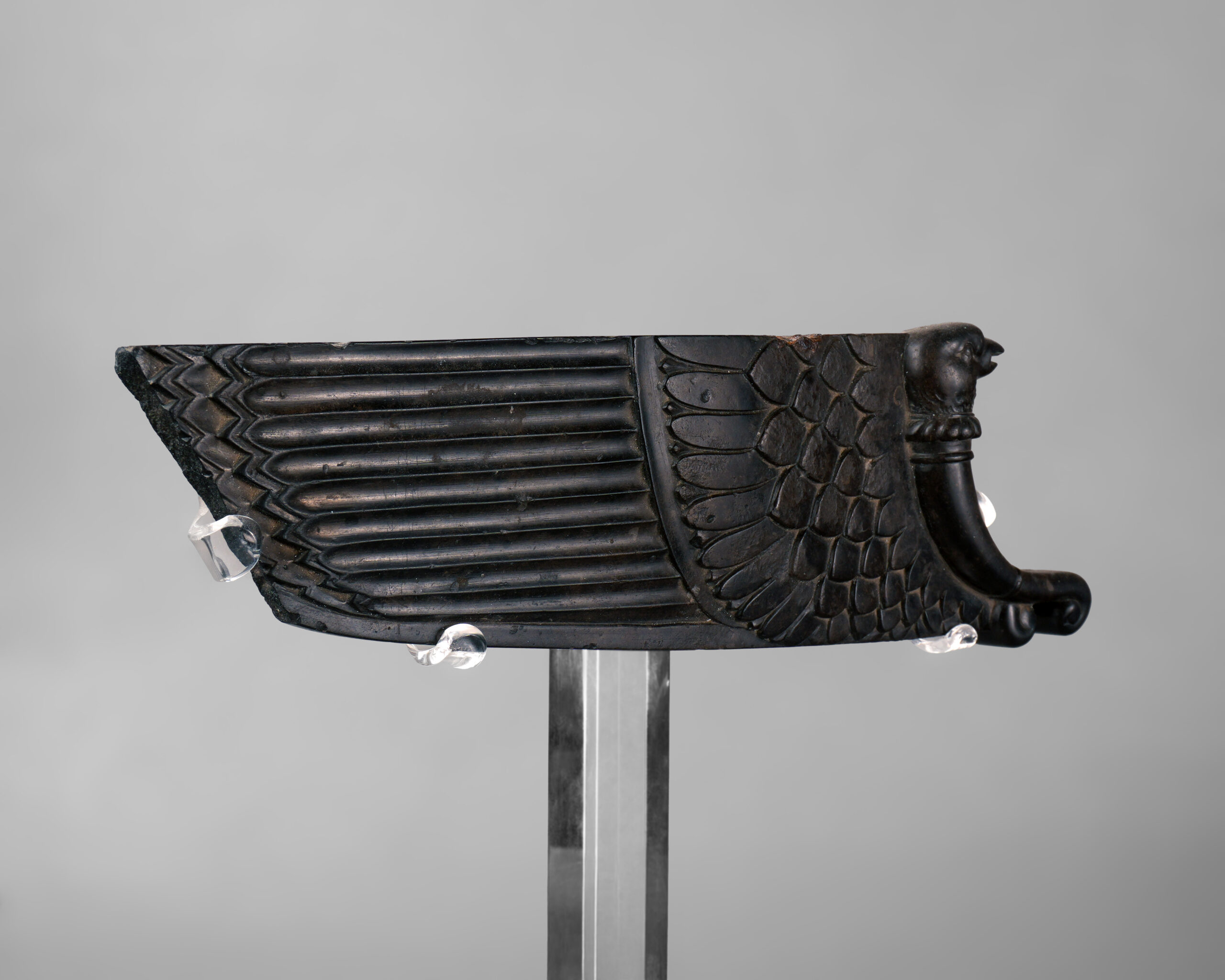
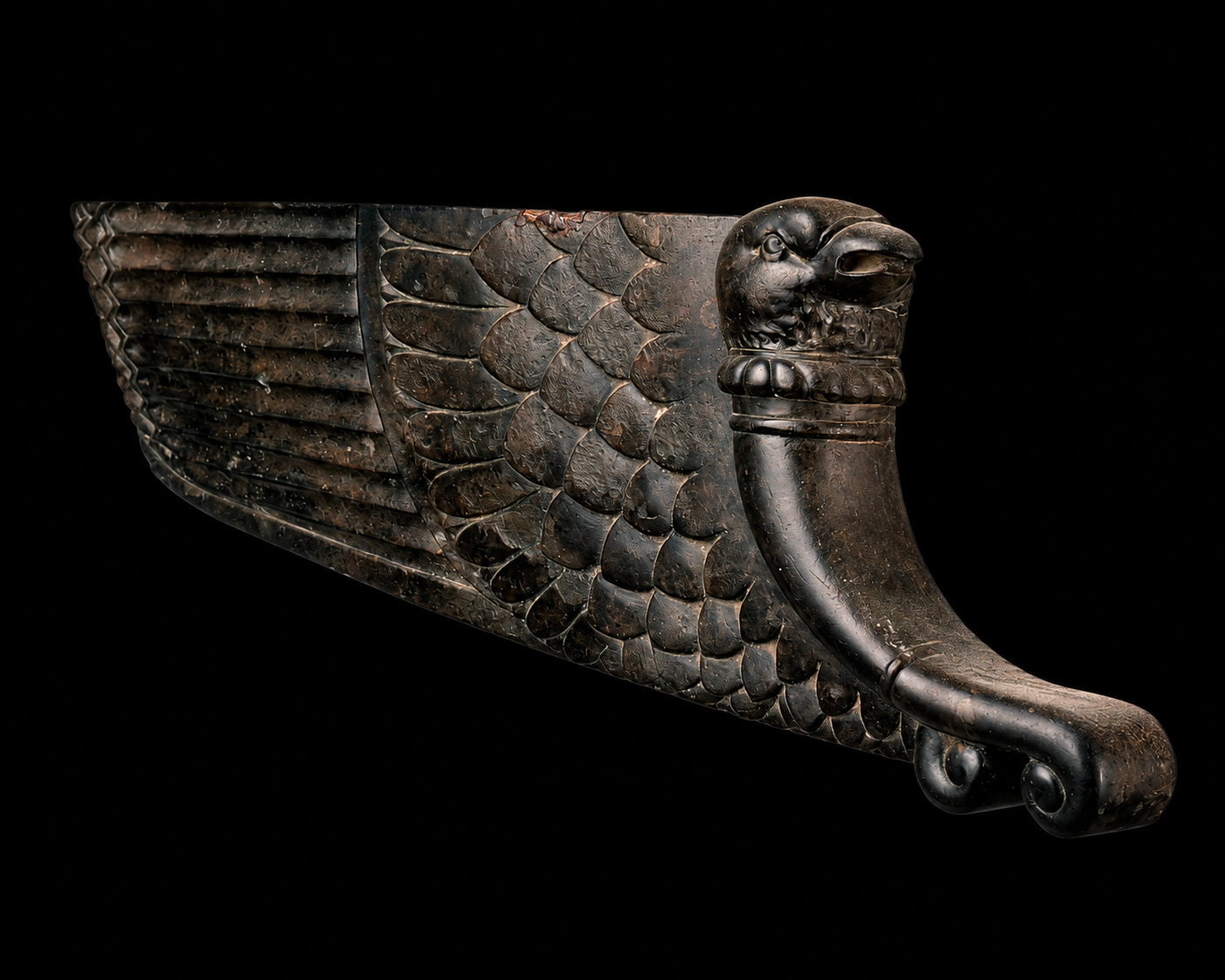
The elongated composition is dominated by a magnificent outstretched wing, meticulously carved in distinct registers of plumage. Long flight feathers extend across the outer section in a disciplined sequence of raised parallel ribs, terminating in a sharply articulated chevron arrangement. Toward the body, these transition into broad overlapping coverts, individually delineated to produce a richly textured, almost scale-like surface.
At the inner end emerges the sculpted head of a powerful raptorial bird, characterized by a rounded crown, prominent eye and strongly defined hooked beak. Beneath the head, a decorative collar develops into an elegant sweeping element terminating in tightly curled volutes. The combination of recognizable avian anatomy with highly formalized ornamental elements gives the creature a distinctly mythological, heraldic and regal character.
The Shahbaz — Royal Power, Renewal and Rebirth
The interpretation of the creature as a Shahbaz is particularly evocative within a Persian context. The Persian term Shahbaz (شاهباز) combines shah, meaning “king,” with baz, referring to a falcon or hawk, and may therefore be understood as the “royal falcon,” “king’s falcon,” or “royal bird.”
Within the broader Iranian cultural tradition, the Shahbaz became an evocative emblem of majesty, courage, strength, freedom and sovereignty. The commanding bird of prey, soaring above the terrestrial world, provided a natural metaphor for royal supremacy and elevated status.
The symbolism of the great or supernatural bird in Iranian tradition could extend beyond earthly kingship. Celestial and mythical birds came to embody concepts of spiritual elevation, renewal, regeneration and rebirth. The ability of the bird to ascend into the heavens made it a particularly powerful image of transcendence, while later Iranian traditions developed increasingly rich associations between supernatural birds and cyclical renewal.
The present creature can therefore be appreciated on several symbolic levels: as the Shahbaz, the royal bird and emblem of sovereignty and strength; and, more broadly, as a mythical sacred bird embodying transcendence, renewal and rebirth.
The object has also traditionally been interpreted as a phoenix. Although this term effectively conveys the concept of a supernatural bird associated with regeneration, it carries associations derived from several different cultural traditions. Likewise, the creature should not be specifically identified with the later Persian Simurgh, whose familiar iconography developed more fully in subsequent periods of Iranian art.
For an Achaemenid object, “Winged Mythical Bird (Shahbaz)” therefore provides an evocative yet appropriately cautious identification.
Achaemenid Artistic Context
Powerful birds and fantastic creatures formed an important component of the visual vocabulary of the Achaemenid Persian Empire. Eagles, falcons, griffins and other real or composite creatures appear throughout Persian imperial art, particularly in architectural ornament, seals, precious metalwork and luxury objects. Their commanding forms contributed to a broader artistic language expressing royal authority, protection, strength and supernatural power.
Particularly remarkable on the present element is the disciplined treatment of the plumage. Natural feather structures have been transformed into an ordered sequence of raised ribs, overlapping coverts and sharply defined geometric patterns. This fusion of recognizable animal anatomy with controlled abstraction is characteristic of the sophisticated decorative principles employed by Achaemenid craftsmen.
Comparable principles of stylization—the transformation of powerful animals into balanced, rhythmic and heraldic compositions—are encountered throughout the art associated with the great Achaemenid imperial centers of Persepolis, Susa and Pasargadae.
The quality and precision of the carving, together with the carefully organized plumage and elaborate ornamental terminal, indicate that the element originally belonged to an object or setting of considerable decorative importance.
Original Function
The abrupt termination of the wing and the surviving fragmentary edges demonstrate that the present object originally formed part of a larger decorative composition.
Its precise original function cannot presently be established. However, its elongated format, substantial dimensions and carefully finished relief carving suggest that it may have formed part of an architectural, ceremonial, furnishing or other prestigious decorative element.
Whatever its original setting, the prominence given to the great winged creature would have created an imposing visual statement entirely appropriate to the symbolic vocabulary of Persian elite and imperial art.
Attribution and Interpretation
The attribution to Achaemenid Persia, circa 5th–4th century BC, is based on the stylistic characteristics of the carving and its relationship to the broader repertoire of animal and fantastic-creature imagery employed in Persian imperial art.
The designation Shahbaz should be understood as an interpretative identification emphasizing the bird’s royal and symbolic character rather than as a claim that this particular creature was specifically identified by that name during the Achaemenid period. Similarly, associations with renewal and rebirth belong to the broader and evolving Iranian symbolism of sacred and supernatural birds and should not be regarded as a securely documented meaning for this individual Achaemenid image.
An exceptionally striking example of ancient Persian lapidary craftsmanship, the element combines the commanding presence of the great royal bird with the disciplined geometry, rhythmic repetition and refined carving characteristic of Achaemenid decorative art. Interpreted within the tradition of the Shahbaz—the royal bird of Persia—it evokes an enduring constellation of ideas surrounding kingship, strength, sovereignty, transcendence, renewal and rebirth.
REFERENCE #
SI_PR_1019
CIVILIZATION
Persian, 500 B.C.E.
SIZE
H. 27.5cm
Condition
Preserved as a substantial fragment of a larger composition. Minor losses, abrasions and surface wear consistent with age are visible, particularly at the outer extremity and along portions of the upper edge. The principal feather decoration, bird’s head and ornamental volute terminal remain remarkably well preserved and clearly defined.
PRICE
$27500
PROVENANCE
Jerusalem Private Collection, late 1970’s.
Frequently Asked Questions
The schist wing dates from the Achaemenid period, approximately between 500 and 300 BC. This era is known for its sophisticated Persian art and craftsmanship.
The schist wing is carved from schist, a durable and locally sourced stone. This material was chosen for its strength and suitability for detailed relief carving, reflecting the technical skills of Achaemenid artisans.
The phoenix depicted on the schist wing symbolizes renewal, immortality, and divine protection. It is a significant mythological bird in Persian art, representing themes of rebirth and divine authority.
Originally, the schist wing fragment likely served as a decorative panel or ornament on furniture such as a throne or within a ceremonial setting, highlighting the grandeur of the Persian elite.
The schist wing showcases intricate workmanship through finely incised and carefully modeled relief carving. This reflects the high level of skill and artistic sophistication of Achaemenid artisans in stonework.
The artifact offers valuable insights into Persian visual language and ceremonial ornamentation, illustrating the symbolic complexity and grandeur that adorned the architecture and surroundings of the ancient Persian ruling class.
The schist wing is in fine condition and was part of a private collection in Jerusalem since the late 1970s, ensuring its preservation and historical significance.