Description
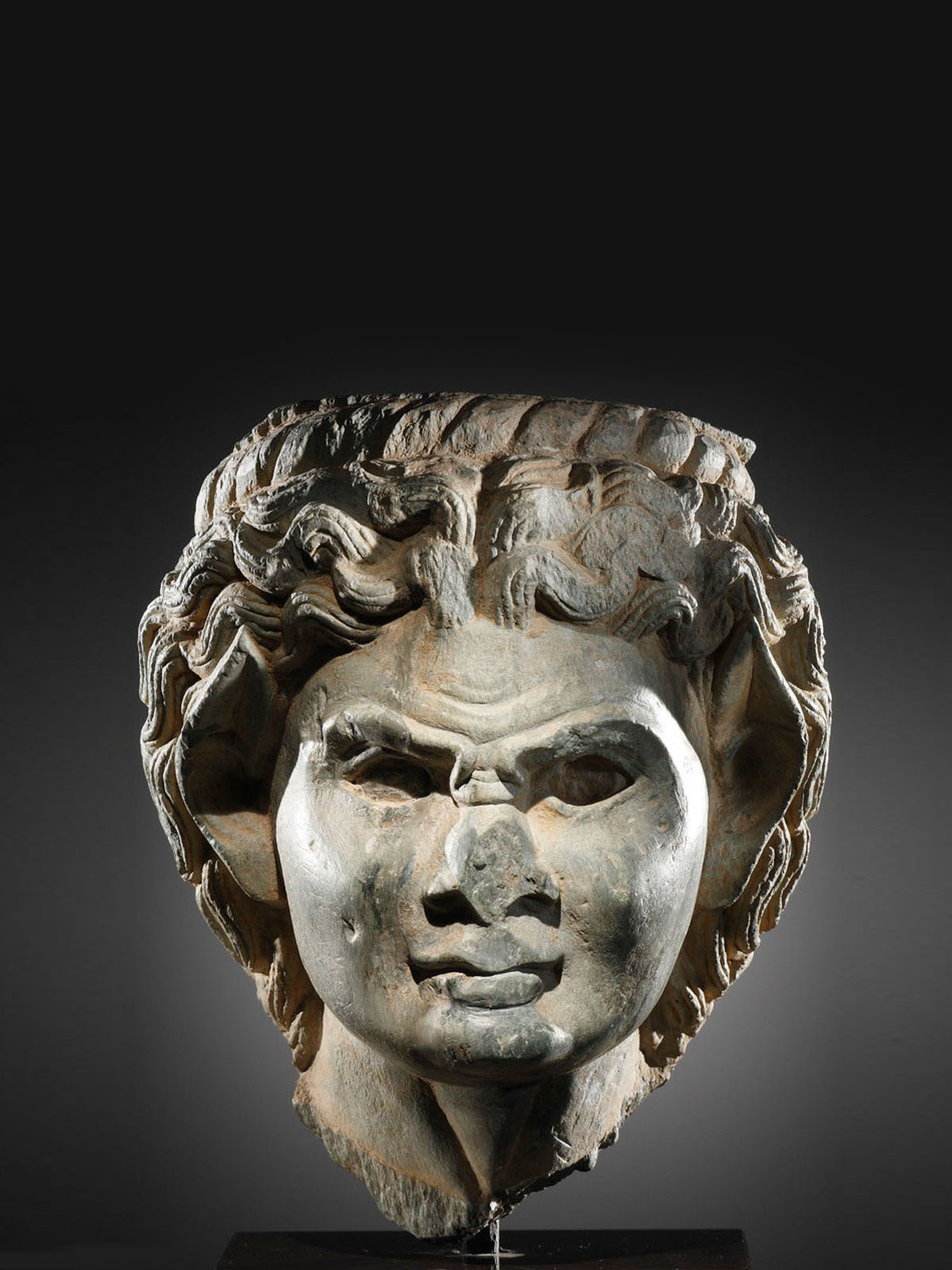
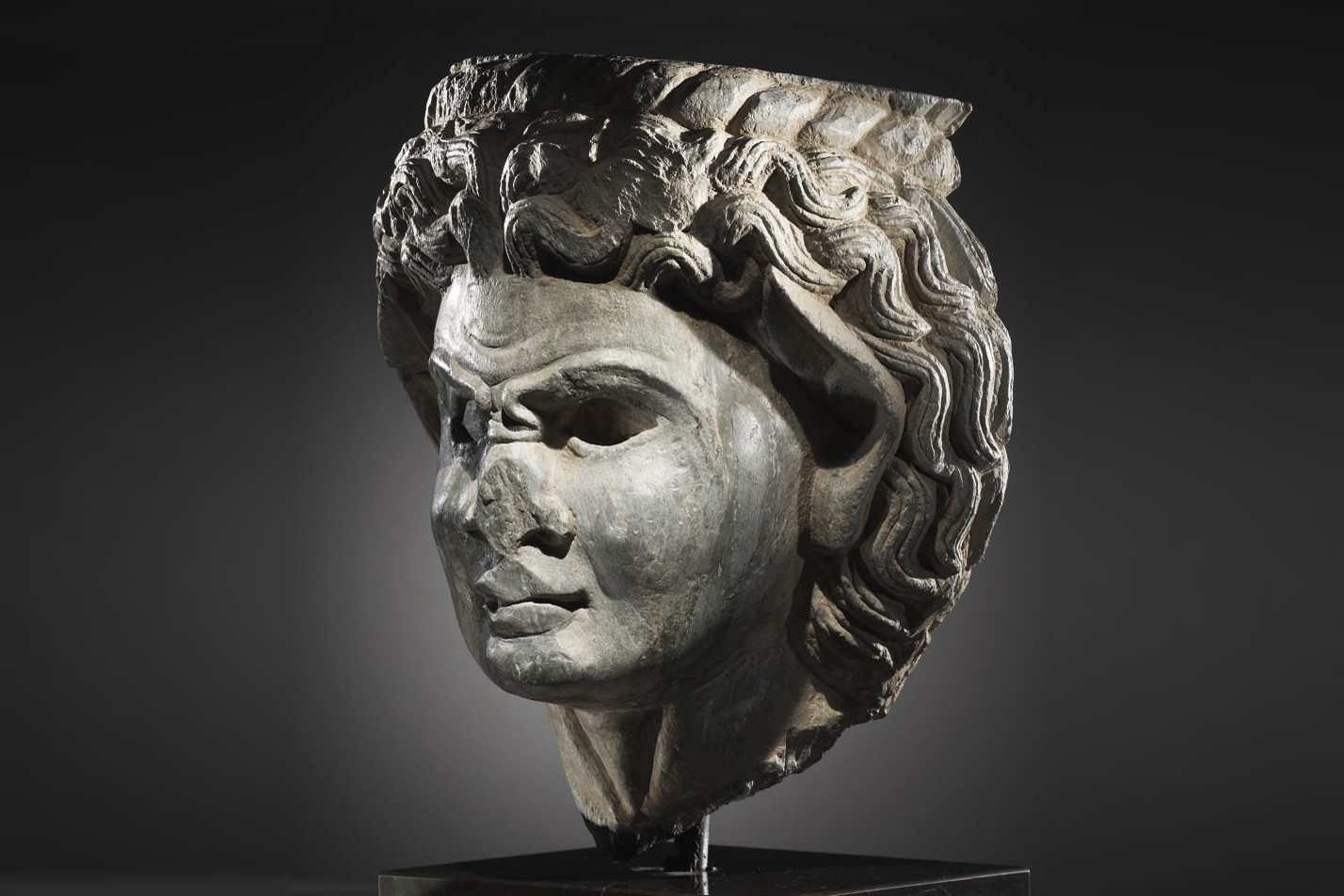
The expressive face of this satyr reveals a right eye that is slightly lower than the left and a smirk carved purposefully askew. The satyr himself may be of Greek origin, yet this piece hails from central Asia, a result of the clash of cultures that arose out of Alexander the Great’s successful campaigns throughout the region. The result was a vast melting pot of culture, art and religion that spanned the subsequent Hellenistic era of Greek history, when Greek cultural influence and power was at its zenith in Europe and Asia. At the time, this satyr’s inlaid eyes and simple braided crown were uncommon in Asian art, particularly seen in Buddhist sculptures of Siddhartha from the Gandhara region of northern Pakistan. Other examples include the famous Parthian relief from Hatra, as well as the hair and head of the Peshawar Museum’s Bodhisattva. In the years after Alexander’s conquests, the region’s sculpture incorporated such elements in the intervening years as trade and technology increased the mingling of Eastern and Western cultures, creating new currents of art and thought that still inspire us to this day.
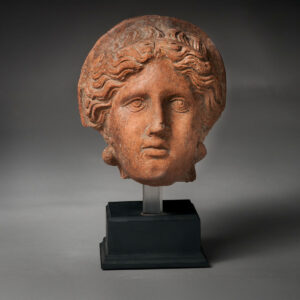
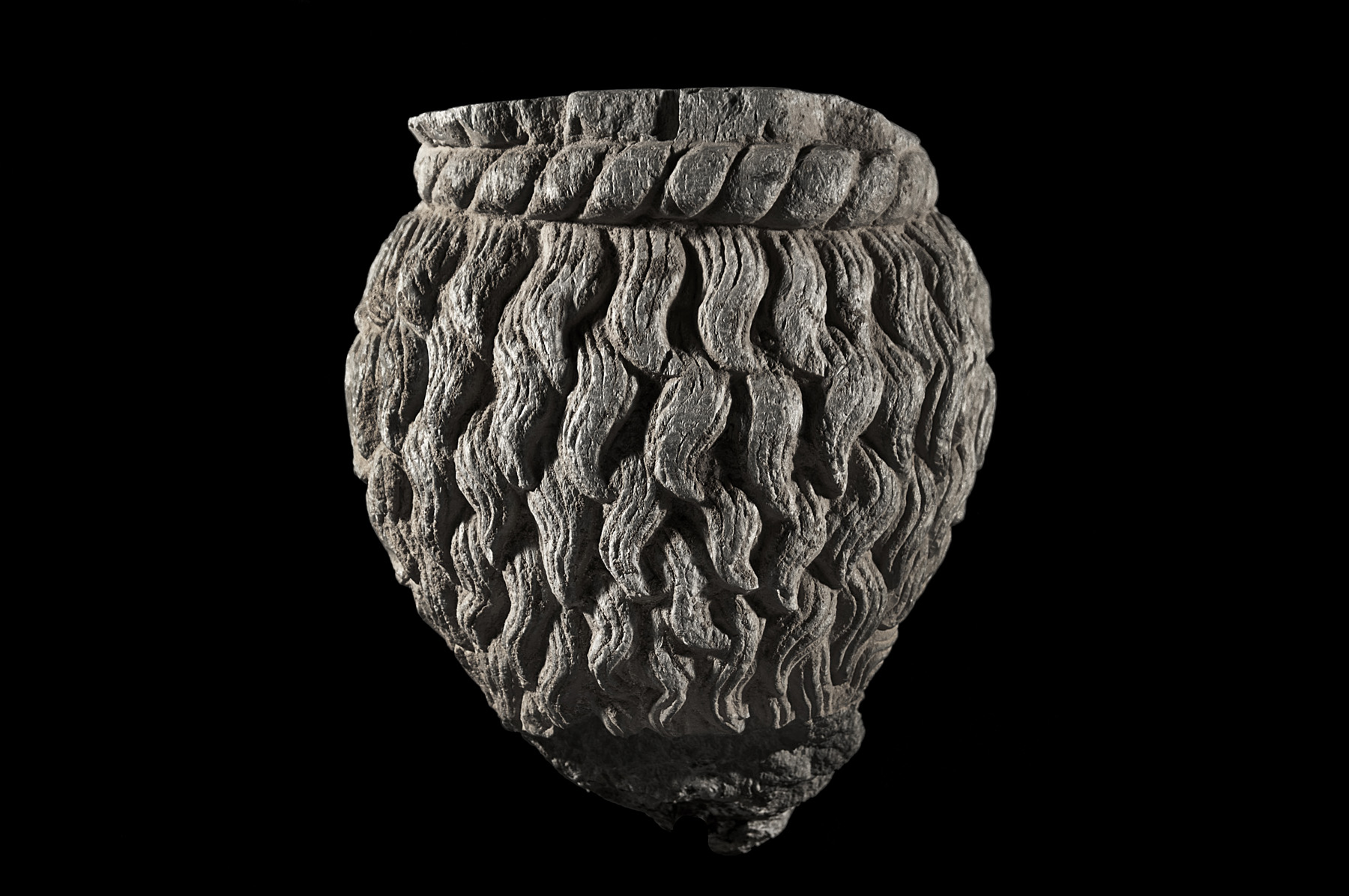
The round face is dominated by deep holes for eyes which were originally inlaid. The root of the nose is strongly furrowed, as too is the forehead above, its series of wavy grooves mirroring the curvature of the expressive high-arched brows. Prominent cheekbones, with fleshy, rounded cheeks below; under the broad nose, full sensuous lips with dimples. To either side of the face, long, pointed ears with deep auricles. A exuberant shock of curling locks, whose individual strands are articulated with incised lines, is parted in the middle to form an anastole and spreads outwards in three luxuriant strands to frame the face.
Similarly rendered locks entirely envelope the head, wig-like, in schematically arranged rows. The sinews of the neck form a pronounced V-shape. The combination of glowering features and unruly hair impart to the head an intensely expressive quality. Encircling the crown of the head is a rope-like wreath which served as the base for an attachment, its upper surface flat to accommodate another element. Head of a statue, in all likelihood an architectural support such as a Caryatid.
REFERENCE #
SI_GR_1003
CIVILIZATION
Central Asia, with influence from Ghandara, 200 B.C.E. – 100 B.C.E.
SIZE
Ht. 24cm
CONDITION
Damage to nose, chin and two locks of hair.
PRICE
$95,000
PROVENANCE
Private Collection R.J. 1962.
Frequently Asked Questions
The satyr sculpture is of Greek origin but was created in Central Asia, reflecting the cultural fusion that occurred after Alexander the Great's campaigns. This blend of Greek and Asian influences is characteristic of the Hellenistic era's artistic exchanges.
The satyr's design incorporates Greek artistic elements such as the expressive face and braided crown, combined with Central Asian features like inlaid eyes and stylistic hair arrangements. This mix highlights the interaction between Eastern and Western art during the Hellenistic period.
The sculpture features inlaid eyes and detailed incised lines to articulate the hair strands. The rope-like wreath around the head served as a base for additional attachments, indicating sophisticated craftsmanship and mixed media use.
The satyr's slightly askew smirk, furrowed nose, and expressive high-arched brows create an intensely expressive and somewhat glowering appearance. These features convey emotion and character, typical of Hellenistic art's focus on realism and expression.
Similar artistic elements such as inlaid eyes and braided crowns appear in Buddhist sculptures from Gandhara, like those of Siddhartha and Bodhisattvas. This indicates a shared artistic vocabulary influenced by Greek and Central Asian interactions.
Created between 200 B.C.E. and 100 B.C.E., the sculpture reflects the Hellenistic era's cultural melting pot following Alexander the Great's conquests, when Greek influence spread across Central Asia, blending with local traditions.
The sculpture has some damage, specifically to the nose, chin, and two locks of hair, but overall retains its expressive features and detailed craftsmanship.
The satyr head likely served as an architectural support, such as a Caryatid, indicated by the flat upper surface of the wreath designed to hold another element.