Description
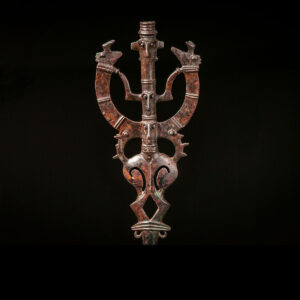
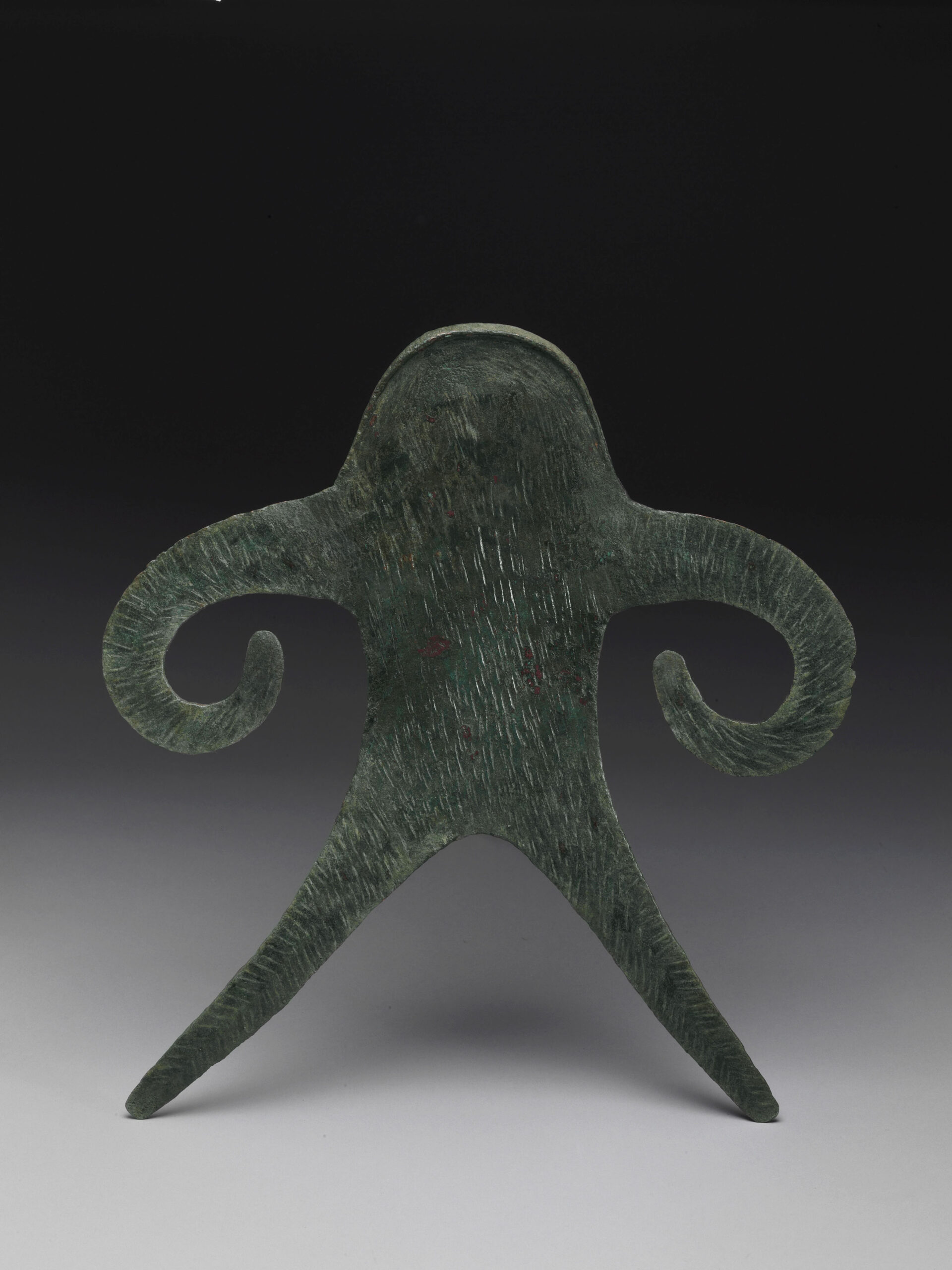
Indian Copper Anthropomorph (Idol)
Type I – i.e. without hieroglyph inscription
This Indus Valley civilization copper anthropomorph is a rare and fine example of abstract silhouettes of human figures that were produced by the indigenous inhabitants of the Ganges river valley. Found together with other implements such as harpoons and rings, the figures were cast in molds from copper and then hammered, with the chisel marks left easily discernible. The natural attractive patina and the earthy deposits are signs of prolonged burial. It has been suggested that these idols functioned as protective guardian spirits.
Four Types of Anthropomorphs
ANTHROPOMORPH FEATURED HERE IS OF TYPE I, i.e. without hieroglyph inscription:
Given that pure copper is a relatively soft metal and most of the objects show little or no signs of wear, it seems likely that their function was largely dedicatory. Hoards of such objects have been found across north India, the greatest concentration being in Uttar Pradesh. The findspots suggest they were ritually deposited in rivers or marshes, though several related antennae swords were recorded in late Indus Valley civilization (ca. 1500 B.C.) burials at Sanauli.
– Type I – semi-circular headed, curved arms signifying ram’s horns, standing with spread legs.
– Type II – (Indus Script ‘fish’ hieroglyph) similar to Type I but with Indus script incription of ‘fish’ hieroglyph.
– Type III – (Seated, with right arm upraised) similar to Type I but with variants of ‘seated posture’ and one right arm lift upwards.
– Type IV – (Indus Script ‘boar’ ligature & ‘yong [sic] bull’ hieroglyh [sic] inscribed) similar to Type I but with Indus Script inscriptions/ligatures of boar’s head and hieroglyph of one-horned young bull.
Paul Yule had identified Type I and Type II artefacts from among the Copper Hoard Culture finds as anthropomorph types based on orthographic features. With the discovery of new artefacts of the Copper Hoard Culture, the typology can now be extended to four types of anthropomorphs. The types are:
– Type I – semi-circular headed, curved arms signifying ram’s horns, standing with spread legs.
– Type II – similar to Type I but with Indus script incription of ‘fish’ hieroglyph.
– Type III – similar to Type I but with variants of ‘seated posture’ and one right arm lift upwards.
– Type IV – similar to Type I but with Indus Script inscriptions/ligatures of boar’s head and hieroglyph of one-horned young bull.
The findspot of Type II “Sheorajpur Anthropomorph” (with ‘fish’ hieroglyph) is Sheorajpur where an ancient Shiva temple has been discovered. The temple ceiling is decorated with metalwork plates of sculptural friezes attesting to the metalwork tradition of the site during the Bronze Age.
Apart from the insribed or ligatured anthropomorphs with Indus Script hieroglyphs, the link to Indus Script tradition is validated by the finds of anthropomorphs in Sultanate of Oman dated to ca. 1900 BCE and to the find of an anthropomorph in Lothal (2500 BCE?). Thus the Copper Hoard Culture can be seen as a continuum of the Bronze Age Revolution evidenced by the Indus Script Corpora of over 7000 inscriptions – all related to metalwork catalogues or data archives.
It is submitted that the anthropomorphs of Copper Hoard Culture are a reinforcement of the Indus Script decipherent as metalwork cataloguing in Prakrtam (Indian sprachbund), a cipher system mentioned by Vatsyayana as mlecchita vikalpa ‘lit.cipher of mleccha/meluhha, ‘copper workers’.
While many anthropomorph examples are of small size which led Paul Yule to infer that they did not have utilitarian value as ‘metal’, some examples have been reported from Metmuseum of anthropomorphs of sizes 4 1/2 x 3 15/16 in. and 6 1/8 x 4 7/8 in. which have led to their identification as axe-heads or ax celts or copper ingots.
Srini Kalyanaraman suggests that all the anthropomorphs are orthographic form hieroglyphs of Indus Script to signify metalwork dharma saṁjñā ‘signifiers of responsibilities (in guild — as artisans/seafaring merchants) or professional calling cards’. Such dharma saṁjñā may have been disseminated as badges to herald or proclaim the holders’ professional competence in metalwork.
RV 1.10.1 indicates ‘worshippers held aloft as it were (on) a pole’ during Indra dhvaja festivals. It is possible that such anthropomorphs were held aloft on poles as exhibits during festivals to proclaim to the people the new competence in metalwork.
Parallel Anthropomorph in Museum
(located at Allahabad Museum, Allahabad, India):
– Anthropomorphic Figure, Copper hoard culture, Farukkhabad, Uttar Pradesh
– http://museumsofindia.gov.in/repository/record/alh_ald-AM-ARCH-218-7671
Parallel “Sheorajpur Anthropomorph” in Museum
(located at State Museum, Lucknow, India):
TYPE II ANTHROPOMORPH
– Sheorajpur anthropomorph with ‘fish’ hieroglyph and ‘markhor’ horns hieroglyph. ayo’fish’ Rebus: ayo ‘iron, metal’ (Gujarati) khambhaṛā ‘fish fin’ rebus: kammaTa ‘mint, coiner, coinage’. Fish sign incised on copper anthropomorph, Sheorajpur, upper Ganges valley, ca. 2nd millennium BCE, 4 kg; 47.7 X 39 X 2.1 cm. State Museum, Lucknow (O.37) Typical find of Gangetic Copper Hoards.
– http://katalog.ub.uni-heidelberg.de/cgi-bin/titel.cgi?katkey=900213101
– http://heidicon.ub.uni-heidelberg.de/heidicon/239/213101.html
– http://heidicon.ub.uni-heidelberg.de/id/213101
– http://asi.nic.in/asi_museums_lucknow.asp
– http://uptourism.gov.in/pages/top/explore/lucknow/state-museum
Parallel “Saipa Anthropomorph” in Museum
(located at Musée Barbier-Mueller, Switzerland):
– Anthropomorphic figure, Copper hoard culture, Northern India, Doab region, Ganges Valley
– http://www.barbier-mueller.ch/collections/antiquite/age-du-bronze/?lang=en
– http://www.barbier-mueller.ch/collections/antiquite/age-du-bronze/?lang=fr
Parallel Anthropomorphs in Museum
(located at MET MUSEUM, New York City, New York, USA):
– Samuel Eilenberg Collection, Bequest of Samuel Eilenberg, 1998
– http://www.metmuseum.org/art/collection/search/39432
– http://www.metmuseum.org/art/collection/search/50592
– http://www.metmuseum.org/art/collection/search/50588
– http://www.metmuseum.org/art/collection/search/50641
Parallel Anthropomorph in Museum
(located at CLEVELAND MUSEUM OF ART, Cleveland, Ohio, USA):
– Anthropomorphic Figure. India. Bronze Age. Mid/Second Half of the 2nd Millenium BCE.
– Norman O. Stone and Ella A. Stone Memorial Fund
– http://www.clevelandart.org/art/2004.31
Parallel Anthropomorph in Cleveland Museum of Art Mentioned in Scholarly Journal:
“Art of Asia Acquired by North American Museums”, 2003-2004 (p. 113, Fig. 8)
Archives of Asian Art
Vol. 56 (2006), pp. 109-132
Published by: Duke University Press
Stable URL: http://www.jstor.org/stable/20111341
Page Count: 24
cf. Scholarly Publication
Anthropomorph in Baidun Collection Most Similar to Fig. 1121 on Page 241:
– P. Yule/A. Hauptmann/M. Hughes, “The Copper Hoards of the Indian Subcontinent: Preliminaries for an Interpretation”, Jahrbuch des Römisch-Germanischen Zentralmuseums Mainz 36, 1989 [1992], 193-275.
– “The Copper Hoards of the Indian Subcontinent: Preliminaries for an Interpretation” with Appendix I and II by Andreas Hauptmann and Michael J. Hughes (p. 239, fig. 1105; see also p. 241-242 figs. 1121-1123, 1128 for similar anthropomorphs).
– http://crossasia-repository.ub.uni-heidelberg.de/509/
– http://crossasia-repository.ub.uni-heidelberg.de/509/1/00jrgzm_all.pdf
cf. Scholarly Publication
– P. Yule, ‘Addenda to “The Copper Hoards of the Indian Subcontinent: Preliminaries for an Interpretation”‘
– http://crossasia-repository.ub.uni-heidelberg.de/510/
– http://crossasia-repository.ub.uni-heidelberg.de/510/1/yule_man_envir_2001.pdf
cf. Scholarly Publication
– P. Yule, “Beyond the Pale of Near Eastern Archaeology: Anthropomorphic Figures from al-Aqir near Bahla’, Sultanate of Oman” within: T. Stöllner et al. (Hrsg.), “Mensch und Bergbau Studies in Honour of Gerd Weisgerber on Occasion of his 65th Birthday”, (Bochum 2003) 537-542
– http://archiv.ub.uni-heidelberg.de/propylaeumdok/109/1/Yule_2003.pdf
cf. Scholarly Publication
cf. Plates with Illustrations of Anthropomorphs:
– P. Yule, “Metalwork of the Bronze Age in India”
– http://crossasia-repository.ub.uni-heidelberg.de/1895/
– http://crossasia-repository.ub.uni-heidelberg.de/1895/1/Metalwork_BronzeAge_India.pdf
cf. Scholarly Publication
“The Copper Hoard Culture of the Gangā Valley”
– B. Lal (1972), “The Copper Hoard culture of the Gangā Valley”. Antiquity, 46 (184), 282-287. doi:10.1017/S0003598X00053886
– https://www.cambridge.org/core/journals/antiquity/article/copper-hoard-culture-of-the-ganga-valley/EB6ABFD8D5BD193835C0145C3BD55925
cf. Scholarly Publication
– J. Manuel, “The antecedent’s diverse influences on and by Vaishnava Art, as perceptible from the times of Copper Anthropomorphic Figures” within:
Journal of Religious History South Asia, Vol. A-1 (Published Fall 2015)
– http://www.jorhsa.com/Edition_2015/Copper.pdf
cf. Scholarly Publication
“On Copper Age Anthropomorphic Figures from North India An Ethnological Interpretation”
Jürgen W. Frembgen
East and West
Vol. 46, No. 1/2 (June 1996), pp. 177-182
Published by: Istituto Italiano per l’Africa e l’Oriente (IsIAO)
Stable URL: http://www.jstor.org/stable/29757261
Page Count: 6
cf. Scholarly Publication
“The Copper Hoards Problem: A Technological Angle”
D. P. AGRAWAL
Asian Perspectives
Vol. 12 (1969), pp. 113-119
Published by: University of Hawai’i Press
Stable URL: http://www.jstor.org/stable/42929067
Page Count: 7
cf. Scholarly Publication
T.K.D GUPTA, “The anthropomorphic figures of the copper-hoards from India”
– https://www.researchgate.net/publication/306878726_The_anthropomorphic_figures_of_the_copper-hoards_from_India
Ancient Indus Museums
15 museums around the world where ancient Indus Civilization artifacts are live.
– https://www.harappa.com/museum
SOURCES
Links Included Above Embedded Inline + Links Below:
- http://bharatkalyan97.blogspot.co.il/2016/07/all-four-types-of-anthropomorphs-of.html
- http://bharatkalyan97.blogspot.co.il/2015/05/composite-copper-alloy-anthropomorphic.html
- http://bharatkalyan97.blogspot.co.il/2014/01/stunning-metallic-ceiling-of-shivrajpur.html
- http://bharatkalyan97.blogspot.co.il/2014/01/meluhha-hieroglyphs-snarling-iron-of.html
- http://bharatkalyan97.blogspot.co.il/2014/01/stunning-metallic-ceiling-of-shivrajpur.html
- https://www.academia.edu/27354911/All_four_types_of_anthropomorphs_of_Copper_Hoard_Culture_are_dharma_saṁjñā_metalwork_signifiers_of_responsibilities_in_guild_or_professional_calling_cards
- https://sarasvati97.wordpress.com/2017/01/02/copper-anthropomorphs-are-dharma-saṃjna-संज्ञा-samskrtam-dhamma-sanna-सञ्ञा-pali/
- http://www.business-standard.com/article/specials/naman-ahuja-is-mastering-the-art-of-reaching-out-114092501180_1.html
REFERENCE #
SI_IN_1001
CIVILIZATION
Late Bronze, 1500 B.C.E. – 1300 B.C.E.
SIZE
Ht. 33 cm, Wd. 31 cm
CONDITION
Fine Condition.
PRICE
Price available upon request
PROVENANCE
Private English Collection, 1969
Frequently Asked Questions
The Indian Copper Anthropomorph is a rare copper figure from the Indus Valley civilization, representing abstract human silhouettes. It was found in the Ganges river valley along with other implements like harpoons and rings, indicating its cultural significance in the region.
The four types of Copper Anthropomorphs are: Type I with semi-circular heads and curved arms; Type II similar to Type I but with a 'fish' hieroglyph inscription; Type III which is seated with one arm raised; and Type IV which includes inscriptions of a boar's head and a one-horned young bull hieroglyph. These types reflect variations in posture and inscriptions linked to the Indus Script.
Inscriptions on some Copper Anthropomorphs, such as the 'fish' and 'boar' hieroglyphs, are linked to the Indus Script and are believed to represent metalwork catalogues or professional guild signs. These inscriptions may have served as badges indicating the artisan's or merchant's professional identity and responsibilities.
The Copper Anthropomorphs were likely used as dedicatory or ritual objects rather than utilitarian tools, possibly serving as protective guardian spirits or as badges of professional competence in metalwork. Some may have been held aloft during festivals to proclaim metalworking skills, as suggested by ancient texts and archaeological context.
Parallel examples of Copper Anthropomorphs are housed in several museums worldwide, including the Allahabad Museum and State Museum in India, Musée Barbier-Mueller in Switzerland, the Metropolitan Museum of Art in New York, and the Cleveland Museum of Art in Ohio. These collections showcase the cultural and historical significance of these artifacts.
The discovery of Copper Anthropomorphs in Oman and Lothal indicates a cultural and trade connection with the Indus Valley civilization, suggesting that the Copper Hoard Culture was part of a broader Bronze Age network. This supports the idea of a continuous tradition of metalwork and script usage across regions during that era.
Copper Anthropomorphs are considered orthographic hieroglyphs of the Indus Script, representing metalwork cataloguing and professional identities within artisan guilds. This connection supports the decipherment of the Indus Script as a system related to metalwork and trade, reinforcing the cultural significance of these figures.