A Beautiful Wide Bronze Sword

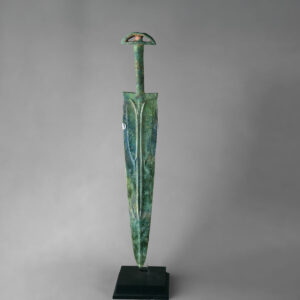
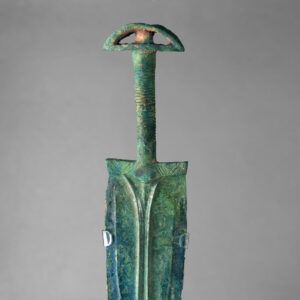
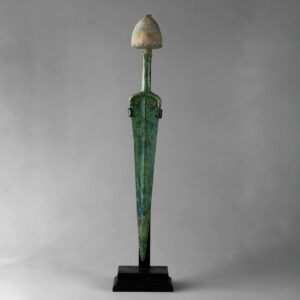
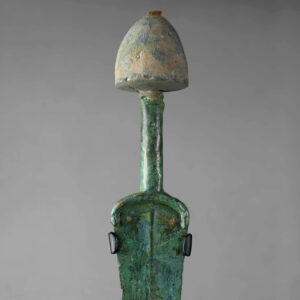
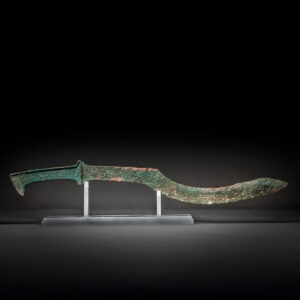
This Persian sword is a remarkable example of the technology and design that went into crafting an ancient piece of weaponry. The dark hue of this sword lends it an austere weight, while the thick ribs and large crescent of the hilt are an indication of the strength required to wield such a heavy object. The broad blade seems to be made not for bludgeoning as much as cutting, with the raised ridge that runs along its length adding force to its blows.

This is a piece that makes a forceful statement in any collection, especially for collectors looking for a simpler alternative to the overwrought designs of later civilizations. The ancient Persians were known for their battle prowess, and this weapon is a fine example as to the tools ancient warriors had at their disposal. This sword has been wonderfully restored and displays a brilliant luster that still gleams along its long blade.


REFERENCE #

WP_PR_1111

CIVILIZATION

Persian, 1200 B.C.E. – 1100 B.C.E.

SIZE

L. 54 cm, 8 cm W

CONDITION

Excellent condition

PRICE

$11500

PROVENANCE

Jerusalem Private Collection

A Bronze Greek Helmet of Illyrian TypeOut of stock

A Bronze Greek Helmet of Illyrian Type

Description

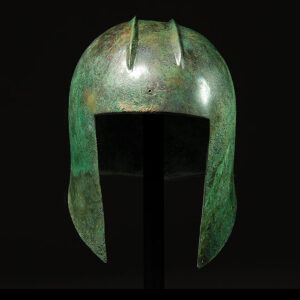
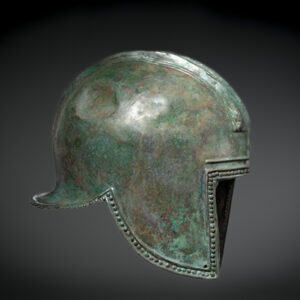
This bronze helmet is designed for combat rather than purely ceremonial purposes, with blade-like wings which slide forward under the jawline from a straight-edge forehead margin. The top of the helmet is fortified with two prominent structural ‘ribs’ designed to deflect sword blows, while the rear edge of the helmet – above the shoulders – is lipped outwards to provide a neck guard. There are faint marks indicating that the helmet was indeed struck, probably by a sword, on the left side.

The early date of this piece put it in the Illyrian (i.e. Macedonian and Albanian) kingdom of the Enchelei, an 8th and 7th century B.C.E. polity focused around Lake Ohrid in what is now Albania and Macedonia. Their economy appears to have been based mainly on fishing, and they had extensive trade networks with Greece. They also had an uneasy relationship with local tribes including Macedonians and the Dardani, among others, and the fact that they seem to have spent much of their time at war may explain why so much of their art and material culture is based around warrior-like iconography and accessories. A helmet such as this would have been worn by a lightly-armed foot-soldier (or Hoplite, in Greek terms), and was designed for skirmishing. This is an evocative and impressive piece of ancient art.

REFERENCE #

WP_GR_1007

CIVILIZATION

Greek, 700 B.C.E. – 500 B.C.E.

SIZE

H. 27 cm

CONDITION

Fine condition

PRICE

Sold

An Illyrian Helmet

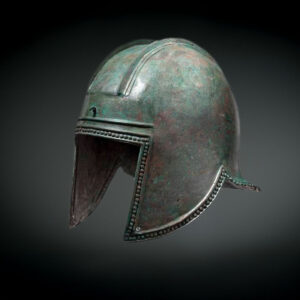
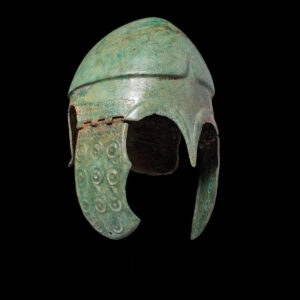
A bronze Illyrian helmet with dark green patina. Tall skull with distinctly raised and stepped ridges, fastening hooks for the attachment of a crest at front and at back. Large face-opening surmounted by two ribs across the brow, long pierced cheek-pieces and flared neck-guard. A row of lenticular decorative pins around the perimeter.


REFERENCE #

WP_GR_1008

CIVILIZATION

Greek, 600 B.C.E.

SIZE

H. 23 cm

CONDITION

Some restorations at the crown, the face-opening and the nape

PRICE

Sold

Ancient Bronze Thrusting Sword

This remarkable bronze weapon is a dagger or short sword from ancient Persia, specifically attributed to the Pre-Achaemenid Empire. During this period, the empire expanded extensively, establishing a formidable and centralized administrative structure that drove the production of luxurious and highly ornate high-status artifacts. Crafted by master smiths, this piece exemplifies the exceptional skill and artistry of Persian metallurgists, renowned for creating prestige items for the military forces.

The weapon features a distinctive strengthening spine, design element that facilitates both easier thrusting. The fine craftsmanship, intricate detailing, and functional design underscore its dual role as both a battlefield implement and a symbol of status and authority.


REFERENCE #

WP_PR_1114

CIVILIZATION

Persian, 1200-800 B.C.E.

SIZE

L. 41 cm

CONDITION

Fine condition

PRICE

$5000

Archaic Bronze Greave

The shape of this bronze shin guard or ‘greave’ is emphasized by the exaggeration of the anatomical muscular structure, on one side a deep crescent-shaped groove and a bulge indicates the position of the calf. The arched upper end protected the knee joint. Above the ankle, the outline of the plaque is rounded and slightly flared to allow for movement.

REFERENCE #

WP_GR_1010

CIVILIZATION

Greek, 600 B.C.E.

SIZE

H. 42 cm

CONDITION

Minor repairs for cracks, and some reinforcements done from the inside

PRICE

Price available upon request

PROVENANCE

Previously in a private Japanese collection since the 1970’s


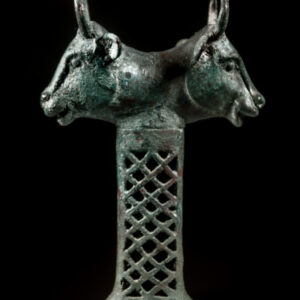
Bronze Double-Headed Bull Mace Head

$25,000.00

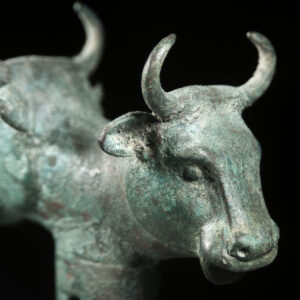
This Elamite Bronze Double-Headed Bull Mace Head, originating from the Near East region circa 2100–1550 B.C.E., is a striking example of ancient artistry and symbolism. The mace head features two imposing bull heads sculpted with remarkable detail and power, with their facial features exuding strength and dominance.

The bulls’ horns and expressions reflect the reverence for these animals in ancient cultures, often symbolizing fertility, power, and protection.

The handle, crafted in an openwork lattice style, showcases the artisan’s advanced skill in metalworking. The lattice pattern adds both aesthetic beauty and functional lightness to the piece. Though one of the bulls’ ears shows an ancient loss, the artifact remains in fine condition, its surface adorned with a rich natural patina, adding to its historical authenticity and appeal.

In the ancient Elamite kingdom, bulls were potent symbols of strength, fertility, and divine power, often associated with deities and rulers. This double-headed bull mace head likely held ceremonial or ritual significance, symbolizing authority, protection, or a connection to the divine. Its exquisite craftsmanship speaks to the advanced skills of the ancient Near Eastern metalworkers and their ability to imbue objects with profound cultural meaning.[/vc_column_text]

REFERENCE #

WP_AT_1001

CIVILIZATION

Persian, Middle Bronze 2100 B.C.E. – 1550 B.C.E.

SIZE

L. 19 cm, W. 13 cm

CONDITION

Fine condition.

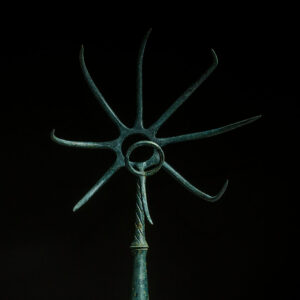
Bronze Etruscan Harpago

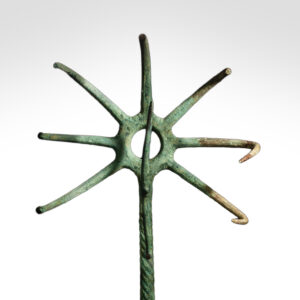
A bronze Etruscan harpago, or underwater sponge collecting hook, with seven curved tines set radially around a central torus. The hook piece is set upon a large handle with a coiled design along its shaft. An additional pair of tines protrudes just below the torus at the top of the coiled shaft.

Reference: Cf. MFA Bronzes, p. 421, fig. 608. Published: HASB 1, 1975, 21ff


REFERENCE #

MW_GR_1006

CIVILIZATION

Etruscan, 600 B.C.E.

SIZE

H. 33 cm

CONDITION

Fine Condition, some of the tips are reattached.

PRICE

$17,000

PROVENANCE

Private Collection P.C. Nuremberg

Bronze Persian Axe Head

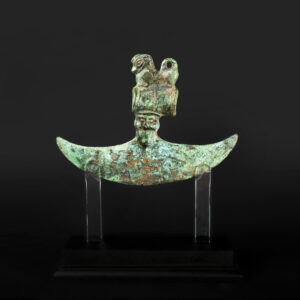
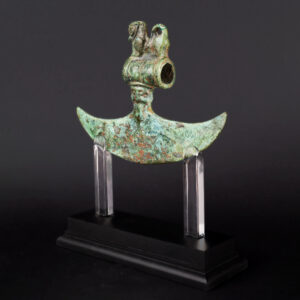
This remarkable ancient Elamite crescent axe features a distinctively curved, finely detailed blade that appears to emerge from the mouth of a bearded man, creating a powerful and evocative visual narrative. The figure of the bearded man, likely representing a deity or a legendary figure, is elegantly cast or carved, with a well-defined facial expression and beard, symbolizing strength or authority. The blade itself, attached seamlessly to the mouth, displays polished surfaces and sharp edges, indicative of high-quality craftsmanship from the Achaemenid periods. The axe’s shaft extends from the figure and is adorned with an intricate relief of a horse, symbolizing power, nobility, or martial prowess. The combination of the mythic figure, the dynamic crescent blade, and the equine motif reflects the sophisticated iconography and artistry characteristic of ancient Persia’s ceremonial weaponry. Crafted from bronze, this artifact exemplifies the masterful metallurgical techniques and symbolic artistry of the period.

REFERENCE #

WP_PR_1116

CIVILIZATION

Iron Age, 1200 B.C.E. – 900 B.C.E.

SIZE

L. 18 cm

CONDITION

Excellent condition, with dark green patina.

PRICE

$6998

PROVENANCE

The Private Collection of K. Baidun

Bronze wine Philae bowl

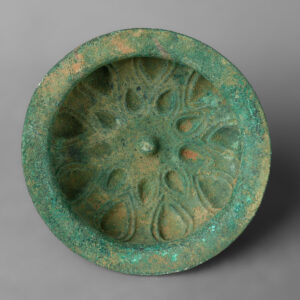
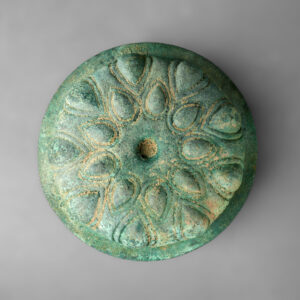
Bronze wine Phiale bowl from the Achaemenid period, circa 500 BC, dating to the time of Ezra and Nehemiah. This elegant vessel is crafted from bronze and measures approximately 16 cm in diameter. It features a shallow, broad form typical of Phiale bowls, with a gently flared rim that enhances its functional and decorative appeal.

The surface of the bowl is decorated with a detailed lotus motif, a symbol of purity, rebirth, and divine beauty, which was commonly used in Persian art and iconography. The intricate design is well-preserved and highlights the craftsmanship of Achaemenid metalworkers. The bowl is in perfect condition, with a rich blue patina that has developed over centuries, adding to its visual richness and historical authenticity.

The bronze material indicates that this vessel was a valued object, likely used in libations or ritual offerings during important ceremonies or banquets associated with the Persian court. Its decoration and form embody the aesthetic ideals and cultural values of the Achaemenid period, combining utility with artistic expression.

The craftsmanship and fine detailing of this bowl reflect a high level of technological skill, characteristic of the Achaemenid metallurgists. Such a substantial vessel was probably used in prestigious contexts, including royal banquets or religious rituals, serving both a utilitarian and decorative purpose.

REFERENCE #

B-22100

CIVILIZATION

Persian, Iron Age

CIRCA 800 B.C.E. – 500 B.C.E.

SIZE

DIAMETER. 16cm, HT. 7cm

CONDITION

Fine condition.

PRICE

$4000

Provenance

Jerusalem Private Collection

Canaanite Bronze Sickle SwordOut of stock

Canaanite Bronze Sickle Sword

Canaanite bronze sickle sword. The sword blade curves for two thirds of its length but is straight at its lower end. The handle has raised edges and ends in a “comma” to ensure the grip.

Reference: Y. Yadin, “The Art of Warfare in Biblical Lands” (London, 1963), p. 207

REFERENCE #

WP_MS_1001

CIVILIZATION

Canaanite, Late Bronze 1400 B.C.E.

SIZE

L. 56 cm

CONDITION

Fine condition

PRICE

Sold

Chalcidian Bronze Helmet with Cheek Guards

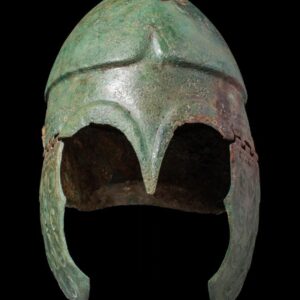
This helmet has a domed crown with medial ridge, with contoured inverted ‘V’ shape above the brow continuing as an occipital rib around the helmet, with pronounced arched brows and narrow flared neck guard, the hinges connected to intact original cheek-guards with rich green patina. The domed crown has a medial ridge, with a contoured inverted ‘V’ shape above the brow continuing as an occipital rib around the helmet, pronounced arched brows and a narrow flared neck guard; the hinges remaining connecting to cheek-pieces originally attached. ‘Chalcidian’ helmets are so named as they resemble those depicted on pottery from the Euboean city of Chalcis. They were used throughout the Greek world as a lighter, less bulky version of the earlier ‘Corinthian’ helmet.


REFERENCE #

WP_GR_1009

CIVILIZATION

Greek, 500 B.C.E. – 400 B.C.E.

SIZE

H. 32.8 cm

CONDITION

Fine Condition

PRICE

Price Upon Request


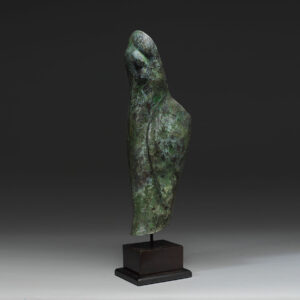
Indian Copper Anthropomorph (Idol) – Type I


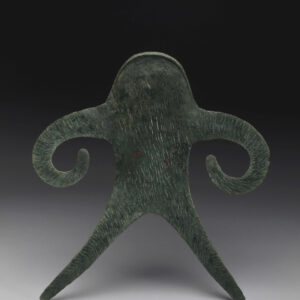
Indian Copper Anthropomorph (Idol)

Type I – i.e. without hieroglyph inscription

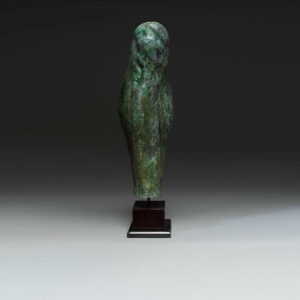
This Indus Valley civilization copper anthropomorph is a rare and fine example of abstract silhouettes of human figures that were produced by the indigenous inhabitants of the Ganges river valley. Found together with other implements such as harpoons and rings, the figures were cast in molds from copper and then hammered, with the chisel marks left easily discernible. The natural attractive patina and the earthy deposits are signs of prolonged burial. It has been suggested that these idols functioned as protective guardian spirits.


Four Types of Anthropomorphs

ANTHROPOMORPH FEATURED HERE IS OF TYPE I, i.e. without hieroglyph inscription:

Given that pure copper is a relatively soft metal and most of the objects show little or no signs of wear, it seems likely that their function was largely dedicatory. Hoards of such objects have been found across north India, the greatest concentration being in Uttar Pradesh. The findspots suggest they were ritually deposited in rivers or marshes, though several related antennae swords were recorded in late Indus Valley civilization (ca. 1500 B.C.) burials at Sanauli.


– Type I – semi-circular headed, curved arms signifying ram’s horns, standing with spread legs.
– Type II – (Indus Script ‘fish’ hieroglyph) similar to Type I but with Indus script incription of ‘fish’ hieroglyph.
– Type III – (Seated, with right arm upraised) similar to Type I but with variants of ‘seated posture’ and one right arm lift upwards.
– Type IV – (Indus Script ‘boar’ ligature & ‘yong [sic] bull’ hieroglyh [sic] inscribed) similar to Type I but with Indus Script inscriptions/ligatures of boar’s head and hieroglyph of one-horned young bull.


Paul Yule had identified Type I and Type II artefacts from among the Copper Hoard Culture finds as anthropomorph types based on orthographic features. With the discovery of new artefacts of the Copper Hoard Culture, the typology can now be extended to four types of anthropomorphs. The types are:
– Type I – semi-circular headed, curved arms signifying ram’s horns, standing with spread legs.
– Type II – similar to Type I but with Indus script incription of ‘fish’ hieroglyph.
– Type III – similar to Type I but with variants of ‘seated posture’ and one right arm lift upwards.
– Type IV – similar to Type I but with Indus Script inscriptions/ligatures of boar’s head and hieroglyph of one-horned young bull.


The findspot of Type II “Sheorajpur Anthropomorph” (with ‘fish’ hieroglyph) is Sheorajpur where an ancient Shiva temple has been discovered. The temple ceiling is decorated with metalwork plates of sculptural friezes attesting to the metalwork tradition of the site during the Bronze Age.


Apart from the insribed or ligatured anthropomorphs with Indus Script hieroglyphs, the link to Indus Script tradition is validated by the finds of anthropomorphs in Sultanate of Oman dated to ca. 1900 BCE and to the find of an anthropomorph in Lothal (2500 BCE?). Thus the Copper Hoard Culture can be seen as a continuum of the Bronze Age Revolution evidenced by the Indus Script Corpora of over 7000 inscriptions – all related to metalwork catalogues or data archives.


It is submitted that the anthropomorphs of Copper Hoard Culture are a reinforcement of the Indus Script decipherent as metalwork cataloguing in Prakrtam (Indian sprachbund), a cipher system mentioned by Vatsyayana as mlecchita vikalpa ‘lit.cipher of mleccha/meluhha, ‘copper workers’.


While many anthropomorph examples are of small size which led Paul Yule to infer that they did not have utilitarian value as ‘metal’, some examples have been reported from Metmuseum of anthropomorphs of sizes 4 1/2 x 3 15/16 in. and 6 1/8 x 4 7/8 in. which have led to their identification as axe-heads or ax celts or copper ingots.


Srini Kalyanaraman suggests that all the anthropomorphs are orthographic form hieroglyphs of Indus Script to signify metalwork dharma saṁjñā ‘signifiers of responsibilities (in guild — as artisans/seafaring merchants) or professional calling cards’.  Such dharma saṁjñā may have been disseminated as badges to herald or proclaim the holders’ professional competence in metalwork.


RV 1.10.1 indicates ‘worshippers held aloft as it were (on) a pole’ during Indra dhvaja festivals. It is possible that such anthropomorphs were held aloft on poles as exhibits during festivals to proclaim to the people the new competence in metalwork.


Parallel Anthropomorph in Museum

(located at Allahabad Museum, Allahabad, India):

– Anthropomorphic Figure, Copper hoard culture, Farukkhabad, Uttar Pradesh
http://museumsofindia.gov.in/repository/record/alh_ald-AM-ARCH-218-7671


Parallel “Sheorajpur Anthropomorph” in Museum

(located at State Museum, Lucknow, India):
TYPE II ANTHROPOMORPH

– Sheorajpur anthropomorph with ‘fish’ hieroglyph and ‘markhor’ horns hieroglyph. ayo’fish’ Rebus: ayo ‘iron, metal’ (Gujarati)  khambhaṛā ‘fish fin’ rebus: kammaTa ‘mint, coiner, coinage’.  Fish sign incised on copper anthropomorph, Sheorajpur, upper Ganges valley, ca. 2nd millennium BCE, 4 kg; 47.7 X 39 X 2.1 cm. State Museum, Lucknow (O.37) Typical find of Gangetic Copper Hoards.
http://katalog.ub.uni-heidelberg.de/cgi-bin/titel.cgi?katkey=900213101
http://heidicon.ub.uni-heidelberg.de/heidicon/239/213101.html
http://heidicon.ub.uni-heidelberg.de/id/213101
http://asi.nic.in/asi_museums_lucknow.asp
http://uptourism.gov.in/pages/top/explore/lucknow/state-museum


Parallel “Saipa Anthropomorph” in Museum

(located at Musée Barbier-Mueller, Switzerland):

– Anthropomorphic figure, Copper hoard culture, Northern India, Doab region, Ganges Valley
http://www.barbier-mueller.ch/collections/antiquite/age-du-bronze/?lang=en
http://www.barbier-mueller.ch/collections/antiquite/age-du-bronze/?lang=fr


Parallel Anthropomorphs in Museum

(located at MET MUSEUM, New York City, New York, USA):

– Samuel Eilenberg Collection, Bequest of Samuel Eilenberg, 1998
http://www.metmuseum.org/art/collection/search/39432
http://www.metmuseum.org/art/collection/search/50592
http://www.metmuseum.org/art/collection/search/50588
http://www.metmuseum.org/art/collection/search/50641


Parallel Anthropomorph in Museum

(located at CLEVELAND MUSEUM OF ART, Cleveland, Ohio, USA):

– Anthropomorphic Figure.  India.  Bronze Age.  Mid/Second Half of the 2nd Millenium BCE.
– Norman O. Stone and Ella A. Stone Memorial Fund
http://www.clevelandart.org/art/2004.31


Parallel Anthropomorph in Cleveland Museum of Art Mentioned in Scholarly Journal:

“Art of Asia Acquired by North American Museums”, 2003-2004 (p. 113, Fig. 8)
Archives of Asian Art
Vol. 56 (2006), pp. 109-132
Published by: Duke University Press
Stable URL: http://www.jstor.org/stable/20111341
Page Count: 24


cf. Scholarly Publication

Anthropomorph in Baidun Collection Most Similar to Fig. 1121 on Page 241:

– P. Yule/A. Hauptmann/M. Hughes, “The Copper Hoards of the Indian Subcontinent: Preliminaries for an Interpretation”, Jahrbuch des Römisch-Germanischen Zentralmuseums Mainz 36, 1989 [1992], 193-275.
– “The Copper Hoards of the Indian Subcontinent: Preliminaries for an Interpretation” with Appendix I and II by Andreas Hauptmann and Michael J. Hughes (p. 239, fig. 1105; see also p. 241-242 figs. 1121-1123, 1128 for similar anthropomorphs).
http://crossasia-repository.ub.uni-heidelberg.de/509/
http://crossasia-repository.ub.uni-heidelberg.de/509/1/00jrgzm_all.pdf


cf. Scholarly Publication

– P. Yule, ‘Addenda to “The Copper Hoards of the Indian Subcontinent: Preliminaries for an Interpretation”‘
http://crossasia-repository.ub.uni-heidelberg.de/510/
http://crossasia-repository.ub.uni-heidelberg.de/510/1/yule_man_envir_2001.pdf


cf. Scholarly Publication

– P. Yule, “Beyond the Pale of Near Eastern Archaeology: Anthropomorphic Figures from al-Aqir near Bahla’, Sultanate of Oman” within:  T. Stöllner et al. (Hrsg.), “Mensch und Bergbau Studies in Honour of Gerd Weisgerber on Occasion of his 65th Birthday”, (Bochum 2003) 537-542
http://archiv.ub.uni-heidelberg.de/propylaeumdok/109/1/Yule_2003.pdf


cf. Scholarly Publication

cf. Plates with Illustrations of Anthropomorphs:

– P. Yule, “Metalwork of the Bronze Age in India”
http://crossasia-repository.ub.uni-heidelberg.de/1895/
http://crossasia-repository.ub.uni-heidelberg.de/1895/1/Metalwork_BronzeAge_India.pdf


cf. Scholarly Publication

“The Copper Hoard Culture of the Gangā Valley”
– B. Lal (1972), “The Copper Hoard culture of the Gangā Valley”. Antiquity, 46 (184), 282-287. doi:10.1017/S0003598X00053886
https://www.cambridge.org/core/journals/antiquity/article/copper-hoard-culture-of-the-ganga-valley/EB6ABFD8D5BD193835C0145C3BD55925


cf. Scholarly Publication

– J. Manuel, “The antecedent’s diverse  influences  on  and  by Vaishnava Art,  as perceptible from the times of Copper Anthropomorphic Figures” within:
Journal of Religious History South Asia, Vol. A-1 (Published Fall 2015)
http://www.jorhsa.com/Edition_2015/Copper.pdf


cf. Scholarly Publication

“On Copper Age Anthropomorphic Figures from North India An Ethnological Interpretation”
Jürgen W. Frembgen
East and West
Vol. 46, No. 1/2 (June 1996), pp. 177-182
Published by: Istituto Italiano per l’Africa e l’Oriente (IsIAO)
Stable URL:  http://www.jstor.org/stable/29757261
Page Count: 6


cf. Scholarly Publication

“The Copper Hoards Problem: A Technological Angle”
D. P. AGRAWAL
Asian Perspectives
Vol. 12 (1969), pp. 113-119
Published by: University of Hawai’i Press
Stable URL:  http://www.jstor.org/stable/42929067
Page Count: 7


cf. Scholarly Publication

T.K.D GUPTA, “The anthropomorphic figures of the copper-hoards from India”
https://www.researchgate.net/publication/306878726_The_anthropomorphic_figures_of_the_copper-hoards_from_India


Ancient Indus Museums

15 museums around the world where ancient Indus Civilization artifacts are live.
https://www.harappa.com/museum


SOURCES

Links Included Above Embedded Inline + Links Below:

http://bharatkalyan97.blogspot.co.il/2016/07/all-four-types-of-anthropomorphs-of.html
http://bharatkalyan97.blogspot.co.il/2015/05/composite-copper-alloy-anthropomorphic.html
http://bharatkalyan97.blogspot.co.il/2014/01/stunning-metallic-ceiling-of-shivrajpur.html
http://bharatkalyan97.blogspot.co.il/2014/01/meluhha-hieroglyphs-snarling-iron-of.html
http://bharatkalyan97.blogspot.co.il/2014/01/stunning-metallic-ceiling-of-shivrajpur.html


https://www.academia.edu/27354911/All_four_types_of_anthropomorphs_of_Copper_Hoard_Culture_are_dharma_saṁjñā_metalwork_signifiers_of_responsibilities_in_guild_or_professional_calling_cards


https://sarasvati97.wordpress.com/2017/01/02/copper-anthropomorphs-are-dharma-saṃjna-संज्ञा-samskrtam-dhamma-sanna-सञ्ञा-‎pali/


http://www.business-standard.com/article/specials/naman-ahuja-is-mastering-the-art-of-reaching-out-114092501180_1.html

REFERENCE #

SI_IN_1001

CIVILIZATION

Late Bronze, 1500 B.C.E. – 1300 B.C.E.

SIZE

Ht. 33 cm, Wd. 31 cm

CONDITION

Fine Condition.

PRICE

Price available upon request

PROVENANCE

Private English Collection, 1969

Luristan Master-of-Animals Finial Standard

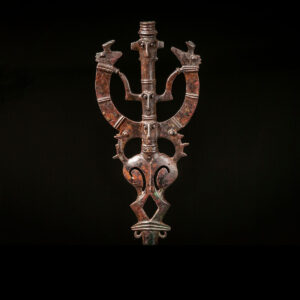
The area of Luristan, in western Iran, was home to a rich tradition of bronze-working in the early part of the first millennium B.C.E., producing an array of finely-crafted and distinctive objects unique to the region. This intricately-cast standard finial was originally intended to sit atop a ceremonial staff to be carried in a procession; the bell-shaped socket at the lower end was designed to enable attachment.

The finial represents, in highly stylized form, the ‘Master of Animals’, a deity considered ancient even at the time this piece was made, and who probably had origins in Stone Age hunters’ cults. The figure has a cylindrical body, with three faces along its length. With a pair of slender arms, it fends off two serpent-like creatures. The lowest part of the figure has an exaggerated, oval-shaped torso and stands on a pair of short, bowed legs.


REFERENCE #

SI_PR_1016

CIVILIZATION

Persian, 1st millennium B.C.E.

SIZE

H. 35cm

CONDITION

Fine Condition

PRICE

SOLD

PROVENANCE

Private UK collection, late 1970’s.

Roman Bronze Phalera

Description

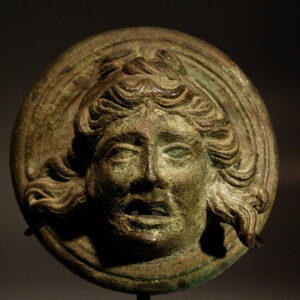
This impressive bronze Roman phalera exemplifies the craftsmanship and symbolic artistry of ancient Roman metalworkers. The circular disk features an intricate high-relief depiction of a classical figure, possibly a deity or mythological character, rendered with expressive detail and dynamic flowing hair. The bronze surface exhibits a rich patina, with hues of green and brown indicating its ancient provenance and the natural weathering process over centuries.

The phalera, would have been used as a decorative ornament on military uniforms or horse harnesses, serving both decorative and symbolic purposes. The finely detailed relief showcases the artisan’s skill in metalwork, with carefully modeled features that convey strength and character.


REFERENCE #

SI_RM_1110

CIVILIZATION

Roman, 100 C.E. – 200 C.E.

SIZED. 8cm

CONDITION

Excellent condition.

PRICE

$8995