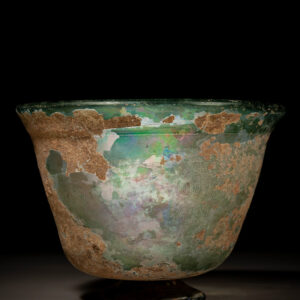
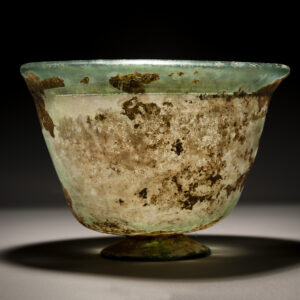
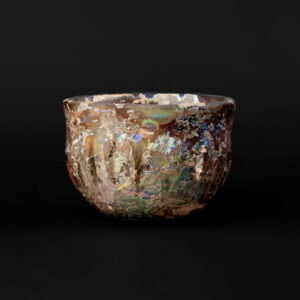
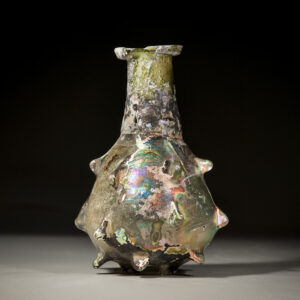
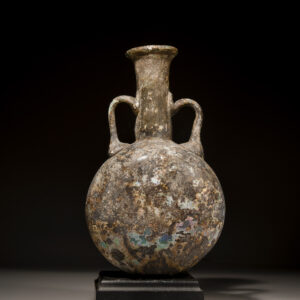
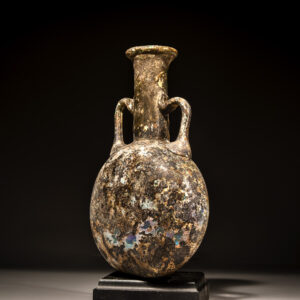
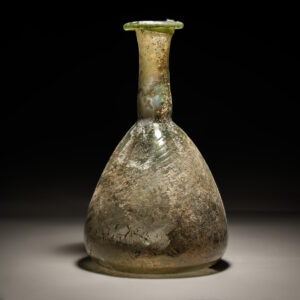
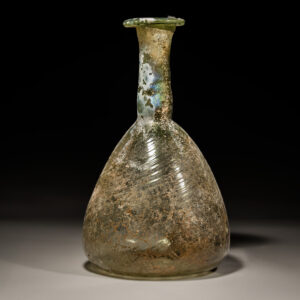
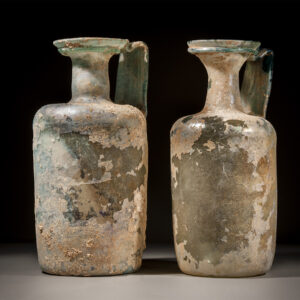
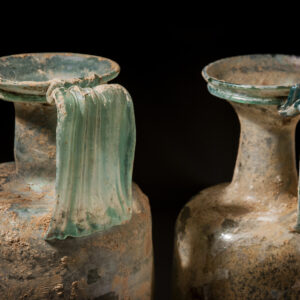
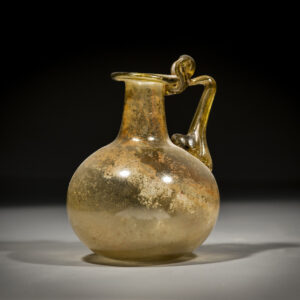
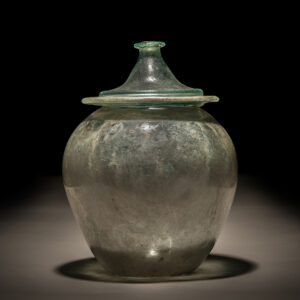
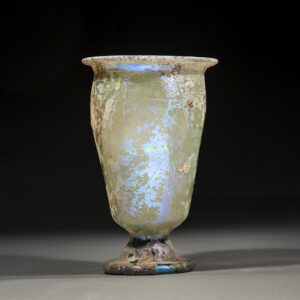
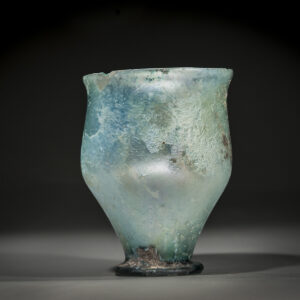
This large glass bowl comes from Samaria, the capital of ancient Israel in the 9th century B.C.E. and 8th century B.C.E.. Located just west of the Jordan River, Samaria was a vibrant city for many centuries; its history is recounted in the Old Testament book of Kings. It experienced many invasions over the intervening centuries located as it was in the strategic mountains of Judea.
By the time this beautiful aquamarine bowl was blown, Samaria had come under Roman rule, a period of great innovation as new Roman technology filtered throughout the region.
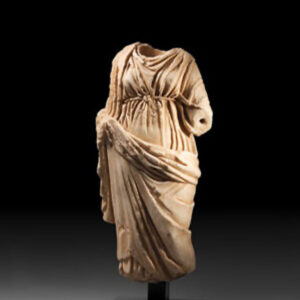
This female body is an interesting example of a Roman sculptor playing with the form of fabric as it drapes in thick folds over this woman’s strong figure. The head of this sculpture has been lost to time, yet we are able to understand that the woman we look upon was of a high standing due to her lush clothing and upright stance.
The skill of the sculptor who carved this piece is seen in the movement of the woman’s himation, or draped robe, as it both cinches below her bosom and sweeps across her waist as it is held back by her right hand. The result is a beautiful statement that highlights her full figure even under the weight of her thick robe.
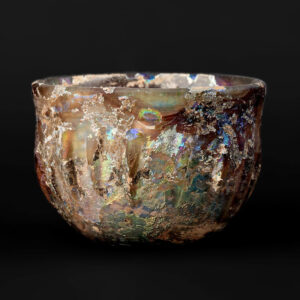
This elegant ribbed glass bowl exemplifies the artistry and technical skill of early Roman glassmakers. Crafted from a rare aubergine-hued soda‑lime glass, the bowl presents a gently flared rim and a rounded, harmonious profile with a lustrous, weathered surface that reveals a rich, multicolored iridescence developed through centuries of natural burial conditions. Measuring approximately [dimensions available on request], it is a compact yet striking domestic vessel.
The most striking feature of the bowl is its pronounced vertical ribbing, which encircles the body and lends a rhythmic, tactile quality to the form. Two finely incised concentric lines around the midsection provide an elegant counterpoint to the ribs, demonstrating careful finishing by hand. The surface iridescence, a product of long-term chemical interaction rather than modern treatment, enhances the deep aubergine tone and accentuates the delicate interplay of light across the exterior.
The workmanship shows mastery of early glass techniques—likely mold‑forming for the ribbed body with subsequent hand incision—resulting in crisp, well-executed details and a smoothly rendered rim. The uncommon deep purple color and strong iridescent sheen mark this piece as a particularly refined example of provincial Roman glass production.
Likely used for both every day and display purposes, this bowl would have served as a functional domestic vessel and possibly as a valued item within a household’s tableware. Its durable glass, sophisticated surface effects, and rare coloration reflect both the aesthetic sensibilities and material culture of the early Imperial period. Found in Sabaste; early Roman, ca. 1st century AD.REFERENCE #
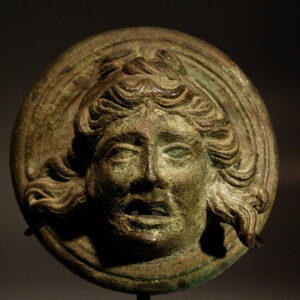
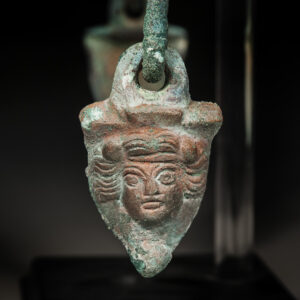
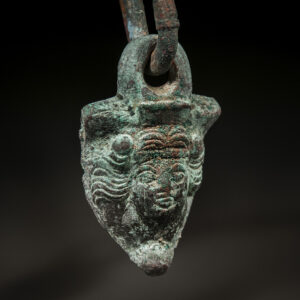
This impressive bronze Roman phalera exemplifies the craftsmanship and symbolic artistry of ancient Roman metalworkers. The circular disk features an intricate high-relief depiction of a classical figure, possibly a deity or mythological character, rendered with expressive detail and dynamic flowing hair. The bronze surface exhibits a rich patina, with hues of green and brown indicating its ancient provenance and the natural weathering process over centuries.
The phalera, would have been used as a decorative ornament on military uniforms or horse harnesses, serving both decorative and symbolic purposes. The finely detailed relief showcases the artisan’s skill in metalwork, with carefully modeled features that convey strength and character.