RARE ANCIENT WESTERN ASIATIC SWORD WITH STONE POMMEL
IRON AGE, ISRAELITE KINGDOM PERIOD
TIME OF KING DAVID
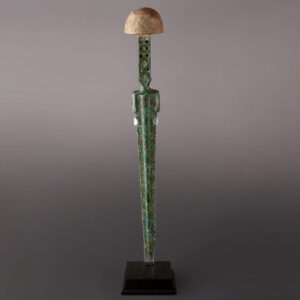
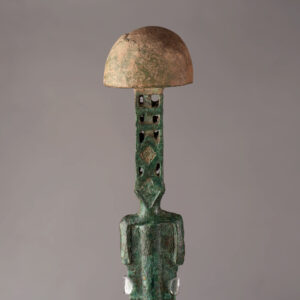
A Western Asiatic bronze Thrusting sword with a long, tapering blade, a prominent large polygonal mid-rib while gracefully curved. The hilt is characterized with a flat openwork cross-section and the dagger culminates in a distinctive, heavy pommel.
This sword was used for close range combat, to pierce armor.
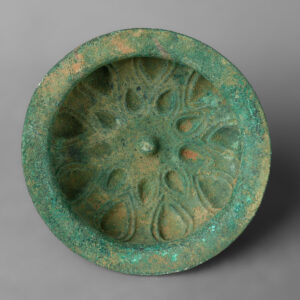
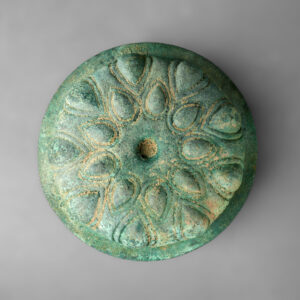
Bronze wine Phiale bowl from the Achaemenid period, circa 500 BC, dating to the time of Ezra and Nehemiah. This elegant vessel is crafted from bronze and measures approximately 16 cm in diameter. It features a shallow, broad form typical of Phiale bowls, with a gently flared rim that enhances its functional and decorative appeal.
The surface of the bowl is decorated with a detailed lotus motif, a symbol of purity, rebirth, and divine beauty, which was commonly used in Persian art and iconography. The intricate design is well-preserved and highlights the craftsmanship of Achaemenid metalworkers. The bowl is in perfect condition, with a rich blue patina that has developed over centuries, adding to its visual richness and historical authenticity.
The bronze material indicates that this vessel was a valued object, likely used in libations or ritual offerings during important ceremonies or banquets associated with the Persian court. Its decoration and form embody the aesthetic ideals and cultural values of the Achaemenid period, combining utility with artistic expression.
The craftsmanship and fine detailing of this bowl reflect a high level of technological skill, characteristic of the Achaemenid metallurgists. Such a substantial vessel was probably used in prestigious contexts, including royal banquets or religious rituals, serving both a utilitarian and decorative purpose.
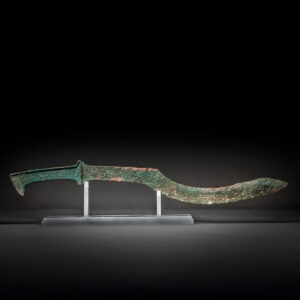
Canaanite bronze sickle sword. The sword blade curves for two thirds of its length but is straight at its lower end. The handle has raised edges and ends in a “comma” to ensure the grip.
Reference: Y. Yadin, “The Art of Warfare in Biblical Lands” (London, 1963), p. 207
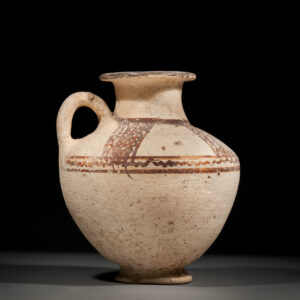
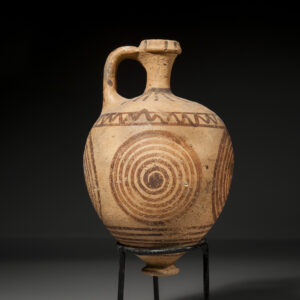
Canaanite artisans were prolific, and their pottery came in an array of fantastic shapes, colors and sizes. This white ware jug is no exception, its ghostly exterior marked with dark brown lines that zigzag across the top half of its bulbous body. A wide base supports the body itself, while the short neck above ends at a large flat mouth.
A handle rises abruptly from the body and connects at the neck’s base, making a sturdy loop for the well-worn hands of an ancient Canaanite
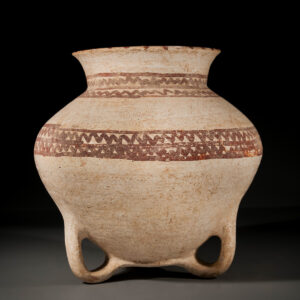
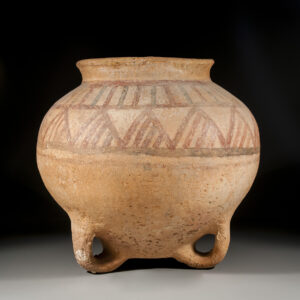
The distinctive base of this Canaanite jar is made of three looped legs that prop the body up in tripod-like fashion. The design is more aesthetically pleasing than innovative, yet the rest of the jug was carefully made to exacting standards that allowed for the flawless curves of its white ceramic exterior.
The upper half of the jug is decorated with chocolate brown bands that alternate between straight lines and tightly wound zigzags. The overall effect is an ancient artifact imbued with a timeless sense of artistry and originality.REFERENCE #
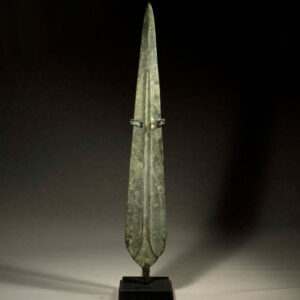
This magnificent leaf-shaped spear head was made by the Canaanites in the mid to late 2nd millennium B.C.E.. It displays excellent engineering and structural elements, particularly in terms of the bilateral central longitudinal fortified rib, widening to a broad tabular section at the butt end which was used to haft the spear head onto the shaft. The body tapers in both frontal and lateral profiles, making it a lethally effective weapon. The size also counts against anything other than a martial function, while the status associated with both warriors and large quantities of bronze (an expensive commodity at the time) marks it out as an important artifact.
Where found in context, such pieces are typically associated with prestige graves, and it would appear that they were probably as important in terms of appearance (i.e. conspicuous governance and threat) as in their evident lethality in combat. Indeed, at almost half a metre long, this piece would have been a very imposing item at the time of its manufacture, as indeed it is now. There is considerable evidence for diversity of manufacture across the Canaanite area, perhaps reflecting something of the modular yet martial nature of the time.
The Canaanites were one of the ‘tribal’ groups of what was to become Israel, Palestine and Jordan, who had their cultural roots in the Neolithic revolution when agriculture revolutionised Near East economics. By the Bronze Age the stability of the area and their position between great trading powers – notably Egypt and Mesopotamia – made them prosperous and culturally diverse, and was a high point for artistic creation. The culture contracted with economic issues suffered by Egypt and the Mesopotamians, and went through a collapse at the end of the Bronze Age due to a combination of ‘Sea People’ invasions, environmental meltdown and internal troubles in Egypt leading to loss of infrastructure throughout the Near East. Their resurgence of power in the Iron Age was matched by that of the Ammonites and Moabites, among others, and the region eventually came under control of the Neo-Assyrians by the mid 8th century B.C.E.. Such symbols of conspicuous consumption and authority are rare, especially in this excellent state of preservation and exquisite patination. This is an attractive and elegant piece of ancient art.
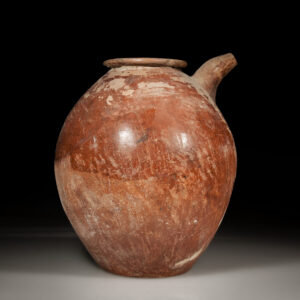
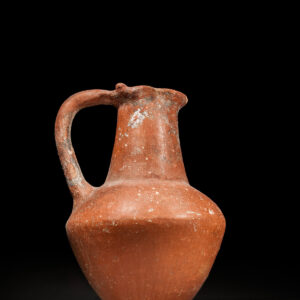
The natural polish of this red slip spouted jar shines brightly even under the softest of lights. The large ovoid body of this piece has no neck, but instead a flattened ring atop its mouth and a bent spout with a small hole for measured pouring. This suggests an efficiency commonly found throughout the arid regions of ancient Canaan, when water and wine were too important for the casual spill.
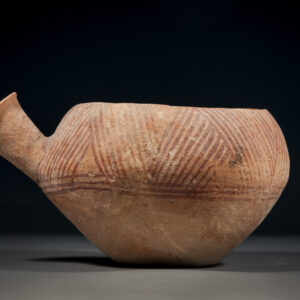
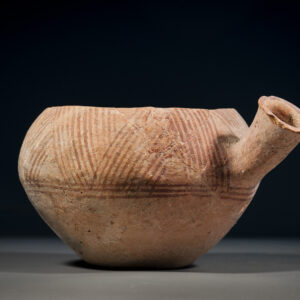
Wide Canaanite terra-cotta bowl with a single large spout protruding at a 45-degree angle from halfway up the body. The body tapers to a flattened base while the large mouth lacks embellishment. Monochrome paint marks the body’s upper half in parallel lines that intersect in diagonal planes.
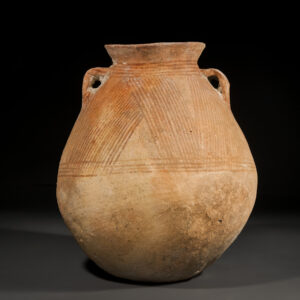
The thin lines that mark the top half of this large amphoriskos are on the primal end of art history, yet their application is so intricate as to reveal the care and attention to detail of the Canaanite artisan who applied them to the vessel’s exterior over 5000 years ago.
The large egg-shaped body of this amphoriskos allowed it to hold substantial amounts of liquid, be it wine, water or oil. The rich desert tones of its smooth exterior stand out boldly among the monochrome paint that scratch its surface.
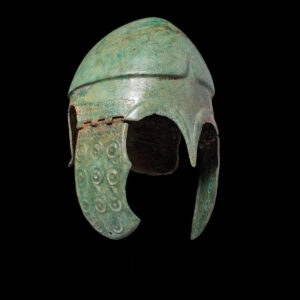
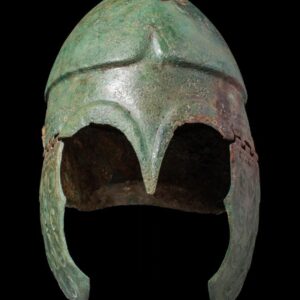
This helmet has a domed crown with medial ridge, with contoured inverted ‘V’ shape above the brow continuing as an occipital rib around the helmet, with pronounced arched brows and narrow flared neck guard, the hinges connected to intact original cheek-guards with rich green patina. The domed crown has a medial ridge, with a contoured inverted ‘V’ shape above the brow continuing as an occipital rib around the helmet, pronounced arched brows and a narrow flared neck guard; the hinges remaining connecting to cheek-pieces originally attached. ‘Chalcidian’ helmets are so named as they resemble those depicted on pottery from the Euboean city of Chalcis. They were used throughout the Greek world as a lighter, less bulky version of the earlier ‘Corinthian’ helmet.