
Showing 65–80 of 227 results
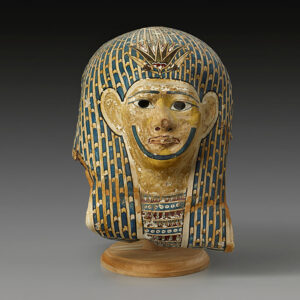
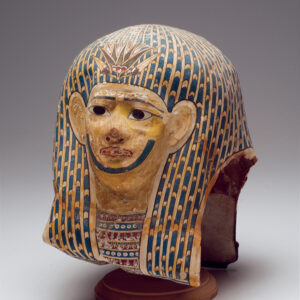
Made of cartonnage – a medium consisting of layers of fibers – this mummy mask features a broad foliate and beaded collar. The wig is decorated with an open lotus blossom on the forehead and a scarab on the crown. The cheek straps and other details are painted in blue, purple, red, pink and green on a yellow ground.
SI_EG_1049
Egyptian, 100 C.E.
H. 33 cm
Some normal areas of edge losses, mostly minor; a few open splits and some areas of the interior have been strengthened with a linen backing. Some normal minor paint flakes. Lower front portion of wig is curled under; the very tip of the nose chipped.
Sold
Private NYS collection, ex. Sotheby’s, Sale 5464, lot 250, May 30th, 1986
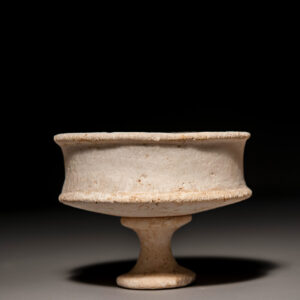
A Tazza refers to a little cup, consisting of a short stem topped by a wide receptacle. This piece comes from the Samarian region, created in the style of either Egyptian or Canaanite craftsmen. The small cup is only 6 cm in size, lending an intimacy to the object during religious ceremonies.
The cup’s body is pinched at its mouth as well as its base, which arcs downward and connects to the wide hourglass shaped stem.
KB_ST_9999
Late Bronze Age, 1500 B.C.E. -1200 B.C.E.
D. 6 cm
Part of the base is missing in antiquity
Price available upon request
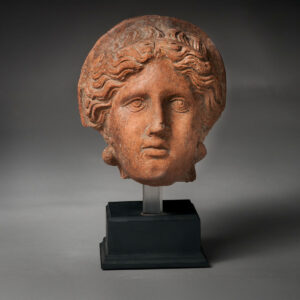
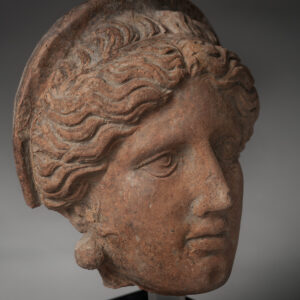
The front of the head is made from a mold and with a modeling tool reworked. The rear is Hollow. The sculpture shows a young female’s head in frontal orientation The even facial features women are very attractive. Expressive, with deep-set eyes coupled with strong eyelids. The pupils are clearly defined. A Strong protruding nose and full lips slightly opened. the chin has a gentle dimple. The symmetrically styled hair is parted in the middle, starting in soft curls that are combed back. On the cheeks is a single sleeping curls, and round earrings. The hairstyle is held by a headband. More curls on Top of the head are covered by a corona.
Cf .: St. Ohlig , antique cabinet, catalog no. 3 ( 1998) ” The Etruscans , a sign of life Civilized people . ” Fig.53 .
REFERENCE #
P 20753
Greek, 400 B.C.E.
H. 19.5 cm
A small chip on the tip of the nose, otherwise in Fine quality,
Price available upon request
Private collection of Dr. Ludenscheid , acquired in the 1960s
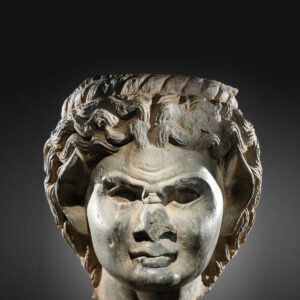
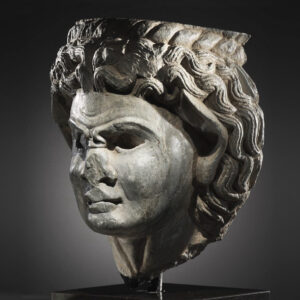
The expressive face of this satyr reveals a right eye that is slightly lower than the left and a smirk carved purposefully askew. The satyr himself may be of Greek origin, yet this piece hails from central Asia, a result of the clash of cultures that arose out of Alexander the Great’s successful campaigns throughout the region. The result was a vast melting pot of culture, art and religion that spanned the subsequent Hellenistic era of Greek history, when Greek cultural influence and power was at its zenith in Europe and Asia. At the time, this satyr’s inlaid eyes and simple braided crown were uncommon in Asian art, particularly seen in Buddhist sculptures of Siddhartha from the Gandhara region of northern Pakistan. Other examples include the famous Parthian relief from Hatra, as well as the hair and head of the Peshawar Museum’s Bodhisattva. In the years after Alexander’s conquests, the region’s sculpture incorporated such elements in the intervening years as trade and technology increased the mingling of Eastern and Western cultures, creating new currents of art and thought that still inspire us to this day.
The round face is dominated by deep holes for eyes which were originally inlaid. The root of the nose is strongly furrowed, as too is the forehead above, its series of wavy grooves mirroring the curvature of the expressive high-arched brows. Prominent cheekbones, with fleshy, rounded cheeks below; under the broad nose, full sensuous lips with dimples. To either side of the face, long, pointed ears with deep auricles. A exuberant shock of curling locks, whose individual strands are articulated with incised lines, is parted in the middle to form an anastole and spreads outwards in three luxuriant strands to frame the face.
Similarly rendered locks entirely envelope the head, wig-like, in schematically arranged rows. The sinews of the neck form a pronounced V-shape. The combination of glowering features and unruly hair impart to the head an intensely expressive quality. Encircling the crown of the head is a rope-like wreath which served as the base for an attachment, its upper surface flat to accommodate another element. Head of a statue, in all likelihood an architectural support such as a Caryatid.
SI_GR_1003
Central Asia, with influence from Ghandara, 200 B.C.E. – 100 B.C.E.
Ht. 24cm
Damage to nose, chin and two locks of hair.
$95,000
Private Collection R.J. 1962.
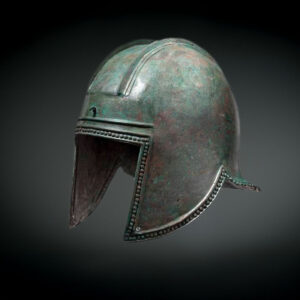
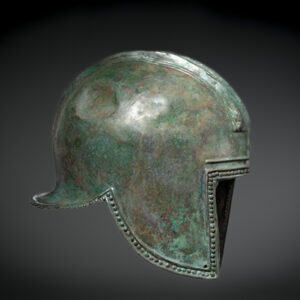
A bronze Illyrian helmet with dark green patina. Tall skull with distinctly raised and stepped ridges, fastening hooks for the attachment of a crest at front and at back. Large face-opening surmounted by two ribs across the brow, long pierced cheek-pieces and flared neck-guard. A row of lenticular decorative pins around the perimeter.
WP_GR_1008
Greek, 600 B.C.E.
H. 23 cm
Some restorations at the crown, the face-opening and the nape
Sold
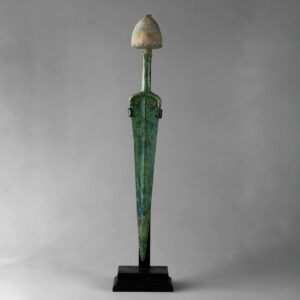
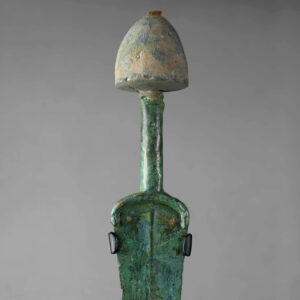
This remarkable bronze weapon is a dagger or short sword from ancient Persia, specifically attributed to the Pre-Achaemenid Empire. During this period, the empire expanded extensively, establishing a formidable and centralized administrative structure that drove the production of luxurious and highly ornate high-status artifacts. Crafted by master smiths, this piece exemplifies the exceptional skill and artistry of Persian metallurgists, renowned for creating prestige items for the military forces.
The weapon features a distinctive strengthening spine, design element that facilitates both easier thrusting. The fine craftsmanship, intricate detailing, and functional design underscore its dual role as both a battlefield implement and a symbol of status and authority.
REFERENCE #
WP_PR_1114
Persian, 1200-800 B.C.E.
L. 41 cm
Fine condition
$5000