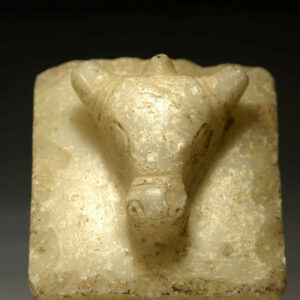
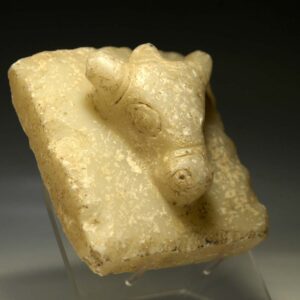
This expertly carved alabaster relief, dating from approximately 300–100 BCE, depicts the commanding head of a bull, exemplifying the high level of artistry achieved by Sabaean sculptors. The broad forehead and prominent, outward-curving horns are rendered with meticulous precision, capturing the animal’s majestic presence. Carved with subtle incisions, the detailed facial features include expressive eyes that convey a sense of calm strength, along with alert ears that subtly indicate the bull’s awareness. The animal’s facial contours are skillfully emphasized, contrasting with the smooth, polished alabaster surface of the rectangular block.
The relief reflects the cultural reverence for bulls within Sabaean society, where such figures symbolized fertility, power, and divine authority. The preservation of fine detail and polished finish underscores its significance as both a religious and artistic object. This piece offers valuable insight into the spiritual and artistic traditions of the Sabaean civilization, standing as a striking testament to their craftsmanship and symbolic imagery.
REFERENCE #
SI_SA_1003
CIVILIZATION
Sabaean, 300 B.C.E. – 100 B.C.E.
SIZE
L. 11cm, W. 10cm
CONDITION
Some natural weathering, Fine condition
PRICE
$4000
PROVENANCE
The Baidun Collection. Purchased from the Jerusalem Local Market, 1980’s.
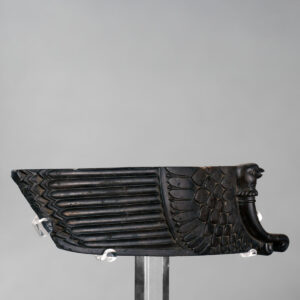
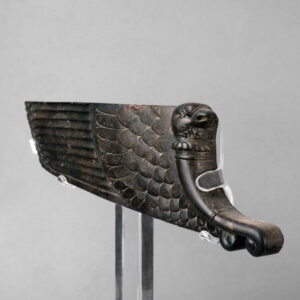
This schist wing, dating from the Achaemenid period circa 500–300 BC and measuring approximately 27.5 centimeters, exemplifies the sophisticated craftsmanship and symbolic motifs of the era. The carved stone fragment depicts a stylized wing, notable for its intricate workmanship and symbolic significance. Central to the design is a finely incised and carefully modeled relief of a phoenix, a mythological bird emblematic of renewal, immortality, and divine protection—an iconic motif in Persian art. The detailed depiction demonstrates the skillful use of incisions and relief carving, highlighting the artisans’ mastery of stonework.
Originally, this fragment would have been part of an elaborate furniture decoration, potentially serving as a decorative panel or ornament within a throne, throne room, or ceremonial setting. The use of schist, a durable and locally sourced stone, reflects both aesthetic preferences and the technical capabilities of Achaemenid artisans. The phoenix motif underscores themes of rebirth and divine authority, aligning with the rich iconography prevalent in Persian cultural and religious symbolism.
Today, this fragment preserves the fine craftsmanship and sophisticated iconography characteristic of Achaemenid decorative arts. Its preserved details provide valuable insights into the visual language and ceremonial ornamentation of the Persian elite, illustrating the grandeur and symbolic complexity that adorned the architecture and surroundings of the ruling class in the ancient empire. REFERENCE #
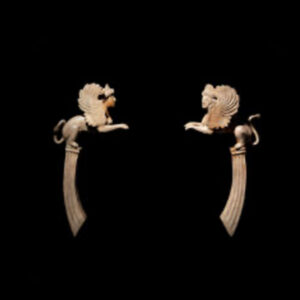
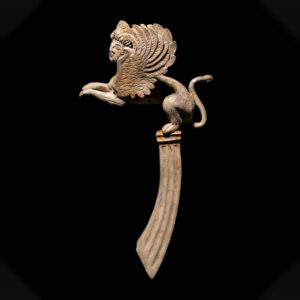
Two handles from a bowl, pot or goblet. The square section is hollow and convex in shape to make holding the vessel easier. Each handle terminates in a sphinx standing on its back legs, with its front paws outstretched. These would be the point where the handles were attached to the upper area of the vessel.
The sphinxes are identical apart from the fact that one head looks to the left and the other to the right, although not quite to the same degree. They are depicted according to the Greek social conception of this mythological creature. Each has the bust of a woman, the body and tail of a lion, great bird wings and a female human head. Each head is depicted wearing a diadem and with the hair swept up and held at the back of the head in a bun. The precision and detail of the working of the faces and wings is notable, giving a sense of movement and realism to the pair. One can appreciate a clear attempt to differentiate between the feathers of the wings: those inserted into the body itself are small and short, rather like scales, while those at the extreme end of the wings are long and narrow, to help the creature take flight.
According to ancient literary sources, the sphinx was a monster with the face and bust of a woman, the claws of a lion, the body of a dog, the tail of a snake and wings of a bird. This demon of divine origin, whose presence excited uncertainty and terror in humans, was also characterized by its pallid appearance, fiery look and venomous mouth. It’s possible that this hybrid had its origin in Egyptian iconography, where it was represented with a feline body and human face, possibly connected to the divine power of the pharaoh.
The sculptural prototype of Greek sphinxes appears around the 7th century BCE in terracotta and was usually found decorating large receptacles. A century later they appeared in marble crowning seated ex-votos on a column. The monstrous, aggressive nature of the hybrid was channelled into funerary art, serving as an apotropaic symbol to keep away malevolent forces. It was usual, therefore, to find this iconography in metopes and hollow acroteria in Greek necropoleis of the 6th century BCE, usually with the animal in profile and turning its head toward the public in an attitude of defiance.
Reference #
SI_GR_1034
Civilization Greek,
5th – 4th century B.C.E.
Size
H. 14 cm
Condition
Intact, Fine
Price
P.O.R.
Provenance
Private collection, Great Britain. Acquired before 1975
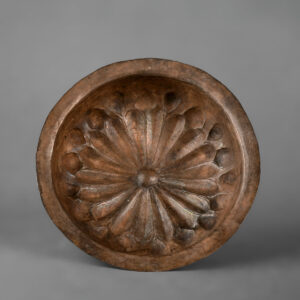
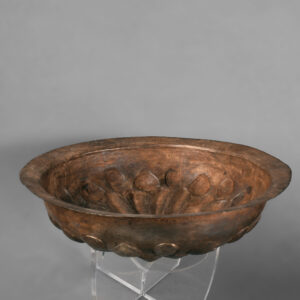
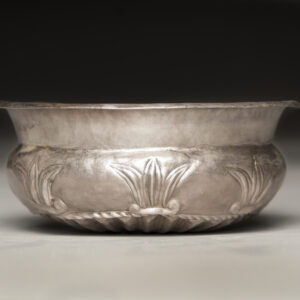
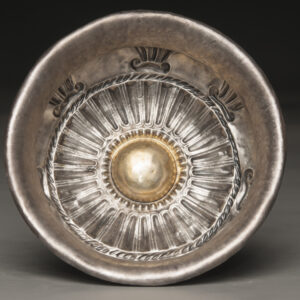
From the Achaemenid period, particularly between circa 800-500 BC, numerous luxury vessels and ritual objects such as wine bowls are depicted in reliefs and artifacts recovered from excavations. These portrayals suggest that artisans began by shaping the vessel from a solid mass of silver, using a combination of chasing, hammering, and possibly casting techniques. The process would have involved roughing out the basic form, which was likely then refined through meticulous hammering and filing to achieve a symmetrical and balanced shape.
The large wine bowl in question exhibits a broad, rounded profile with a wide opening, designed to facilitate the pouring and serving of wine during banquets or ceremonial occasions. Its surface is decorated with intricate engraved motifs, which may include geometric patterns, stylized florals, or mythological symbols, indicative of the sophisticated ornamentation favored by Achaemenid artisans. These engravings would have been executed with precise metal tools, emphasizing symmetry and aesthetic harmony.
This vessel was crafted from silver, a metal highly prized in Persian courtly culture for its brilliance and symbolic association with purity and wealth. The silvery sheen and fine workmanship would have signified the high status of its owner, most likely a noble or a member of the royal court. The rim of the bowl is reinforced and slightly everted, suggesting a functional consideration to prevent damage and facilitate handling.
The craftsmanship and fine detailing of this bowl reflect a high level of technological skill, characteristic of the Achaemenid metallurgists. Such a substantial vessel was probably used in prestigious contexts, including royal banquets or religious rituals, serving both a utilitarian and decorative purpose.
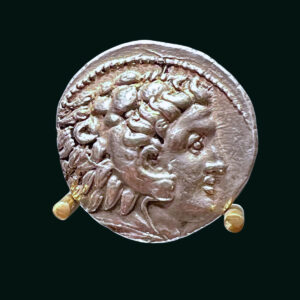
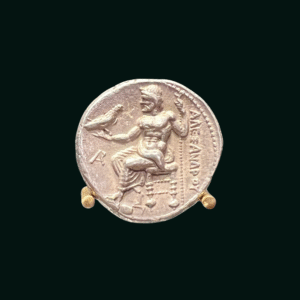
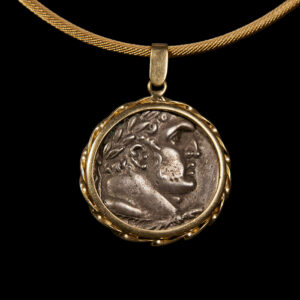
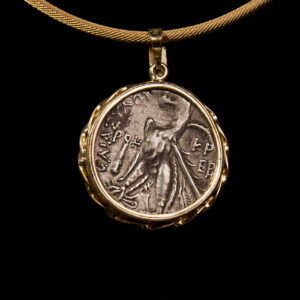
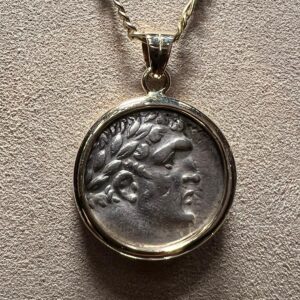
Suspended elegantly from an 18K gold necklace, this striking silver shekel coin features the visage of a distinguished figure crowned with an olive leaf, symbolizing peace and prosperity from ancient Tyre, a historic city in southern Lebanon. On the reverse side, an intricately detailed eagle, accompanied by ancient inscriptions, displays its sharp talons and delicate plumage, showcasing skilled craftsmanship and artistic finesse. The coin’s surface is polished to a brilliant finish, accentuating the bold, embossed designs that grace both sides.
Dating from 126 B.C.E. to 66 C.E., this pendant hails from a period when Tyre had reasserted its independence, even as neighboring provinces fell under Roman dominion. Its preservation is exquisite, retaining a beauty that transcends time, making it a wearable artifact that maintains its elegance and historical significance to this day.
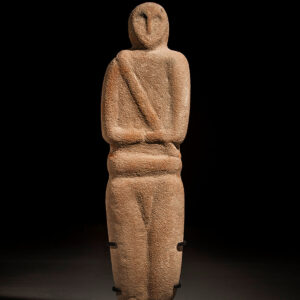
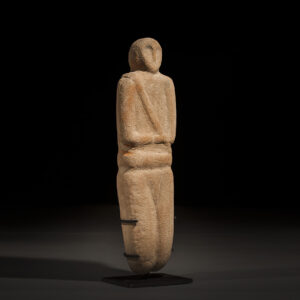
Pink statuette of Sabaean idol with stylized representation for the eyes and nose set on an oval face. Rectangular body is marked by diagonal sash running along torso. Arms are folded at right angles from the shoulders, set above belted waist and smooth legs.
REFERENCE #
SI_SA_1015
CIVILIZATION
Sabaean, 3000 B.C.E. – 2000 B.C.E.
SIZE
H. 39 cm
CONDITION
Fine condition
PRICE
Sold
PROVENANCE
Former Swiss private collection, acquired ca. 1980.
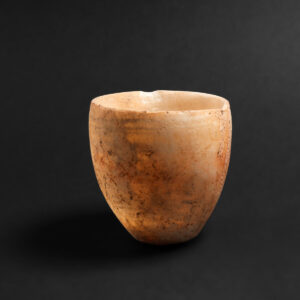
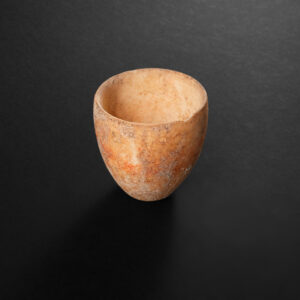
Alabaster cup from the Israelite kingdom period, dating to the time of King David, circa 1200–800 BC. This vessel has been carefully fashioned from fine, translucent alabaster, which remains in perfect condition, emphasizing the skill of its ancient maker. The cup measures approximately 6 cm in height and features a simple, elegant form with a rounded bowl and a narrow, slightly flared lip.
The use of alabaster, a soft stone prized for its translucence and smooth finish, suggests the object was valued and possibly used in ceremonial contexts. Both the interior and exterior surfaces have been polished to a glossy, refined texture, with no visible signs of damage or deterioration. Its translucent quality would have enhanced its visual appeal when held in light, creating a delicate play of shadow and glow.
Discovered in the Judean hills, this cup is linked to the material culture of early Israelite society during the Iron Age. Its form and material imply it may have played a role in rituals or religious offerings typical of the period, serving both practical and symbolic functions within domestic or religious settings. Objects of this nature are rare, providing valuable insight into the craftsmanship and spiritual practices of the ancient Israelites during the era of King David.
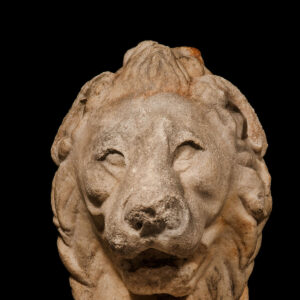
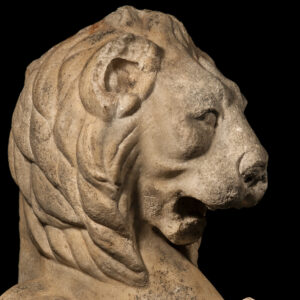
Table leg in the form of an upright lion. It’s back forms an S-shaped curve. The Jaws are wide open, revealing the canines and the tongue. The hair of the mane is arranged in regular tufts. Originally, acanthus leaves adorned it’s chest and sides. The reverse from the shoulders blades upward is flattened, forming a rectangular support. A circular drill hole between the shoulders to insert a horizontal bar supporting the table. On the top of the head, part of the pilaster on which the table top rested is missing. The lack of incised iris and pupil as well as the simple execution of the curls without drilling are indicative of an early date Drill holes on both sides of the lion’s chest where the acanthus emerge.
Reference: For the construction of a Roman table with trapezophoroi in the form of lions, cf. a marble table in the National Museum, Naples, in Richter – 1966, pl 577.
cf. two trapezophori in the Musei Vaticani in Rome, Arachne – 53732 and the Museum of Ancient Art Stockholm, Arachne – 130164
REFERENCE #
SI_RM_1082
CIVILIZATION
Roman, 100 C.E.
SIZE
H. 50 cm
CONDITION
Nose slightly worn, lower jaw and ears fragmentary. The rolled up leaf on the right largely preserved. The leaves on the chest and the left side missing. Preserved from the hips upward. Reassembled from two parts. Right hip slightly worn. Transition to foot preserved