
Showing 161–176 of 227 results
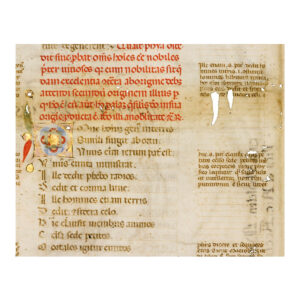
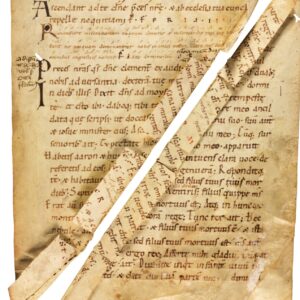
An Illuminated Manuscript On Vellum [Italy (Perhaps Florence), Fourteenth Century] a leaf, 315mm. by 230mm., 22 lines in a high grade angular bookhand, initials formed from ornamental penstrokes and separated from beginning of lines of verse, full border of the continuous gloss of the early fourteenth-century English author William Wheatley (see below) in smaller hand, rubrics and paragraph marks in red, two illuminated initials on blue or pink grounds with scrolling coloured acanthus leaves and large teardrop-like bezants, recovered from the binding of a series of Florentine historical works, partly by the Florentine humanist Matteo Palmieri, with sixteenth-century inscriptions identifying those works on its blank back, with scuffs, rubbing to initials, folds and small holes in places (with minor affect to 3 of glosses), overall in fair and presentable condition.
MS_BZ_1010
Byzantine, Medieval , 1400 C.E.
H. 31.5 cm x W. 23 cm
Overall in fair and presentable condition
Price available upon request
Baidun Collection, acquired at Sotheby’s sale December 2013
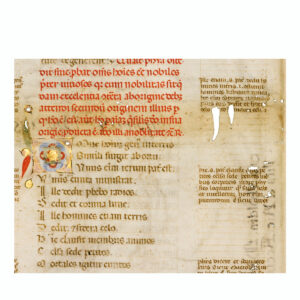
An Illuminated Manuscript On Vellum [Italy (Perhaps Florence), Fourteenth Century] a leaf, 315mm. by 230mm., 22 lines in a high grade angular bookhand, initials formed from ornamental penstrokes and separated from beginning of lines of verse, full border of the continuous gloss of the early fourteenth-century English author William Wheatley (see below) in smaller hand, rubrics and paragraph marks in red, two illuminated initials on blue or pink grounds with scrolling coloured acanthus leaves and large teardrop-like bezants, recovered from the binding of a series of Florentine historical works, partly by the Florentine humanist Matteo Palmieri, with sixteenth-century inscriptions identifying those works on its blank back, with scuffs, rubbing to initials, folds and small holes in places (with minor affect to 3 of glosses), overall in fair and presentable condition.
MS_BZ_1010
Byzantine, Medieval , 1400 C.E.
H. 31.5 cm x W. 23 cm
Overall in fair and presentable condition
Price available upon request
Baidun Collection, acquired at Sotheby’s sale December 2013
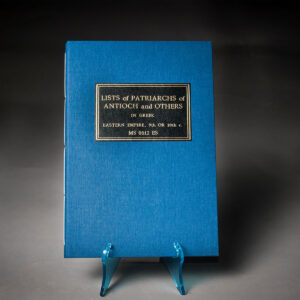
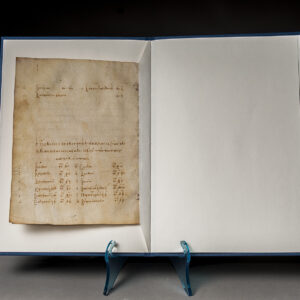
ANTIOCH preceded by the end of a list of the PATRIARCHS OF ALEXANDRIA and followed by a list of the canonical books of the Bible, in Greek, bifolium from a MANUSCRIPT ON VELLUM [Greece?, mid- to late- 10th century] 196 x 153mm. 17 lines ruled in blind written in brown ink in a fine and formal Greek minuscule, headings in uncials, modern foliation 46-47. In a modern cloth binding.
Provenance: (a) the conservative character of the writing is very marked, as is customary with the codices vetustissimi and vetusti of the 9th – 13th centuries. The minuscule slants slightly to the right, the breathings are square and the accents precise, and there is no enlargement of certain letters and intermixing with uncial forms as tends to happen in later centuries, all indicating a possible dating to the 10th century. The list of the Patriarchs of Alexandria ends with Peter IV (642-651), while the list of the Patriarchs of Antioch ends with Anastasius II (599-610), and the scribe has left space for 9 and 10 more names respectively, which would suggest he was copying the text from an earlier manuscript and writing a few centuries after the names listed. (b) ANDRe ROORYCK (1923-2010), sold at Sotheby’s, 5 July 2005, lot 7. An interesting and early bifolium from what would probably have been a compendium of useful religious dates, events, and lists relating to the Greek Orthodox Church. George I (621-630), Cyrus (631-641) and Peter IV (642-651) close the list of Patriarchs of Alexandria (following the Greek Orthodox as opposed to the Coptic Orthodox tradition, after the schism of 536), while the Patriarchs of Antioch run from Peter the Apostle (c.37 – 53) to Anastasius II (599-610).
MS_BZ_1003
Byzantine
L. 19.6 cm, W. 15.3 cm
Fine Condition
Price available upon request
Baidun Collection
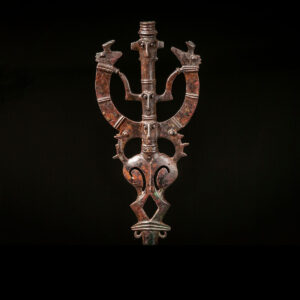
The area of Luristan, in western Iran, was home to a rich tradition of bronze-working in the early part of the first millennium B.C.E., producing an array of finely-crafted and distinctive objects unique to the region. This intricately-cast standard finial was originally intended to sit atop a ceremonial staff to be carried in a procession; the bell-shaped socket at the lower end was designed to enable attachment.
The finial represents, in highly stylized form, the ‘Master of Animals’, a deity considered ancient even at the time this piece was made, and who probably had origins in Stone Age hunters’ cults. The figure has a cylindrical body, with three faces along its length. With a pair of slender arms, it fends off two serpent-like creatures. The lowest part of the figure has an exaggerated, oval-shaped torso and stands on a pair of short, bowed legs.
REFERENCE #
SI_PR_1016
Persian, 1st millennium B.C.E.
H. 35cm
Fine Condition
SOLD
Private UK collection, late 1970’s.
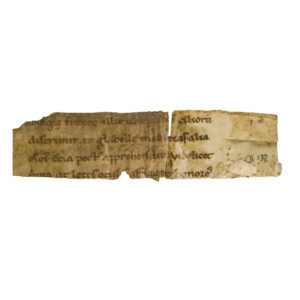
Manuscript Of The Text, In Latin, On Vellum [Germany, Early Twelfth Century] 9 fragments: 2 strips approximately 85mm. by 20mm. and 7 rectangular pieces, each approximately 42mm. by 25mm., one strip and one rectangle cut from same section of text allowing the reconstruction of 4 lines of a single column (35mm. wide): II:132-33, “Philologie frontem illuc ubi … oculis afflaret honores” and on back “sunt inclytam majestatem … hac regali lectica in”, and showing that the original volume was single-column and pocket-sized (with only approximately 21 lines missing between the lines here), other fragments with text from II:109, 110, 113, 130, and another part of 132, text in a fine late Carolingian hand with a pronounced ct-ligature, recovered from a binding of an sixteenth-century printed book from Leipzig, and hence with stains, cockling and splits.
MS_BZ_1009
Byzantine, Medieval , 1200 C.E.
W. 8.5 cm, H. 2 cm
Fine condition
Price available upon request
Baidun Collection, acquired at Sotheby’s sale December 2013
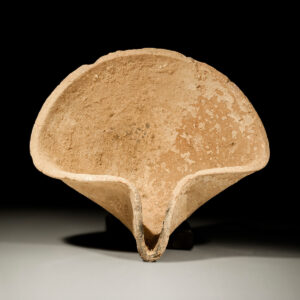
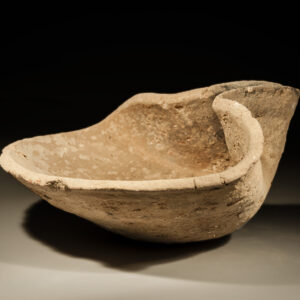
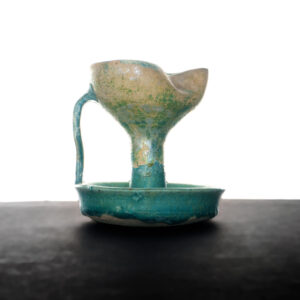
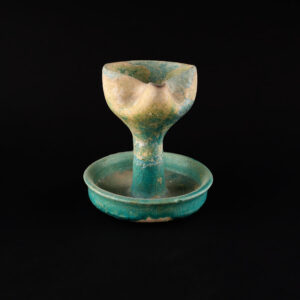
A massive Canaanite oil lamp. Among the earliest of clay lamps is the saucer lamp. In antiquity, these developed after a saucer or shallow bowl had its edges folded up to form a spout. A great variety of these lamps exists. These lamps would have been the style in use in the Old Testament especially in king David’s time. Every Canaan lamp is hand folded, so minor variation will occur, but all have this general look.
KB_PT_9985
Late Bronze Age IIB, 1300 B.C.E. – 1100 B.C.E.
W. 24 cm
Fine condition
Price available upon request
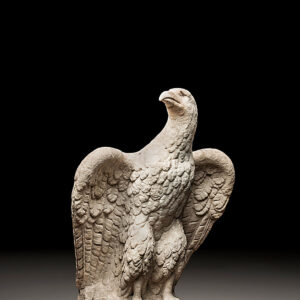
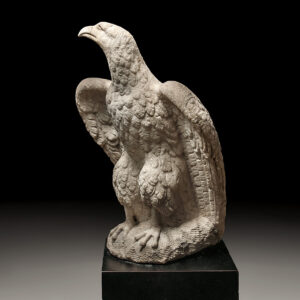
A large and imposing majestic Roman marble eagle, straight gaze, with its wings spread and legs bent preparing to take flight
SI_RM_1100
Roman, 100 C.E. – 200 C.E.
H. 64 cm
The beak is restored, otherwise in perfect condition.
Price available upon request
French Private Collection purchased in Paris in the 1970’s.
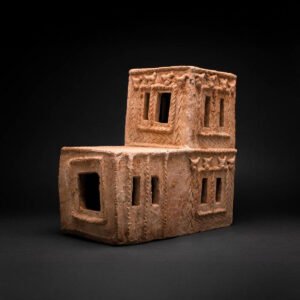
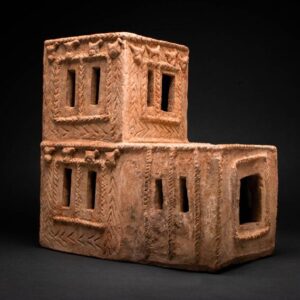
An incredible Mesopotamian architectural terracotta model designed as an ancient Mesopotamian house with two stories. Little and narrow windows were used to preserve the internal rooms from the hot rays of the sun. The second floor with the same characteristics.
For similar see: MET Museum Accession Number: 68.155.
This piece is accompanied by a historical report from Alessandro Neri, an international Cultural Heritage expert based in Florence, Italy.
#CR_MS_1017
Babylonian-Mesopotamian, 1600 B.C.E. – 1200 B.C.E.
43cm x 39cm
Fine condition
P.O.R
Private royal collection, 1990s
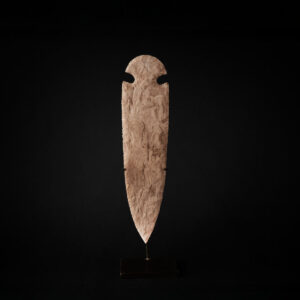
This exceptional Neolithic flint dagger exemplifies the sophisticated stone tool craftsmanship of early Egypt or the broader Levantine region, dating from approximately 6000 to 3150 BCE. The elongated, pointed form showcases skillful knapping and pressure flaking techniques, with a smooth surface and subtle signs of use wear, indicating its original function as a utilitarian weapon or ceremonial object. Made from high-quality flint, its natural color ranges from light beige to pale brown, with a finely worked edge that demonstrates the precision and artistry of Neolithic artisans. This piece retains excellent preservation and exhibits the characteristic features of early prehistoric tools—both functional and symbolic. Its history and craftsmanship make it a noteworthy acquisition for collectors, museums, or institutions seeking authentic artifacts from one of the most significant periods in human history. An opportunity to acquire a unique and visually striking example of ancient stone technology with profound cultural and archaeological significance.
ST-CL-1003
Egyptian, 4000 B.C.E.
H 25 cm
fine condition.
$8500
fragments: (i) 7 sections of leaves from a Missal, 5 triangular in shape (approximately 185mm. by 260mm.) and cut diagonally from the parent leaves, 2 further smaller pieces used as gathering supports (230mm. by 40mm. and 60mm. by 11mm.), the larger showing that the original codex was single column, 24 lines in light brown ink in a fine late Carolingian minuscule leaning to the right, with pronounced ct- and st-ligatures, lines of music in smaller script with simple neumes, rubrics (in ornamental capitals in style of ninth and tenth century) and simple red initials (some with tiny baubles at the head and foot), a few additions in later medieval hands including the apparent folio numbers “xxxi” and “xxxij” in late thirteenth-century script at the head of two leaves, Germany, second half of the eleventh century or c.1100; (ii) two long strips cut horizontally from a Lectionary leaf, each approximately 65mm. by 283mm., with remains of two columns of 7 lines of large and elegant early gothic script, rubrics and 17 one-line initials in red, Germany, mid-twelfth century; all recovered from bindings of early sixteenth-century books printed in Augsburg, and with some folds, scuffs, small stains and red ink oxidised to silver in places, but overall in good condition.
MS_BZ_1012
Byzantine, Medieval , 1100 C.E. – 1200 C.E.
Overall in good condition
Price available upon request
Baidun Collection, acquired at Sotheby’s sale December 2013