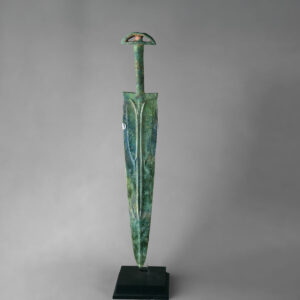
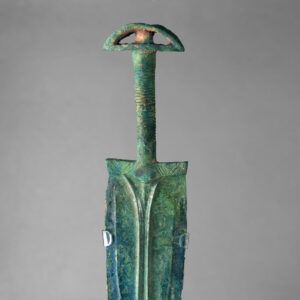
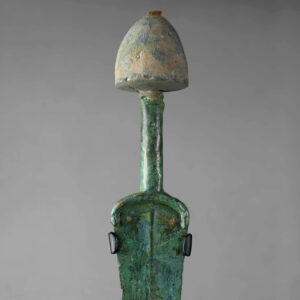
This Persian sword is a remarkable example of the technology and design that went into crafting an ancient piece of weaponry. The dark hue of this sword lends it an austere weight, while the thick ribs and large crescent of the hilt are an indication of the strength required to wield such a heavy object. The broad blade seems to be made not for bludgeoning as much as cutting, with the raised ridge that runs along its length adding force to its blows.
This is a piece that makes a forceful statement in any collection, especially for collectors looking for a simpler alternative to the overwrought designs of later civilizations. The ancient Persians were known for their battle prowess, and this weapon is a fine example as to the tools ancient warriors had at their disposal. This sword has been wonderfully restored and displays a brilliant luster that still gleams along its long blade.
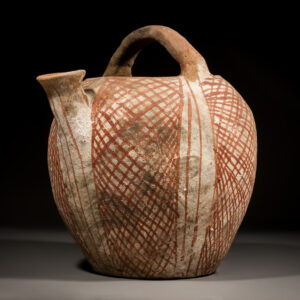
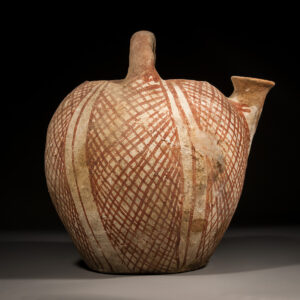
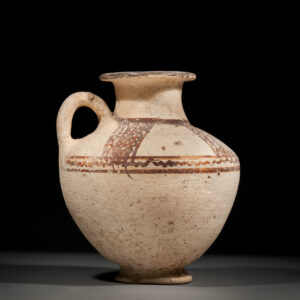
This round Canaanite jug is covered in a series of frenzied red lines that seem to buzz through time, the intersecting spaces broken up by a clearing of just three vertical marks at four spots along the jug’s body. The jug’s basket handle arches above the mouth’s large opening, while a short spout arises from the front, flaring slightly for an easy pour.
The little we know of ancient Canaan comes from the rich archeological record they left behind. This piece is an excellent example of the simple rites of ancient history, when the storage and transportation of water meant the difference between life and death in the arid realm of Canaan.
REFERENCE #
KB_PT_9993
CIVILIZATION
Early Bronze Age I, 3500 B.C.E. – 3000 B.C.E.
SIZE
H. 21.5 cm
CONDITION
Fine condition
PRICE
Price available upon request[/vc_column_text][/vc_column][/vc_row]
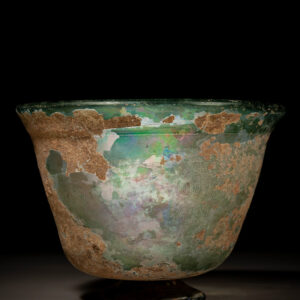
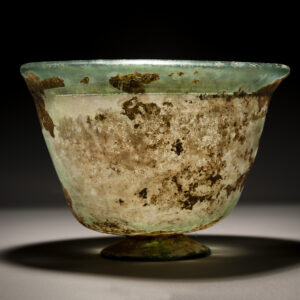
This large glass bowl comes from Samaria, the capital of ancient Israel in the 9th century B.C.E. and 8th century B.C.E.. Located just west of the Jordan River, Samaria was a vibrant city for many centuries; its history is recounted in the Old Testament book of Kings. It experienced many invasions over the intervening centuries located as it was in the strategic mountains of Judea.
By the time this beautiful aquamarine bowl was blown, Samaria had come under Roman rule, a period of great innovation as new Roman technology filtered throughout the region.
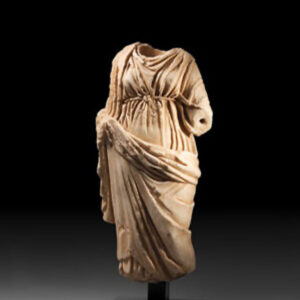
This female body is an interesting example of a Roman sculptor playing with the form of fabric as it drapes in thick folds over this woman’s strong figure. The head of this sculpture has been lost to time, yet we are able to understand that the woman we look upon was of a high standing due to her lush clothing and upright stance.
The skill of the sculptor who carved this piece is seen in the movement of the woman’s himation, or draped robe, as it both cinches below her bosom and sweeps across her waist as it is held back by her right hand. The result is a beautiful statement that highlights her full figure even under the weight of her thick robe.
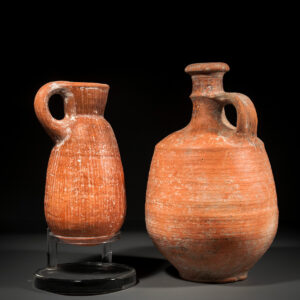
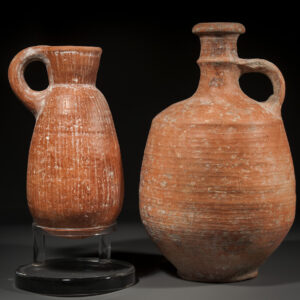
These ancient Israeli red slip ceramic vessels were found together in the mountains west of the Jordan River, an area known both then and now as Samaria. The smaller vessel with the large mouth is a wine decanter while the larger jug was made to hold large amount of cooking oil for generous use in old Israeli cuisine.
There is something homey, even quirky, about the thick handles that loop at the top of each vessel. The warm red colors of their grooved exterior transports us to a dimly lit kitchen filled with the smells of traditional meals still savored today across the Levant.
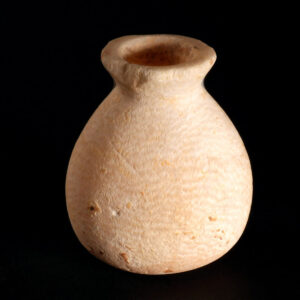
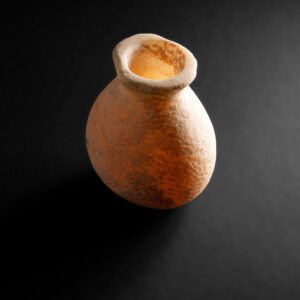
This elegant translucent alabaster perfume flask exemplifies the artistry and craftsmanship of Israelite artisans of the Iron Age, First Temple Period. Crafted from fine, translucent alabaster, the flask presents an ovoid body with a narrow, well‑formed neck and a gently everted mouth, its surface smoothly polished to reveal the subtle veining and soft luminosity of the stone.
The most striking feature of the flask is its delicate, refined profile and the way the translucent material captures and diffuses light, lending a quiet, luminous quality to the form. The workmanship demonstrates mastery of stone‑carving techniques, with a precise, symmetrical shape and a satin finish that highlights the inherent beauty of the alabaster. Any surviving tool marks are minimal and secondary to the overall polished presentation.
This object likely served both personal and ritual functions, used to contain precious oils or perfumes for daily grooming, anointing, or sacred ceremonies. Its refined material and careful execution reflect the value placed on aromatic substances in Israelite society and suggest ownership by an individual of some standing. Found in Jerusalem. Iron Age, First Temple Period (circa 10th–6th centuries BCE).
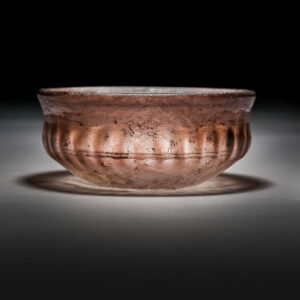
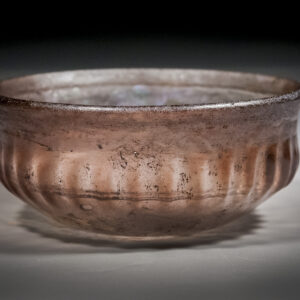
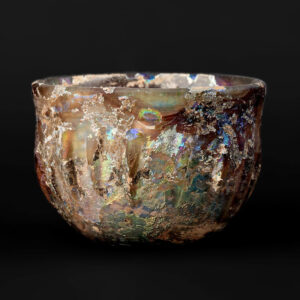
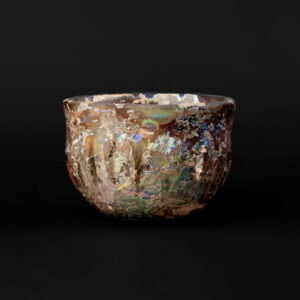
This elegant ribbed glass bowl exemplifies the artistry and technical skill of early Roman glassmakers. Crafted from a rare aubergine-hued soda‑lime glass, the bowl presents a gently flared rim and a rounded, harmonious profile with a lustrous, weathered surface that reveals a rich, multicolored iridescence developed through centuries of natural burial conditions. Measuring approximately [dimensions available on request], it is a compact yet striking domestic vessel.
The most striking feature of the bowl is its pronounced vertical ribbing, which encircles the body and lends a rhythmic, tactile quality to the form. Two finely incised concentric lines around the midsection provide an elegant counterpoint to the ribs, demonstrating careful finishing by hand. The surface iridescence, a product of long-term chemical interaction rather than modern treatment, enhances the deep aubergine tone and accentuates the delicate interplay of light across the exterior.
The workmanship shows mastery of early glass techniques—likely mold‑forming for the ribbed body with subsequent hand incision—resulting in crisp, well-executed details and a smoothly rendered rim. The uncommon deep purple color and strong iridescent sheen mark this piece as a particularly refined example of provincial Roman glass production.
Likely used for both every day and display purposes, this bowl would have served as a functional domestic vessel and possibly as a valued item within a household’s tableware. Its durable glass, sophisticated surface effects, and rare coloration reflect both the aesthetic sensibilities and material culture of the early Imperial period. Found in Sabaste; early Roman, ca. 1st century AD.REFERENCE #
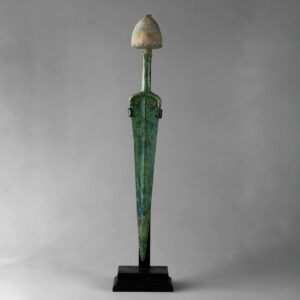
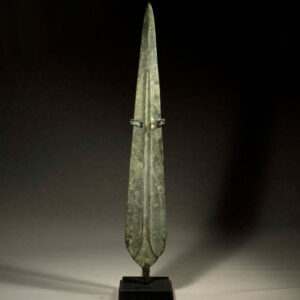
This remarkable bronze weapon is a dagger or short sword from ancient Persia, specifically attributed to the Pre-Achaemenid Empire. During this period, the empire expanded extensively, establishing a formidable and centralized administrative structure that drove the production of luxurious and highly ornate high-status artifacts. Crafted by master smiths, this piece exemplifies the exceptional skill and artistry of Persian metallurgists, renowned for creating prestige items for the military forces.
The weapon features a distinctive strengthening spine, design element that facilitates both easier thrusting. The fine craftsmanship, intricate detailing, and functional design underscore its dual role as both a battlefield implement and a symbol of status and authority.
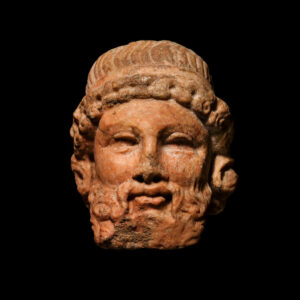
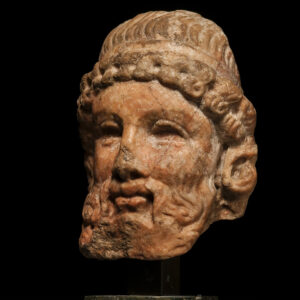
Dionysus, the god of wine, is portrayed frontal, looking forward. His hair is tied with a thick fillet with two rows of locks across his forehead. He has a long moustache and a square beard composed of curving locks. The face with arched eyebrows, large eyes sockets, pronounced cheeks, straight nose and a smiling mouth with fleshy lips. The Archaistic head is inspired by the Greek Archaic style, frontal and frozen, with stylized features and smiling mouth. It has a strong and majestic expression.
Reference: Cf. Anderson M. L., Nista L. (Eds.), Radiance in Stone. Sculptures in Colored Marble from the Museo Nazionale Romano, De Luca Edizioni d’Arte, Rome, 1989, p.72, fig. 9.
REFERENCE #
SI_RM_1081
CIVILIZATION
Roman, 100 C.E. – 200 C.E.
SIZE
H. 10.2 cm
CONDITION
Missing inlayed eyes and lower part of beard, chipped at the back of the upper part.
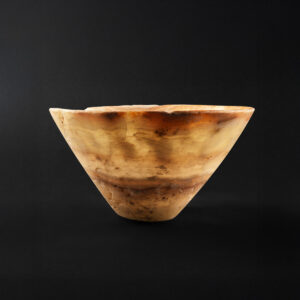
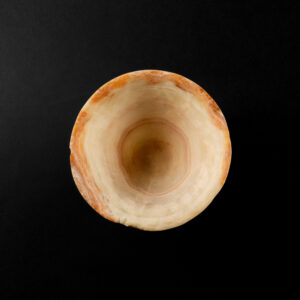
This elegant alabaster bowl exemplifies the artistry and craftsmanship of ancient Mesopotamian artisans. Crafted from fine, translucent alabaster, the bowl features a rounded, symmetrical form with a smooth, polished surface that showcases the natural beauty of the stone. Measuring approximately 12 cm in diameter and 7 cm in height, it is a compact yet finely detailed vessel.
The most striking feature of the bowl is its decorative banding, which encircles its exterior. These bands are composed of carved lines and geometric motifs, adding a sense of rhythm and harmony to the piece. The craftsmanship demonstrates a mastery of stone carving techniques, with precise incisions and smooth finishes that highlight the skilled artisanship of the period.
This vessel likely served both functional and ceremonial purposes, possibly used in ritual offerings or as a display piece in a noble or religious setting. Its durable alabaster material and sophisticated decoration reflect the high status of its owner and the cultural importance of craftsmanship in ancient Mesopotamian society.
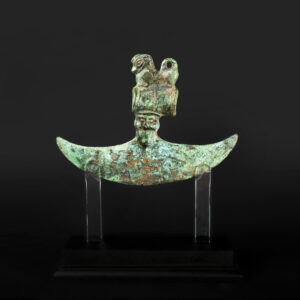
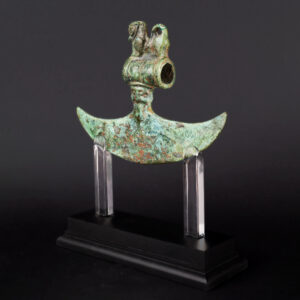
This remarkable ancient Elamite crescent axe features a distinctively curved, finely detailed blade that appears to emerge from the mouth of a bearded man, creating a powerful and evocative visual narrative. The figure of the bearded man, likely representing a deity or a legendary figure, is elegantly cast or carved, with a well-defined facial expression and beard, symbolizing strength or authority. The blade itself, attached seamlessly to the mouth, displays polished surfaces and sharp edges, indicative of high-quality craftsmanship from the Achaemenid periods. The axe’s shaft extends from the figure and is adorned with an intricate relief of a horse, symbolizing power, nobility, or martial prowess. The combination of the mythic figure, the dynamic crescent blade, and the equine motif reflects the sophisticated iconography and artistry characteristic of ancient Persia’s ceremonial weaponry. Crafted from bronze, this artifact exemplifies the masterful metallurgical techniques and symbolic artistry of the period.
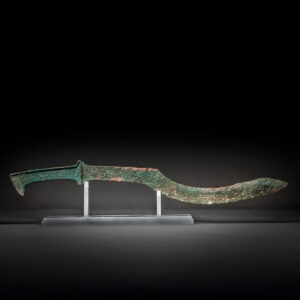
Canaanite bronze sickle sword. The sword blade curves for two thirds of its length but is straight at its lower end. The handle has raised edges and ends in a “comma” to ensure the grip.
Reference: Y. Yadin, “The Art of Warfare in Biblical Lands” (London, 1963), p. 207
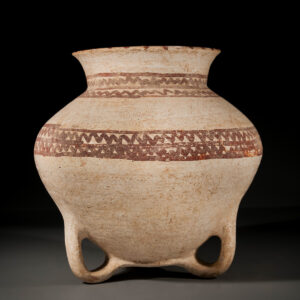
Canaanite artisans were prolific, and their pottery came in an array of fantastic shapes, colors and sizes. This white ware jug is no exception, its ghostly exterior marked with dark brown lines that zigzag across the top half of its bulbous body. A wide base supports the body itself, while the short neck above ends at a large flat mouth.
A handle rises abruptly from the body and connects at the neck’s base, making a sturdy loop for the well-worn hands of an ancient Canaanite
The distinctive base of this Canaanite jar is made of three looped legs that prop the body up in tripod-like fashion. The design is more aesthetically pleasing than innovative, yet the rest of the jug was carefully made to exacting standards that allowed for the flawless curves of its white ceramic exterior.
The upper half of the jug is decorated with chocolate brown bands that alternate between straight lines and tightly wound zigzags. The overall effect is an ancient artifact imbued with a timeless sense of artistry and originality.REFERENCE #
This magnificent leaf-shaped spear head was made by the Canaanites in the mid to late 2nd millennium B.C.E.. It displays excellent engineering and structural elements, particularly in terms of the bilateral central longitudinal fortified rib, widening to a broad tabular section at the butt end which was used to haft the spear head onto the shaft. The body tapers in both frontal and lateral profiles, making it a lethally effective weapon. The size also counts against anything other than a martial function, while the status associated with both warriors and large quantities of bronze (an expensive commodity at the time) marks it out as an important artifact.
Where found in context, such pieces are typically associated with prestige graves, and it would appear that they were probably as important in terms of appearance (i.e. conspicuous governance and threat) as in their evident lethality in combat. Indeed, at almost half a metre long, this piece would have been a very imposing item at the time of its manufacture, as indeed it is now. There is considerable evidence for diversity of manufacture across the Canaanite area, perhaps reflecting something of the modular yet martial nature of the time.
The Canaanites were one of the ‘tribal’ groups of what was to become Israel, Palestine and Jordan, who had their cultural roots in the Neolithic revolution when agriculture revolutionised Near East economics. By the Bronze Age the stability of the area and their position between great trading powers – notably Egypt and Mesopotamia – made them prosperous and culturally diverse, and was a high point for artistic creation. The culture contracted with economic issues suffered by Egypt and the Mesopotamians, and went through a collapse at the end of the Bronze Age due to a combination of ‘Sea People’ invasions, environmental meltdown and internal troubles in Egypt leading to loss of infrastructure throughout the Near East. Their resurgence of power in the Iron Age was matched by that of the Ammonites and Moabites, among others, and the region eventually came under control of the Neo-Assyrians by the mid 8th century B.C.E.. Such symbols of conspicuous consumption and authority are rare, especially in this excellent state of preservation and exquisite patination. This is an attractive and elegant piece of ancient art.