Description
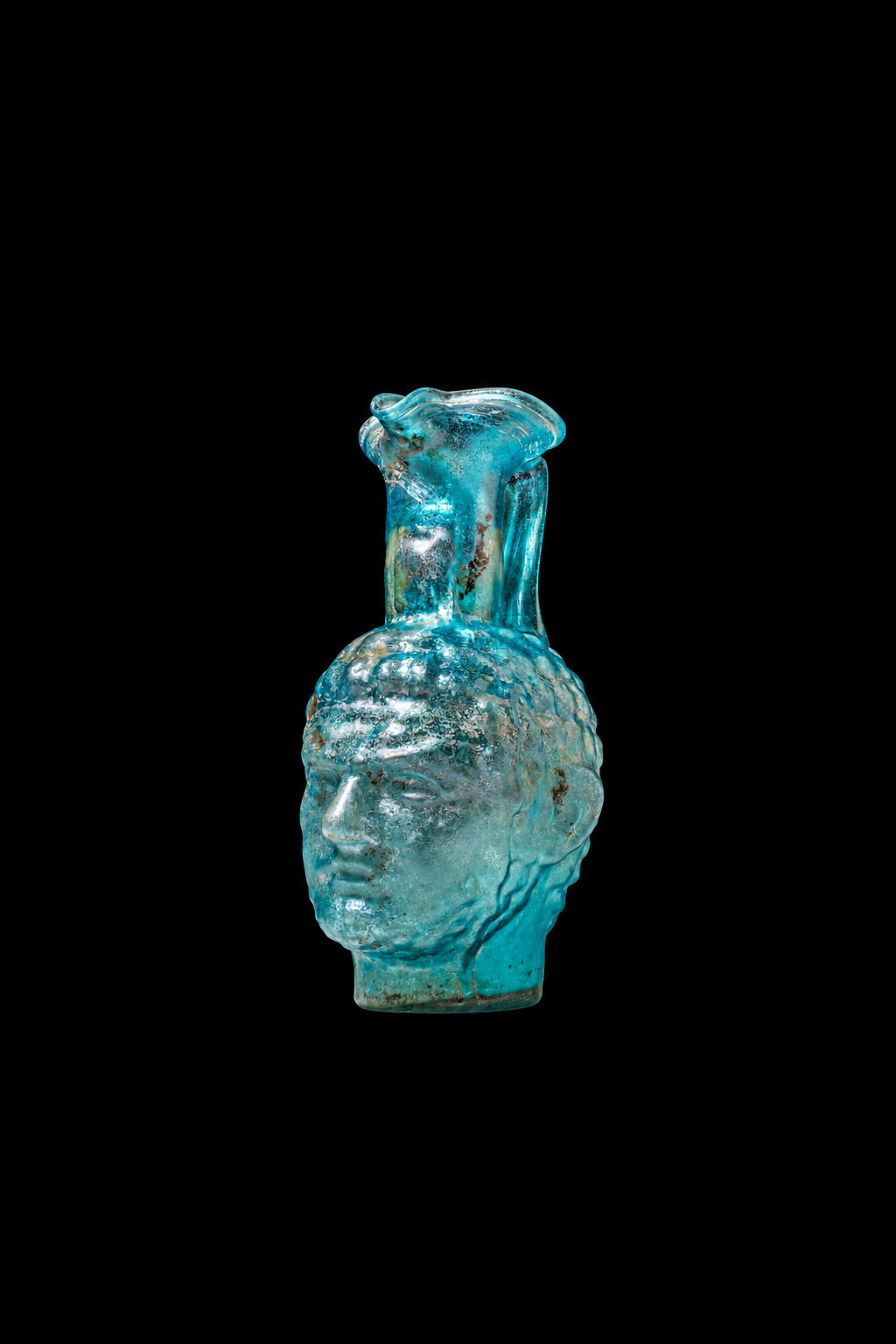
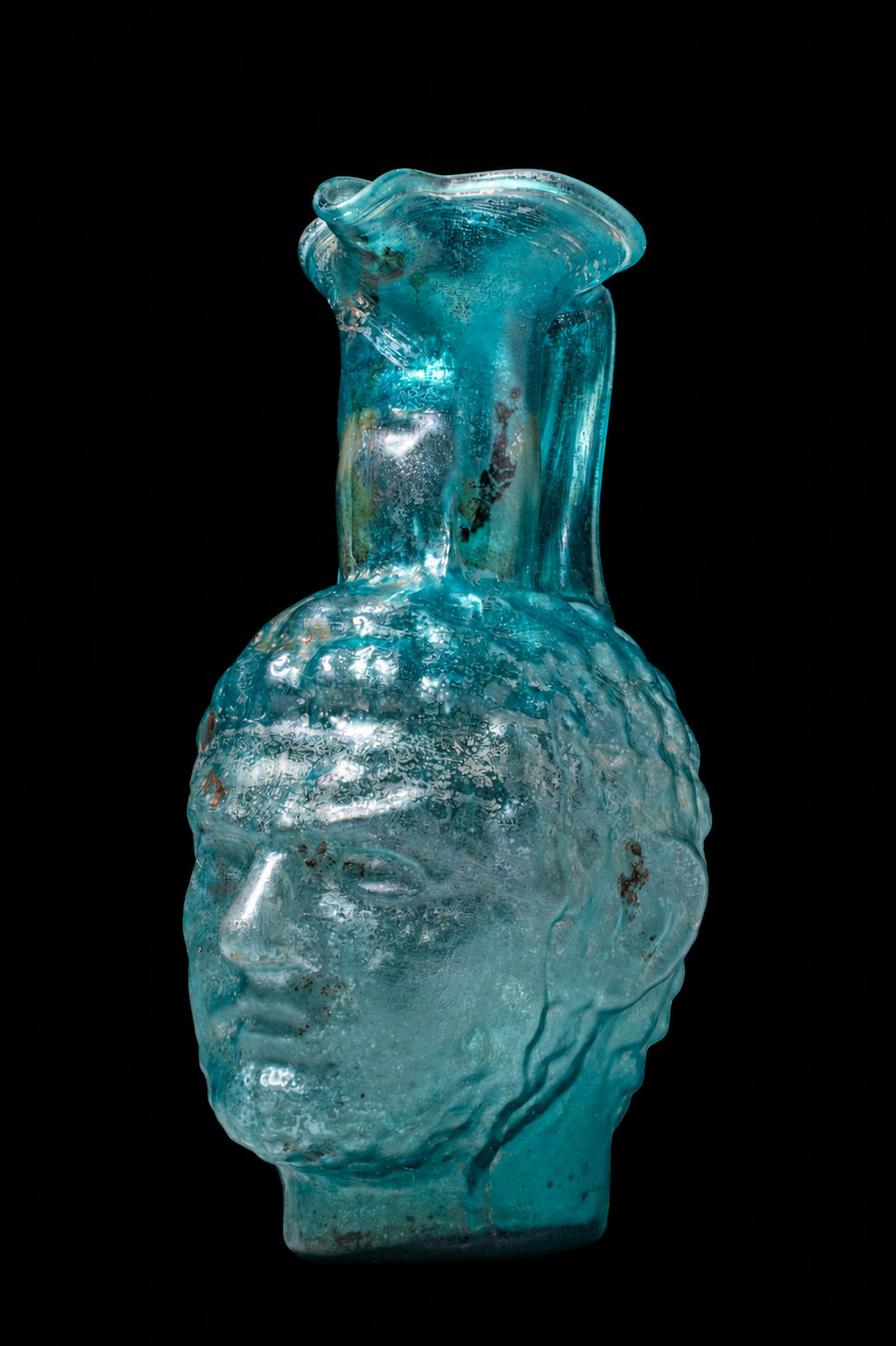
An exceptional and unusually large Roman mold-blown glass jug, standing an impressive 24 cm high and fashioned in the form of a male portrait head. Distinguished by its substantial scale, sculptural character, and remarkable survival, the vessel is a particularly impressive example of Roman figural glassmaking.
The body of the jug is conceived entirely as a human head, boldly modeled with a broad forehead, almond-shaped eyes, prominent straight nose, closed lips, rounded chin, and carefully articulated ears. Of particular distinction is the elaborate coiffure, with pronounced locks arranged across the forehead and longer, undulating strands framing the temples, ears, and back of the head.
The dignified and idealized character of the portrait recalls the visual language of Roman imperial portraiture. Although the physiognomy and distinctive hairstyle may evoke representations of Roman emperors or members of the imperial elite, the absence of a definitive identifying attribute prevents a secure association with a particular historical individual. The figure is therefore best understood as an imperial or elite male portrait type.
Rising from the crown is a tall cylindrical neck terminating in an elegantly formed trefoil pouring mouth, while a separately applied handle extends from the rear of the vessel to the rim. The successful combination of a large mold-blown sculptural body with a tall neck, manipulated trefoil mouth, and applied handle demonstrates the considerable technical skill of the Roman glassworker.
The vessel’s exceptional 24 cm height is one of its most remarkable characteristics. Anthropomorphic Roman glass vessels were generally produced on a more modest scale, and the manufacture of a complex figural jug of these substantial proportions would have presented considerable technical challenges. The molten glass had to be expanded successfully into the detailed mold while retaining sufficient heat and structural integrity for the subsequent formation of the neck, mouth, and handle.
Even more noteworthy is its remarkable survival. Ancient glass is inherently fragile, and large, elaborately formed vessels are particularly vulnerable to damage and loss. The preservation of a figural glass jug of this scale in substantially intact condition is therefore especially significant. Its combination of unusual size, complex manufacture, sculptural quality, and exceptional completeness makes the vessel a rare survival of Roman glass production.
The translucent aquamarine glass retains extensive ancient surface weathering, mineral accretions, and areas of attractive iridescence acquired through prolonged burial. Despite these deposits, the facial features, elaborate hairstyle, and overall sculptural modeling remain remarkably well defined.
Anthropomorphic vessels rank among the most visually compelling products of Roman glassmaking, transforming a functional container into a work of three-dimensional sculpture. The present example is particularly distinguished by its imposing scale, sophisticated mold-blown construction, expressive portrait modeling, and remarkable state of preservation.
An exceedingly rare and impressive example of Roman figural glass, combining the technical mastery of ancient glassmaking with the sculptural tradition of Roman portraiture.
REFERENCE #
GL-RM-1199
CIVILIZATION
Roman Imperial Period, circa A.D. 100–300
SIZE
H. 24 cm W. 12.5 cm
CONDITION
Excellent condition
PRICE
Por
PROVENANCE
Jerusalem Private Collection
Frequently Asked Questions
The vessel is made of mold-blown translucent aquamarine glass with an iridescent, weathered surface that is typical of ancient glass that has been buried. This gives it a unique and authentic ancient look.
The vessel is shaped like a human head, featuring youthful facial features with a straight nose and composed mouth. The trefoil-mouthed spout and handle rise from the crown, and the hair is styled with a short comma-curl fringe and waved locks at the temples, consistent with Nero's early imperial portrait type.
The vessel most likely depicts the Roman Emperor Nero, as indicated by the hairstyle and youthful features that match Nero's early imperial portrait type from around 130 to 250 AD.
The vessel dates from approximately 130 AD to 250 AD and belongs to the Roman civilization, reflecting the artistic style and glassmaking techniques of that period.
The vessel measures 24 cm in height and 12.5 cm in width. It is reported to be in excellent condition, preserving its detailed features and iridescent surface.
The provenance of the vessel is a private collection in Jerusalem, indicating it was likely acquired or preserved there before being documented.