


Description
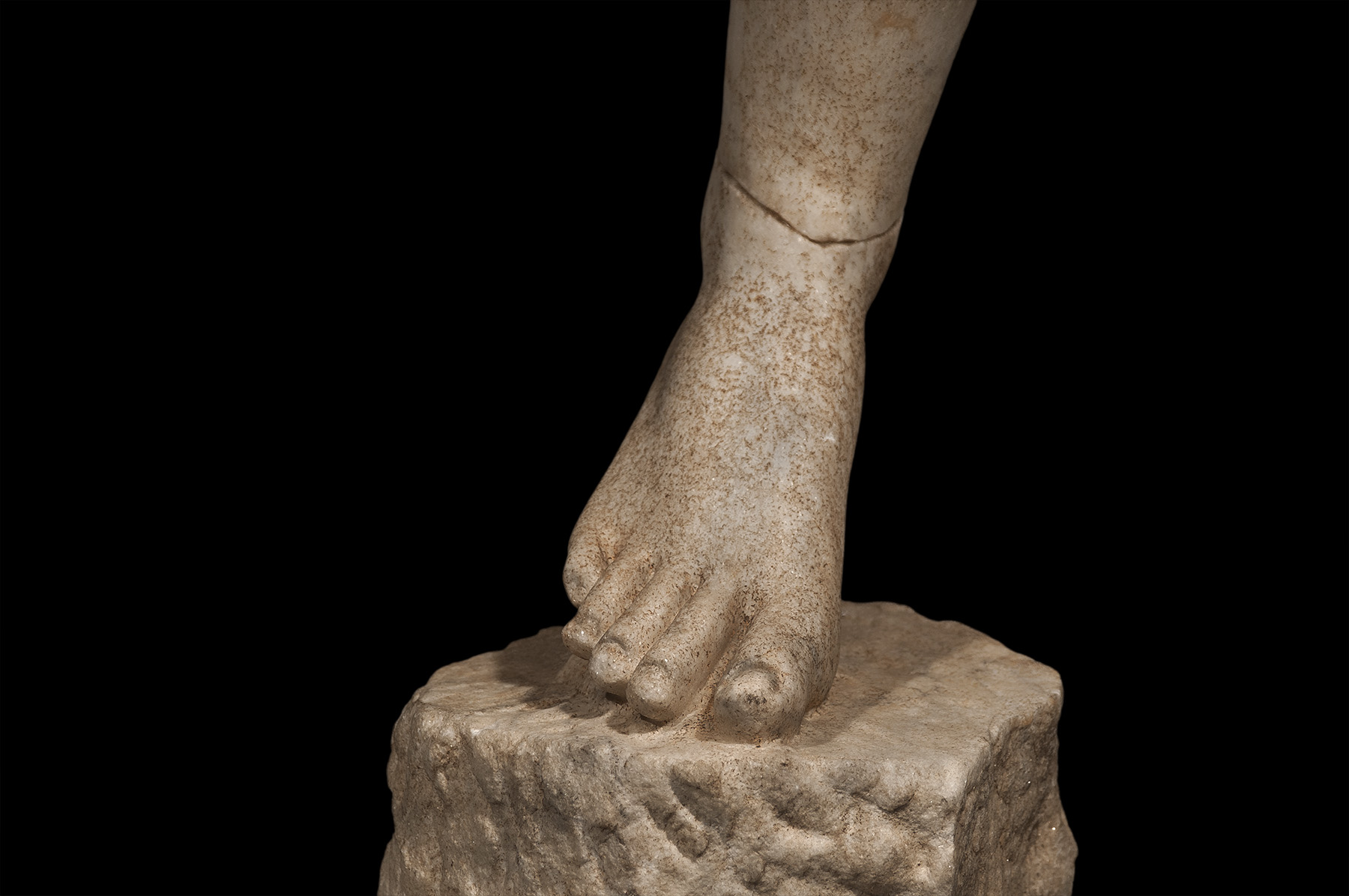
An impressive life-size Roman marble sculptural fragment, preserving the greater part of the leg of an idealized male figure, most probably an athlete or heroic youth. The sculpture survives from approximately mid-thigh through the knee and lower leg to the remarkably well-preserved bare foot, which rests upon a substantial ancient marble plinth.
The leg is represented in a dynamic, carefully balanced stance. The knee is subtly flexed and the lower leg inclines forward, imparting a sense of controlled movement rather than rigid repose. The musculature is sensitively modeled, particularly through the knee, calf and ankle, combining close anatomical observation with the harmonious, idealized proportions characteristic of Roman sculpture inspired by the Classical Greek tradition.
Particularly accomplished is the treatment of the foot. The toes are individually articulated, with the great toe prominently defined, while the transitions between the ankle, instep and toes are rendered with considerable naturalism. The survival of the foot together with the marble base is especially significant, as it preserves important evidence for the stance and disposition of the original complete statue.
The idealized male anatomy, life-size scale and poised movement strongly suggest that the complete sculpture represented an athlete, heroic youth, deity, or similarly idealized male figure. Such subjects occupied an important place in Roman art, reflecting the profound admiration of Roman patrons for the artistic traditions of Classical Greece.
Greek athletic sculpture of the fifth and fourth centuries BC established an influential canon for the representation of the male body. Roman sculptors subsequently reproduced and adapted these celebrated compositions in marble for display in villas, gardens, bath complexes, gymnasia and other prestigious public and private settings throughout the Empire.
The present fragment belongs convincingly within this tradition. Its carefully observed anatomy and sense of restrained movement are particularly evocative of Roman adaptations of Classical athletic statuary, in which the distribution of weight through the legs formed an essential component of the figure’s contrapposto.
Parallels
Important comparisons can be found among Roman marble versions and adaptations of Classical Greek athletic sculpture.
The Marble Statue of a Youth in the Metropolitan Museum of Art, dated to the 1st century AD, is identified as a Roman adaptation of a late fifth-century BC Greek sculptural type, probably associated with the commemoration of an athletic victory. The work demonstrates the Roman continuation of Classical Greek ideals of proportion and youthful male anatomy.
A particularly significant comparison is the Metropolitan Museum’s Marble Statue of a Youthful Hercules (Diadoumenos), dating to the Flavian period, circa AD 69–96, after the celebrated fifth-century BC athletic type associated with Polykleitos. The statue demonstrates the carefully calculated distribution of weight and controlled suggestion of movement characteristic of the Classical athletic tradition as interpreted by Roman sculptors.
The Metropolitan Museum’s Stephanos Athlete, dated to the late 1st century BC–1st century AD, provides another relevant comparison for the Roman adaptation of earlier Greek athletic types and the continued popularity of idealized, life-size male statuary during the Early Imperial period.
Further comparison may be made with the Roman marble Statue of an Athlete in the Cleveland Museum of Art, dated AD 1–100, a life-size idealized male figure ultimately derived from Greek sculptural traditions of the fifth century BC.
Together, these parallels support the attribution of the present sculpture to the Early–High Roman Imperial period, circa AD 50–150, while the fragmentary survival of the statue prevents secure identification with a particular Greek prototype.
Provenance
Ex. private collection 1980, Baidun Fine Antiquities, Jerusalem, inventory no. SI_RM_1098, IAA database number: 5422
References and Comparative Material
For comparable Roman representations of idealized athletes and heroic male figures, see:
The Metropolitan Museum of Art, New York: Marble statue of a youth, Roman, 1st century AD, adaptation of a Greek statue type of the late 5th century BC.
The Metropolitan Museum of Art, New York: Marble statue of a youthful Hercules (Diadoumenos), Roman, Flavian period, circa AD 69–96, adaptation of the Greek athletic type associated with Polykleitos.
The Metropolitan Museum of Art, New York: Marble statue of an athlete (Stephanos type), Roman, late 1st century BC–1st century AD.
The Cleveland Museum of Art: Statue of an Athlete, Roman, AD 1–100, marble, life-size.
REFERENCE #
SI_RM_1098
CIVILIZATION
Roman, 100 C.E.
SIZE
H. 75 cm
CONDITION
Fragmentary, preserving the leg from approximately mid-thigh to the foot and a substantial portion of the ancient marble plinth. The sculpture has visible joins at approximately the knee and above the ankle. The upper thigh terminates where the remainder of the statue is lost.
The marble exhibits extensive surface weathering, mineral deposits and an attractive warm cream to beige-brown patination. Minor losses and abrasions are present, particularly around the upper termination and edges of the base. Despite its fragmentary condition, the anatomical modeling remains remarkably legible, with the foot and toes especially well preserved.
An imposing and highly evocative survival from a life-size Roman marble statue.
PRICE
Price available upon request
Frequently Asked Questions
The marble leg sculpture is of Roman origin, dating back to around 100 C.E. It represents the artistic style and anatomical ideals of that period in Roman civilization.
The sculpture depicts the lower part of an athlete's leg, beginning midway up the thigh and extending down to the original marble base. It showcases the idealized Roman anatomy with elements of equal proportion.
The sculpture stands at a height of 75 centimeters, making it a substantial fragment of the original statue.
The sculpture has been rejoined at the knee and at the ankle, indicating restoration work to maintain its structural integrity.
The price of the marble leg sculpture is not listed publicly but is available upon request, suggesting it may be a valuable or rare piece.
The sculpture reflects the Roman emphasis on idealized anatomy and balanced proportions, highlighting their appreciation for athletic form and physical perfection in art.