Description
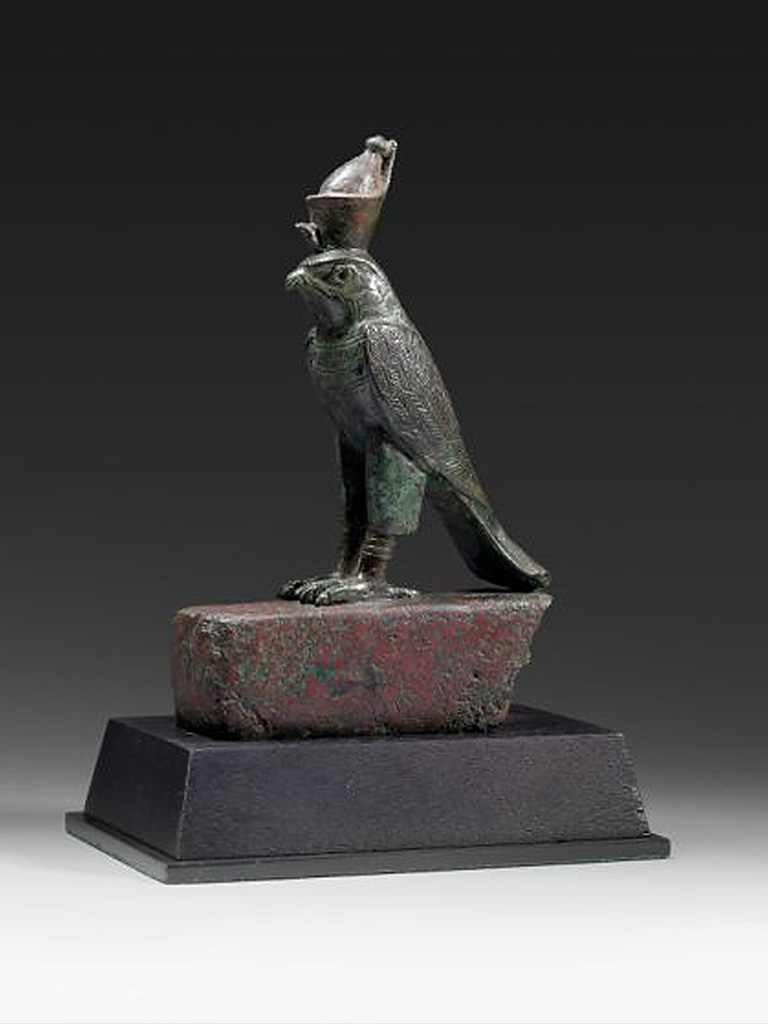
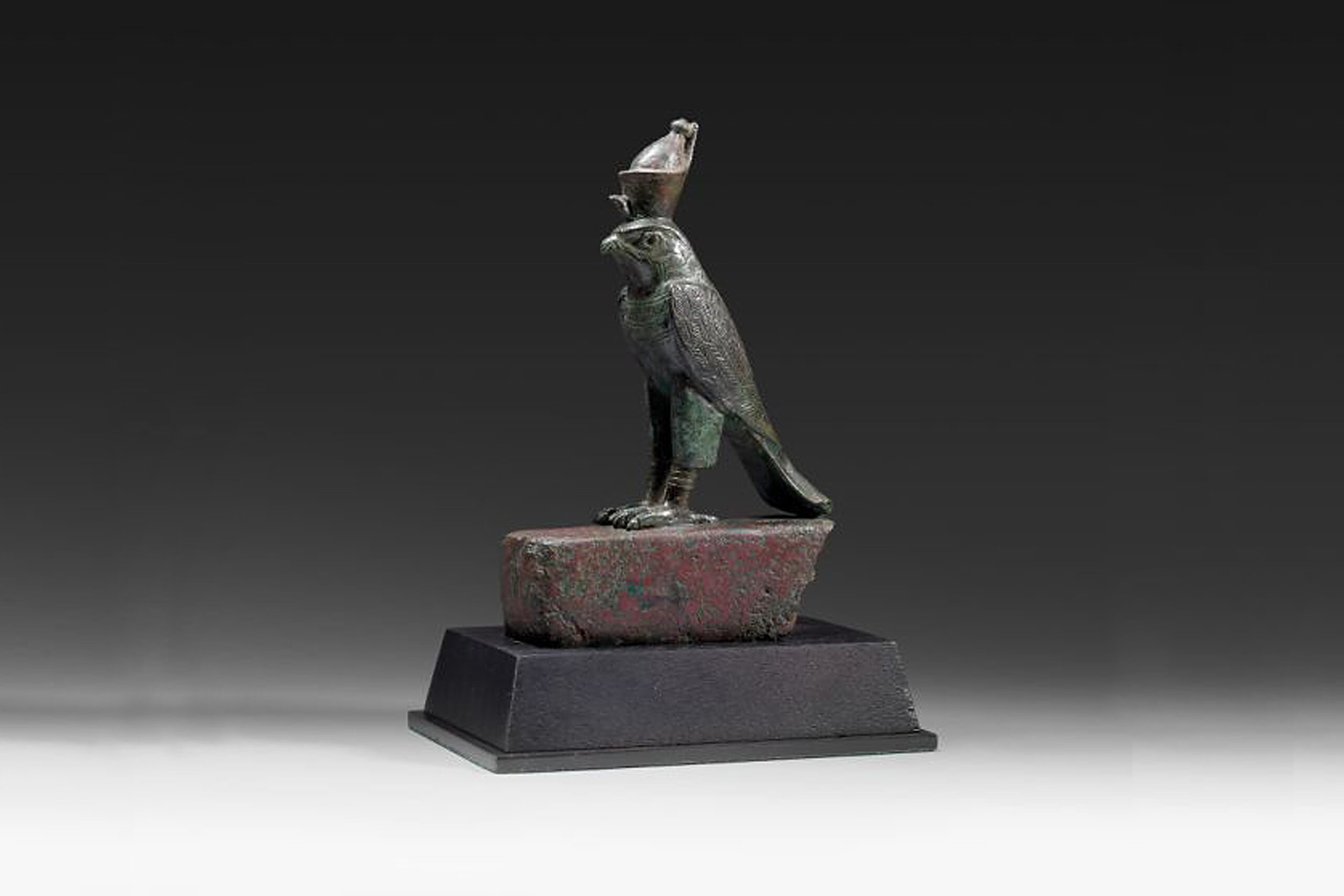
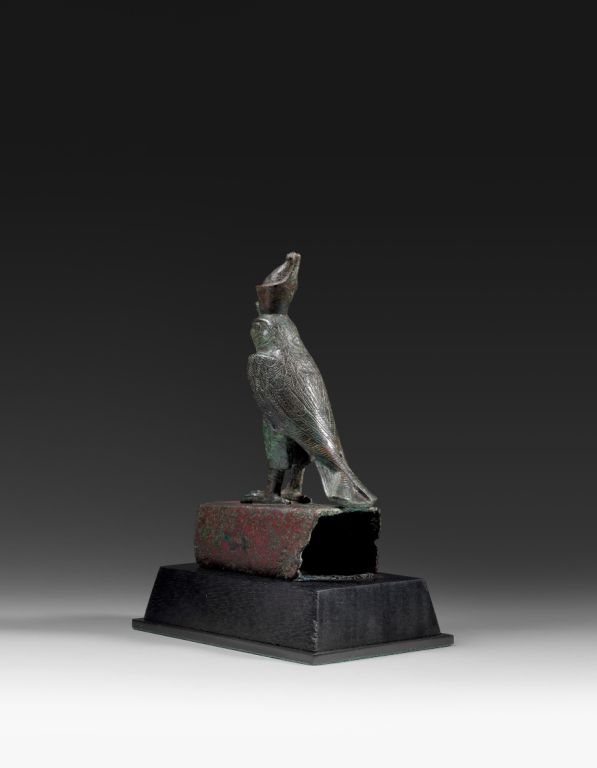
Solid cast, the bird is shown in a typical pose, wings crossed over the tail with the feathers all cleanly incised. It wears the double crown of Egypt and traces of gilding remains scattered over the surface. This probably once decorated the top of a sarcophagus.
The so-called Horus falcon is one whose characteristics do not conform exactly with any of the four species known to the Egyptians: it is an idealized falcon with elements inspired by more than one of the predatory birds. The falcon was revered from earliest times for its awesome climb into the heavens and its headlong yet sure swoop upon its prey. The earliest element of the royal titulary, which officially proclaimed the ruler’s name, was the Horus name by which the holder of the royal office and the royal bird were indissolubly linked. Horus was essentially protective of the king and so an image of a falcon held an inherent concept of protection. But in one creation legend, the creator god was held to be a falcon whose outspread wings formed the vault of heaven, his two eyes being the sun and moon. Thus the image of the falcon was also strongly associated with creation and regeneration.
Not surprisingly it was a form adopted by a number of Egyptian gods. Even the name Horus refers to more than one deity since Horus of Edfu, Horus the son of Isis and Osiris and Horus the Elder are three completely separate gods with only the name in common; all could manifest themselves as a falcon. In addition, the sun god Re, Monthu the Theban war god, Sokar the Memphite funerary god, Khonsu of Thebes, even one of the Sons of Horus called Qebhsenuef could appear as falcons or falcon-headed (and there are others), with only special attributes to help distinguish each from the other and the multiplicity of Horuses. If none of these distinctive features is present and there is no inscription, identification of a falcon as being the manifestation of a specific deity is frequently impossible.
REFERENCE #
SI_EG_1047
CIVILIZATION
Egyptian, 26th/30th Dynasty, 664 B.C.E. – 342 B.C.E.
SIZE
H. 14.4 cm
CONDITION
Excellent condition
PRICE
SOLD
PROVENANCE
Former French private collection, acquired ca. 1970. French Passport # 128908
Frequently Asked Questions
The falcon was revered in ancient Egypt for its majestic flight and hunting prowess. It symbolized protection, creation, and regeneration, often linked to the royal office through the Horus name, which connected the king to the falcon deity Horus.
The Horus falcon does not match any of the four known Egyptian falcon species exactly. Instead, it is an idealized representation combining features from multiple predatory birds, embodying symbolic qualities rather than biological accuracy.
Several Egyptian gods could appear as falcons or falcon-headed figures, including Horus of Edfu, Horus the Elder, Horus the son of Isis and Osiris, the sun god Re, Monthu, Sokar, Khonsu, and Qebhsenuef, each distinguished by specific attributes.
The double crown symbolizes the unification of Upper and Lower Egypt, signifying the ruler's dominion over the entire land. Its presence on the falcon sculpture emphasizes the bird's connection to royal authority and protection.
Without inscriptions or distinctive attributes, it is often impossible to determine which specific deity a falcon figure represents due to the many gods associated with falcon imagery. Identification relies heavily on unique features or accompanying symbols.
The solid cast falcon, adorned with the double crown and traces of gilding, likely decorated the top of a sarcophagus, serving as a protective symbol for the deceased in the afterlife.
The falcon sculpture dates from the Egyptian 26th to 30th Dynasty, approximately between 664 B.C.E. and 342 B.C.E., a time known for its artistic refinement and revival of earlier traditions.