

Description
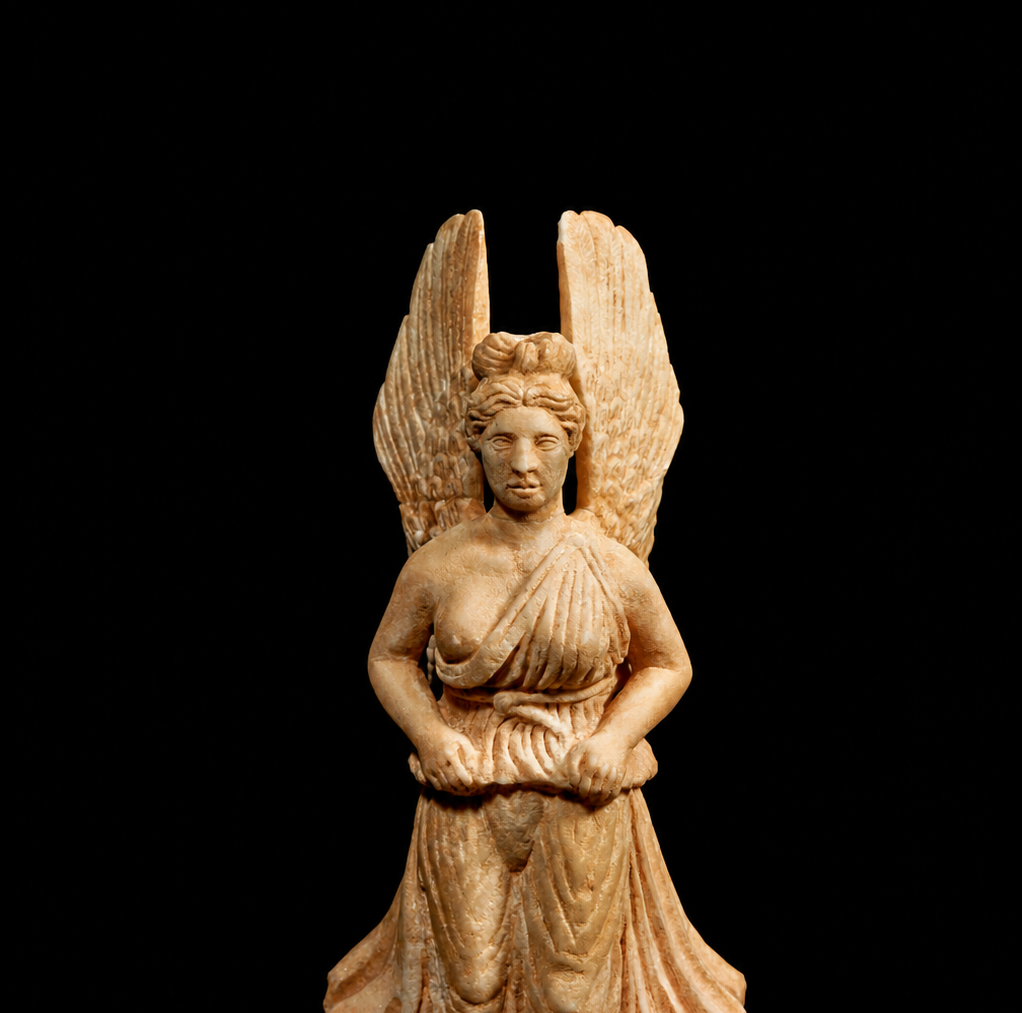
A finely carved Roman marble statuette representing Nike, the winged goddess and personification of Victory, shown standing frontally with her great feathered wings rising dramatically behind her.
Nike was one of the most enduring symbols of triumph in the Greek and Roman worlds. To the Greeks she personified victory itself, appearing in contexts of warfare, athletic competition and divine favor. Adopted extensively into Roman visual culture as Victoria, the winged goddess became an equally powerful emblem of military success, imperial authority and prosperity.
The goddess stands upon an integral rectangular base with a slightly inclined upper surface. Her body is enveloped in a long peplos, fastened at the shoulder and gathered beneath the breasts. Deep cascading folds descend toward her feet, while the outer edges of the garment flare outward on either side. This suggestion of movement, together with the elevated position of the wings, creates the impression that Nike has only just descended from flight and alighted upon the ground.
Her wings are particularly impressive. Rising high above the shoulders, they are carefully articulated with successive registers of individually carved feathers. The wings frame the head almost architecturally, emphasizing both the supernatural identity of the figure and her commanding frontal presence.
Nike’s youthful face is rendered in an idealized manner, with almond-shaped eyes, a straight nose and small, softly modeled mouth. Her centrally arranged hair is swept upward into an elaborate coiffure. The serene facial type recalls the idealized female portraiture of the Antonine period, including portraits associated with Faustina the Elder, wife of Emperor Antoninus Pius (AD 138–161), providing a useful stylistic context for a 2nd-century date.
The broad, deeply cut folds of the garment and somewhat linear treatment of the wings are compatible with provincial Roman sculpture of the eastern Mediterranean, particularly the sculptural traditions of Roman Syria and the neighboring Levant. A Levantine origin is therefore plausible, although the precise ancient workshop cannot be established from style alone.
The positioning of the arms is unusual and visually compelling. Both hands are brought forward at waist level and appear to grasp the gathered garment or a horizontal element. Combined with the spreading drapery and raised wings, this gives the small sculpture an unexpectedly monumental quality.
Nike — The Personification of Victory
In Greek mythology, Nike was the divine embodiment of victory. She was frequently associated with Zeus and Athena and could descend from the heavens to bestow success upon gods, rulers, warriors and victorious athletes.
Her wings are her defining attribute, allowing her to move between the divine and mortal realms and to bring victory to the favored individual. In Greek and subsequently Roman art, images of Nike could therefore communicate much more than military conquest: they could signify success, achievement, divine favor, glory and triumph over adversity.
Under Roman rule, this imagery remained enormously important. Known to the Romans as Victoria, the winged personification became closely associated with the victories and legitimacy of the Roman state and emperor.
REFERENCE #
SI_RM_1060
CIVILIZATION
Roman, 200 A.D.
SIZE
H. 21.5 cm
CONDITION
Tips of the wings and neck rejoined; otherwise in fine condition. The statuette is remarkably well preserved, retaining the figure, integral base and substantial original detailing. The facial features, elaborate coiffure, feathering of the wings and deeply carved folds of the drapery remain clearly defined. The marble exhibits an attractive warm cream coloration with natural surface deposits and minor age-related wear.
PRICE
$30,000
PROVENANCE
Found in Jordan river valley, Jerusalem private collection
Frequently Asked Questions
Nike is the ancient Greek personification of victory, often depicted as a young winged woman. She symbolizes triumph and success in various endeavors, especially in battle and athletic competitions.
The statue shows Nike standing with her wings unfolded towards the heavens, dressed in a peplos fastened at the shoulder and tied below the bosom. Her pose and the movement of the peplos suggest she has just alighted on the ground, symbolizing a moment of victorious arrival.
The face of the statue is idealized and somewhat impersonal, resembling portraits of Faustine the Elder, wife of Antoninus Pius. The large folds of the peplos reflect the local sculptural style of the Levant region, indicating the statue likely originated from Syria or Jordan.
This statue of Nike originates from the Roman civilization and dates back to around 200 A.D., reflecting the artistic influences and cultural exchanges of that era.
The statue stands 21.5 cm tall. It is in fine condition overall, with some restoration where the tips of the wings and neck have been rejoined.
The statue was found in the Jordan River Valley and was part of a private collection in Jerusalem before being made available for sale.
The Nike statue is priced at $30,000, reflecting its historical significance, condition, and provenance.