Description
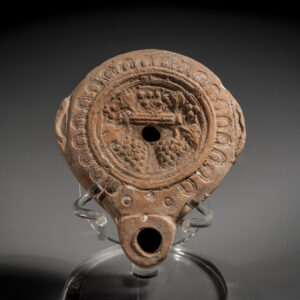
An ancient terracotta oil lamp from the Holy Land, dating to the Herodian and Early Roman period, the era associated with the life of Jesus and the beginnings of Christianity.
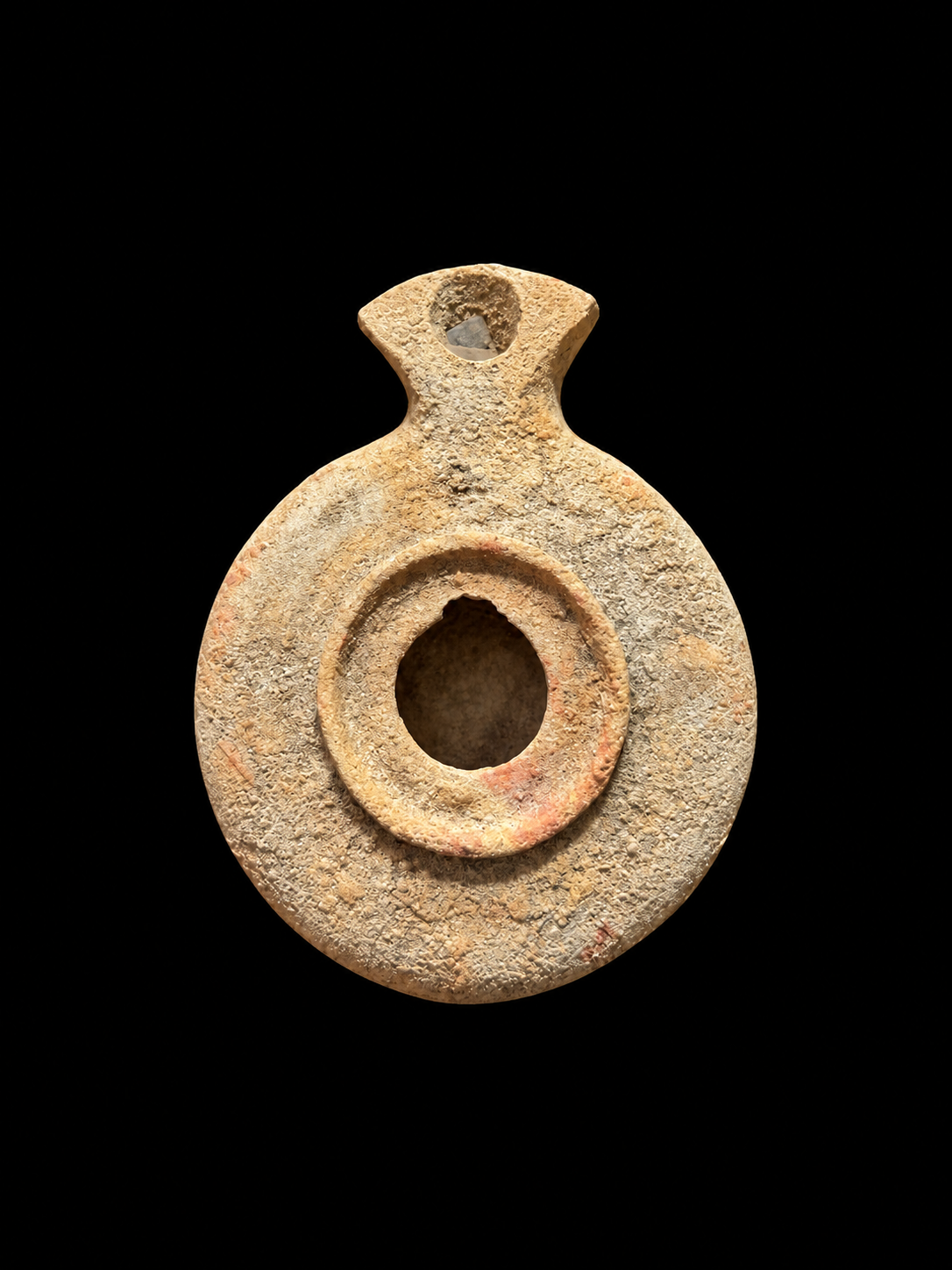
The lamp is formed with a broad rounded body centered by a large circular filling aperture surrounded by a pronounced raised collar. At one end is the projecting nozzle through which the wick was inserted. The opposite end incorporates a pierced lug or handle, allowing the lamp to be conveniently held, suspended, or carried.
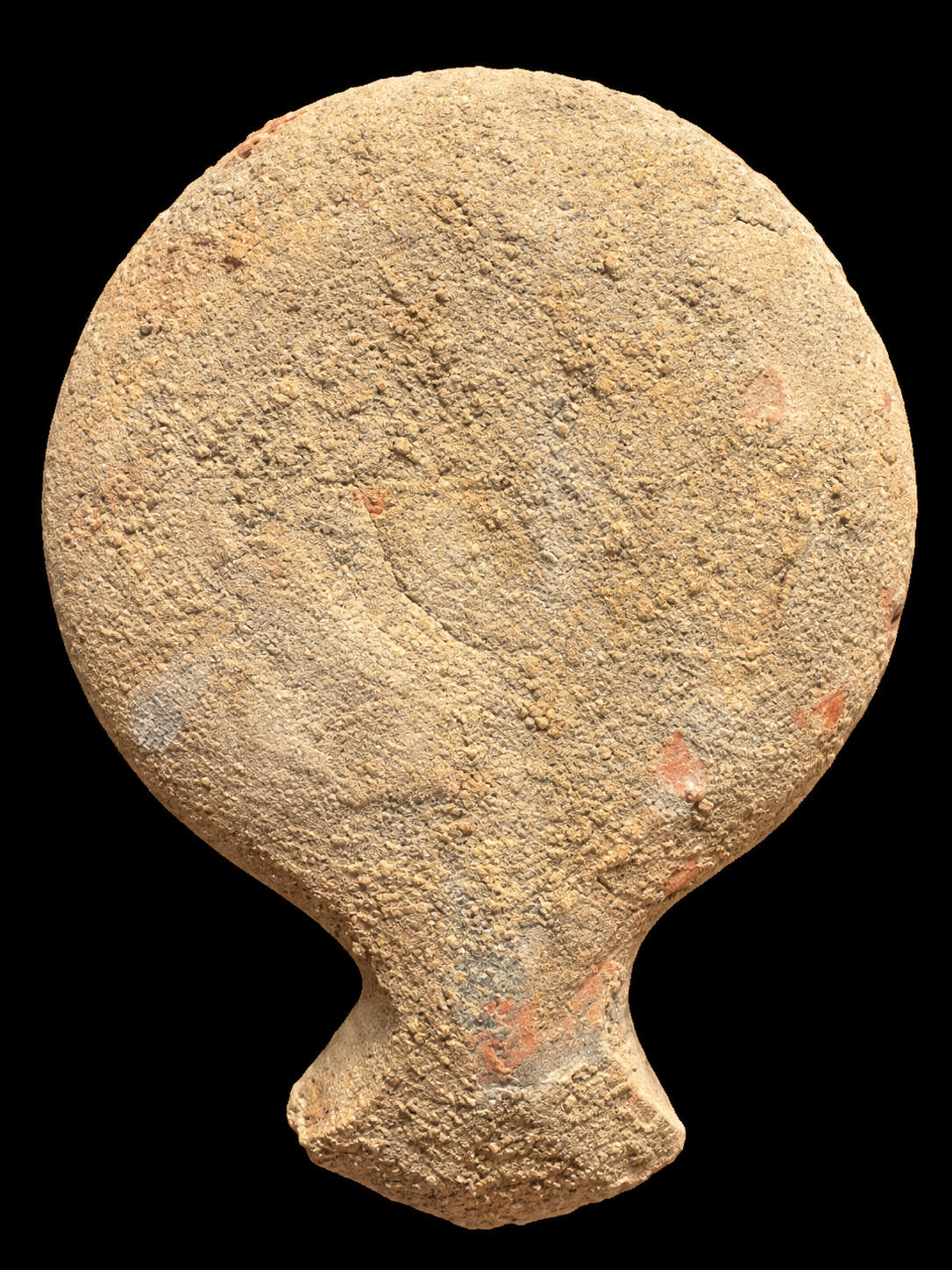
The vessel is deliberately functional and largely undecorated, reflecting the restrained character of many utilitarian lamps used in Judea during the late Second Temple period. Its coarse buff-colored terracotta surface retains extensive earthen deposits and encrustation acquired through burial, giving the piece a particularly evocative archaeological appearance.
Oil lamps were among the most fundamental objects of everyday life in ancient Judea. Filled with olive oil and fitted with a twisted flax or fiber wick, a lamp such as this provided light after sunset in houses, workshops and other interior spaces. Archaeological excavations throughout Jerusalem and Judea have recovered large numbers of lamps from contexts dating to the late Second Temple period.
Historical And Biblical Significance
The significance of an ancient Judean lamp extends far beyond its practical function. Light and the lamp are among the most frequently employed metaphors in the Bible, representing divine presence, faith, guidance, vigilance and spiritual illumination.
Jesus repeatedly drew upon the familiar household lamp in his teachings. In the Sermon on the Mount, he tells his listeners:
“Neither do men light a candle, and put it under a bushel, but on a candlestick.”
— Matthew 5:15
The imagery appears again in the Parable of the Ten Virgins (Matthew 25:1–13), in which the women wait with their lamps for the arrival of the bridegroom. Five wisely bring additional oil while five do not. The lamp becomes a powerful metaphor for preparedness, faith and spiritual vigilance.
Another particularly appropriate passage is:
“I am the light of the world.”
— John 8:12
Although this statement does not specifically describe an oil lamp, it demonstrates the central importance of light as a Christian metaphor.
An Object From The World Of The New Testament
What makes a lamp of this period particularly compelling is its connection to ordinary life in Judea during the first century AD. Lamps were not luxury objects reserved for the wealthy; they were everyday necessities. Objects of this general class illuminated the homes and communities of the same cultural landscape in which the events described in the New Testament took place.
It is therefore best understood not as an object that can be personally associated with Jesus or his followers, but as a tangible survival from the material world of the New Testament period.
Its simple form also provides an immediate visual connection with biblical references to lamps and oil—objects that Jesus’ original audience would have encountered routinely and immediately understood.
REFERENCE #
OL-JD-1005
CIVILIZATION
Herodian–Early Roman Period-Circa 1st century BC–1st century AD
SIZE
L. 10 cm W. 7 cm
CONDITION
Very fine
PRICE
$500
PROVENANCE
Found in Israel