Description
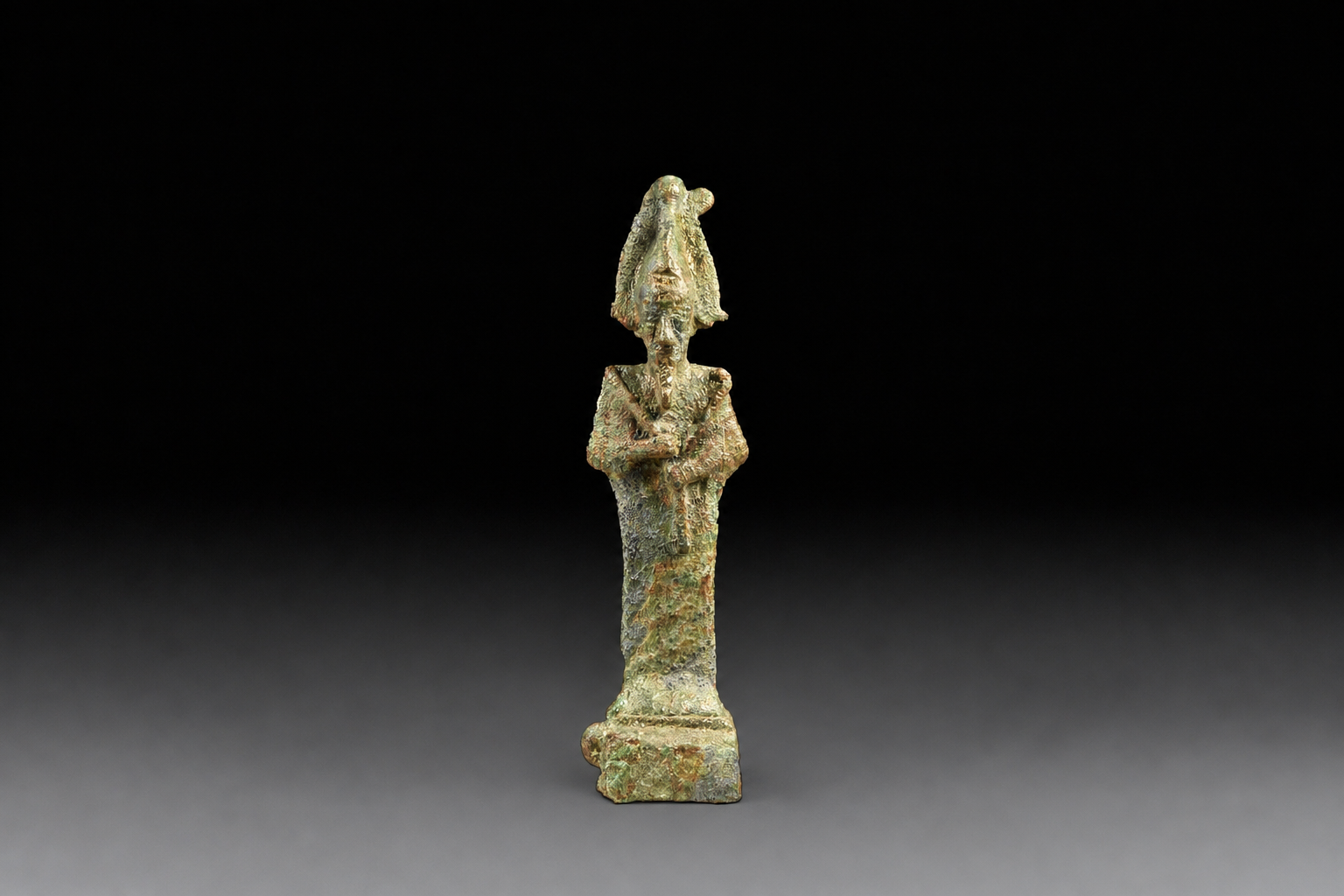
A finely cast ancient Egyptian bronze statuette representing Osiris, one of the most important deities of the Egyptian pantheon and the divine ruler of the afterlife.
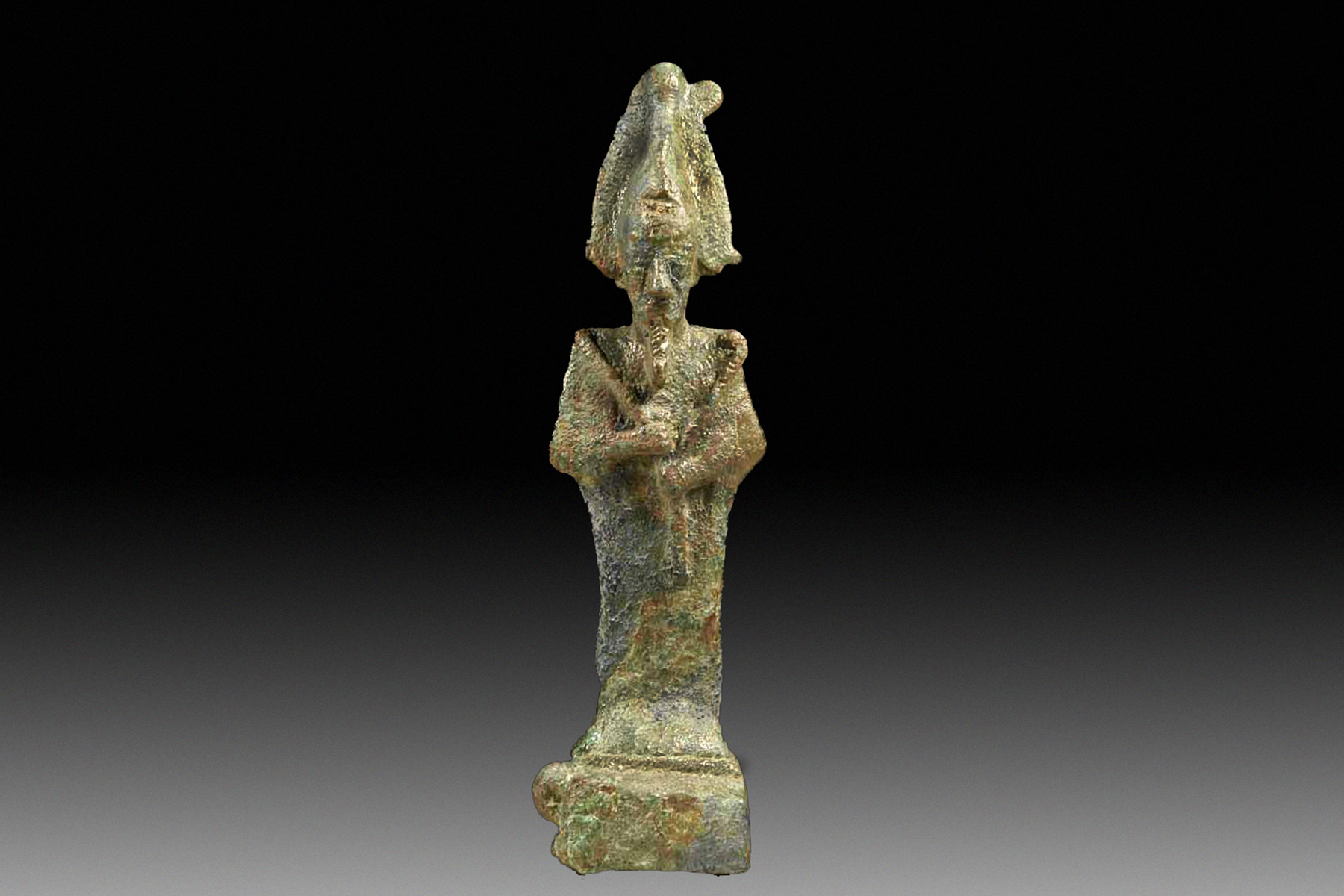
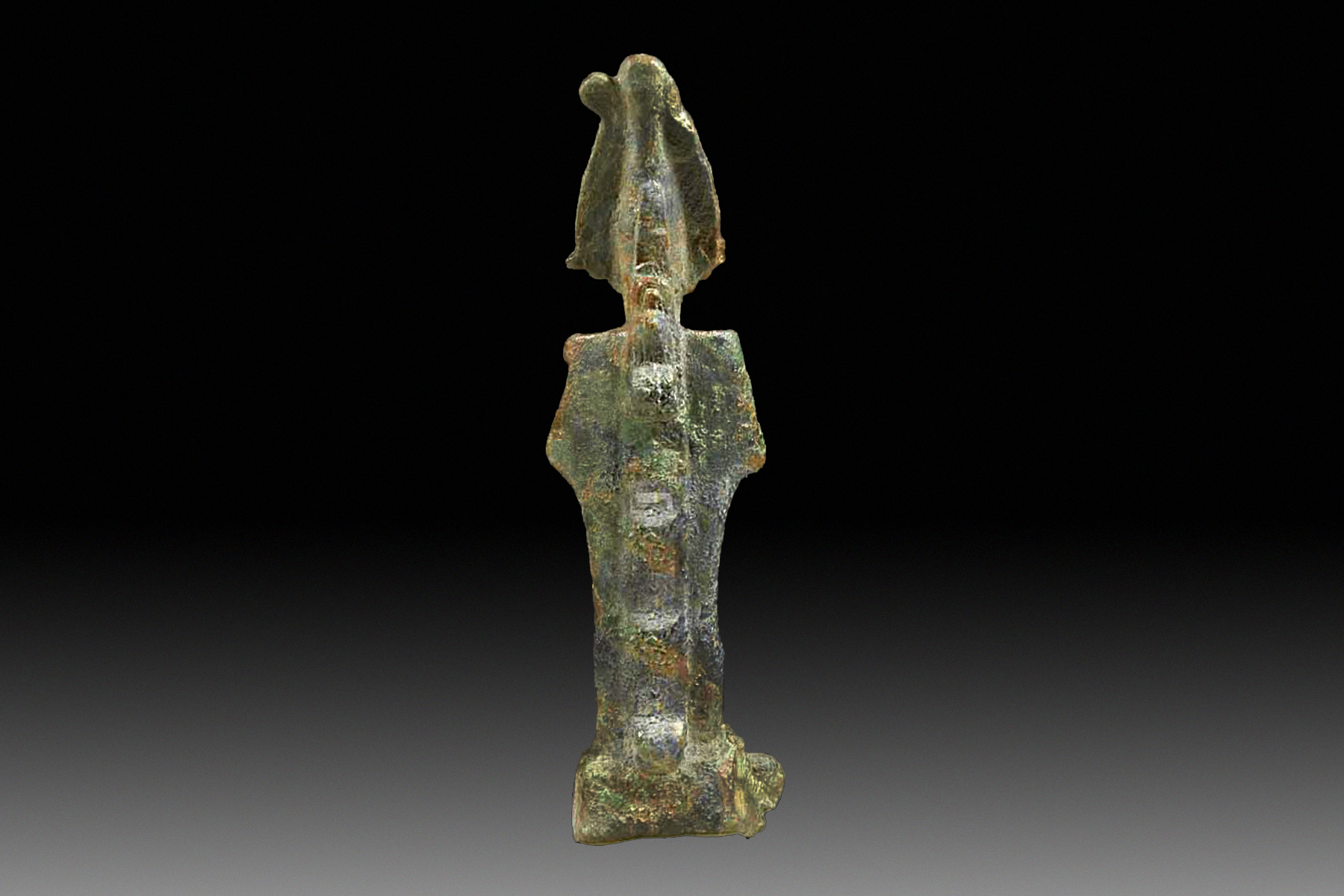
The god is depicted in his canonical mummiform form, standing rigidly frontal with the body enveloped in a close-fitting funerary garment and the arms crossed over the chest in the traditional Osirian pose. The elongated figure rises from an integral rectangular base, giving the composition the formal monumentality characteristic of Egyptian representations of the deity.
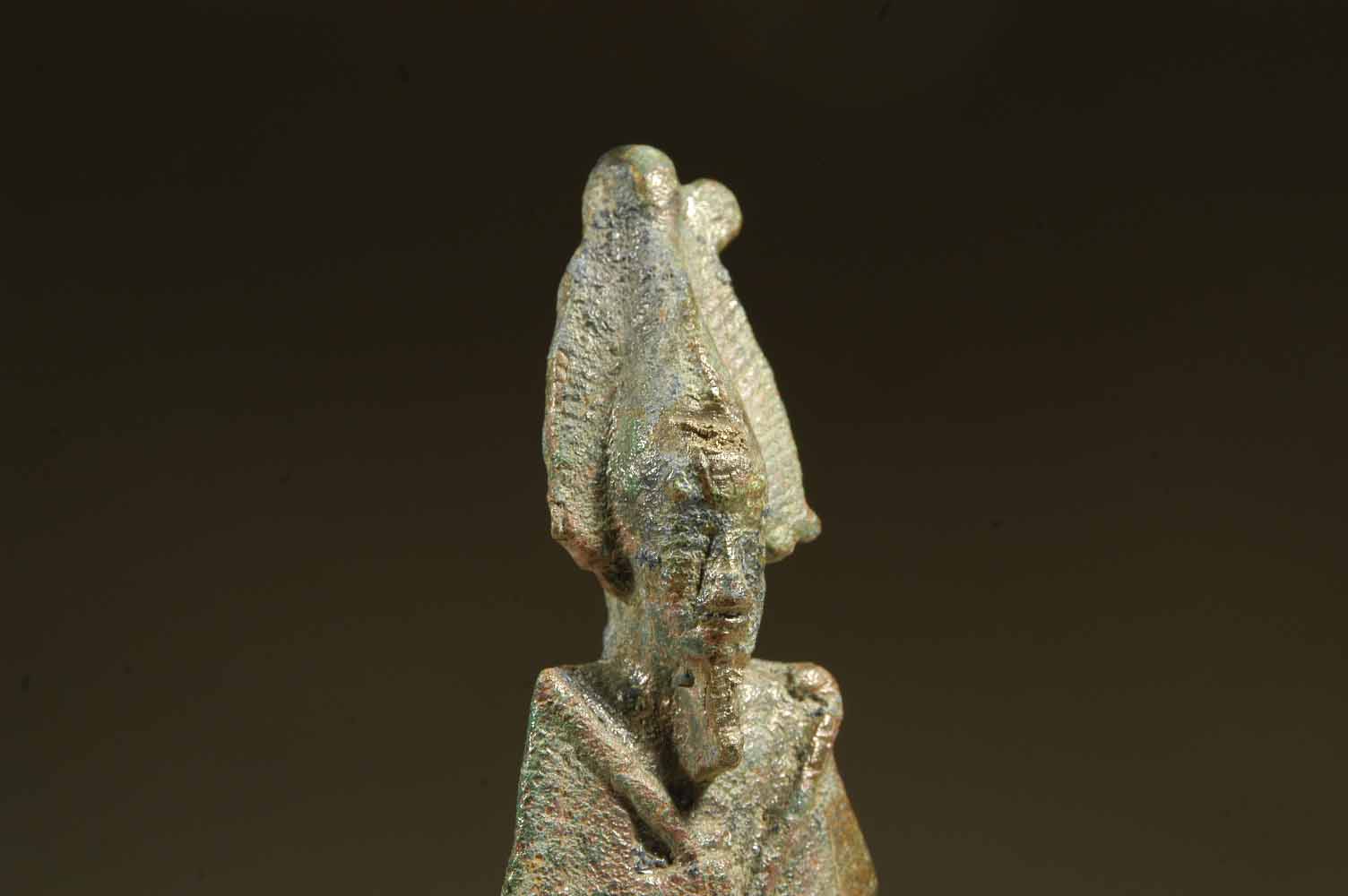
Osiris wears his distinctive Atef crown, composed of a tall central crown flanked by feathers. His face is rendered with strongly defined features beneath the imposing headdress, while a long ceremonial divine beard descends from the chin. Despite areas of ancient surface wear and mineralization, the principal facial and iconographic details remain clearly discernible.
The statuette is particularly attractive for its surviving ancient surface. The bronze displays a richly varied patina of green, brown, grey and darker mineralized tones, providing evidence of considerable age and burial or prolonged environmental exposure.
Osiris was among the most significant gods of ancient Egyptian religion. According to Egyptian mythology, he was murdered by his brother Seth and subsequently restored through the actions of Isis. Thereafter he became ruler of the realm of the dead and the supreme embodiment of death, resurrection and regeneration. The deceased hoped to participate in this same cycle of renewal and ultimately attain eternal life through association with Osiris.
During the first millennium B.C., and particularly throughout the Late Period, bronze statuettes of Egyptian deities were produced as votive objects for dedication within temples and sacred precincts. Representations of Osiris were especially popular, reflecting the extraordinary importance of the god’s cult and the central place occupied by concepts of resurrection and eternal life in Egyptian religious belief.
The statuette’s frontal mummiform presentation, Atef crown, divine beard, crossed arms and integral base conform closely to the established iconography of Late Period bronze figures of Osiris. The restrained modeling and elongated proportions are likewise consistent with examples produced during the later dynastic period.
REFERENCE #
SI_EG_1003
CIVILIZATION
Egyptian. Late Period, 26th–30th Dynasty, Circa 664–342 B.C.
SIZE
H. 14.5 cm
CONDITION
Good condition and substantially complete. The figure, Atef crown, integral base and principal iconographic elements are preserved. Ancient surface wear, oxidation, mineral encrustation and areas of green and brown patination are present throughout, consistent with the age and material of the object.
PRICE
$2,000
PROVENANCE
Jerusalem private collection
Frequently Asked Questions
Osiris is one of the most important deities in the Egyptian pantheon, known as the divine ruler of the afterlife. He symbolizes death, resurrection, and regeneration, and was believed to grant eternal life to the deceased through association with him.
The Atef crown is a distinctive headdress worn by Osiris, featuring a tall central crown flanked by feathers. It signifies his divine authority and status as ruler of the afterlife, and is a key iconographic element in representations of Osiris during the Late Period.
The statuette is finely cast in bronze, a common material for votive objects during the Late Period of ancient Egypt. It features a richly varied patina from ancient surface wear and mineralization, indicating its considerable age and burial exposure.
Osiris is depicted in his canonical mummiform form, standing rigidly frontal with arms crossed over the chest, wearing the Atef crown and a divine beard. The figure rises from an integral rectangular base, reflecting the formal monumentality characteristic of Egyptian deity representations.
During the first millennium B.C., bronze statuettes of Osiris were produced as votive objects for dedication in temples and sacred precincts. They reflected the importance of Osiris's cult and the central role of resurrection and eternal life concepts in Egyptian religion.
The statuette is in good condition and substantially complete, with preserved iconographic elements despite ancient surface wear and oxidation. It comes from a private collection in Jerusalem and dates to the Late Period, 26th–30th Dynasty, circa 664–342 B.C.
The statuette measures 14.5 cm in height and is priced at $2,000. Its size and detailed craftsmanship reflect typical votive bronze figures from the Late Period of ancient Egypt.