Description
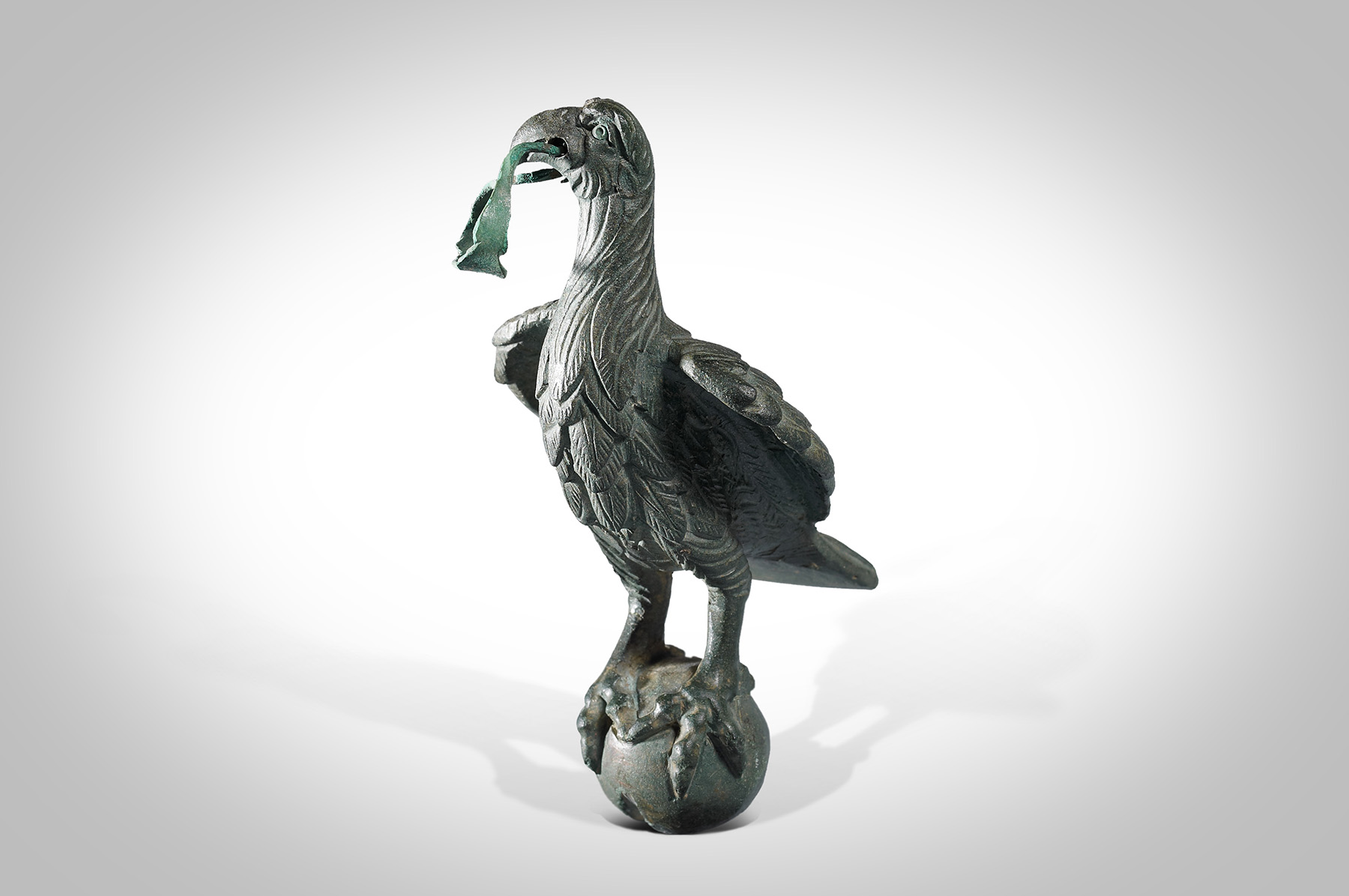
Ancient Roman bronze eagle statue (statuette) of a Roman eagle holding a crown in its beak showing finely detailed metalwork by the artist in the feathers, face and talons. The wings of the metal eagle are slightly raised from its side and the legs are close together set on thick talons.
The majestic eagle, being one of the traditional Roman symbols, stands atop a bronze orb which represents the dominion of Rome over the world. A simple crown of laurels hangs from the bird’s beak in a nod to the eagle’s close association with the royalty of ancient Rome.
The eagle, was a prominent symbol used in ancient Rome, especially as the standard of a Roman legion. A Roman legionaire known as an aquilifer, or eagle-bearer, was the standard bearer who carried this standard on Roman military conquests. Each Roman legion carried one eagle. The eagle was extremely important to the Roman army, beyond merely being a symbol of a legion. A lost standard was considered an extremely grave occurrence, and the Roman military often went to great lengths to both protect a standard and to recover it if lost.
For example, see the aftermath of the Battle of the Teutoburg Forest, where the Roman army spent decades attempting to recover the lost standards of three Roman legions. That’s why they are relatively small size, since a standard bearer in circumstances of danger will wrench the eagle from its staff and conceal it in the folds of his girdle.
REFERENCE #
SI_RM_1090
CIVILIZATION
Roman, 200 C.E. – 300 C.E.
SIZE
H. 10.2 cm
CONDITION
Excellent condition
PRICE
SOLD
PROVENANCE
Ex private collection, acquired before 1973.
Frequently Asked Questions
The bronze eagle statue symbolizes the majesty and power of ancient Rome. The eagle, a traditional Roman symbol, represents dominion and authority, often associated with the Roman legions and the empire's control over the world, as depicted by the eagle standing atop a bronze orb.
The crown of laurels hanging from the eagle's beak signifies the eagle's close association with Roman royalty and victory. Laurel crowns were traditionally awarded to victors and leaders, emphasizing the eagle's role as a symbol of imperial authority and military success.
The aquilifer was the Roman legionary responsible for carrying the eagle standard during military campaigns. This role was highly prestigious and critical, as the eagle was a sacred symbol of the legion's honor and losing it was considered a grave misfortune.
Roman eagle standards were relatively small so that in dangerous situations, the standard bearer could quickly remove the eagle from its staff and conceal it within his clothing to protect it from capture or loss during battle.
Recovering lost eagle standards was crucial because they symbolized the honor and spirit of a Roman legion. Losing a standard was a severe disgrace, prompting the Roman military to invest significant effort and time, such as after the Battle of the Teutoburg Forest, to retrieve them.
The bronze eagle statue features finely detailed metalwork, especially in the feathers, face, and talons. The wings are slightly raised, and the legs are close together with thick talons, showcasing the artist's skill in creating a lifelike and majestic representation.
The bronze eagle statue dates from the Roman civilization, approximately 200 C.E. to 300 C.E. It is in excellent condition, measuring 10.2 cm in height, and was part of a private collection acquired before 1973.