Alexander the Great Silver Tetradrachm Coin with Lion Symbol
An impressive Hellenistic silver tetradrachm struck at the celebrated Greek city of Miletos in Ionia, bearing the iconic portrait of Heracles and the enthroned figure of Zeus. Issued more than a century after the death of Alexander the Great, this coin belongs to the enduring monetary tradition established by the Macedonian conqueror, whose name and imagery continued to command prestige throughout the eastern Mediterranean.
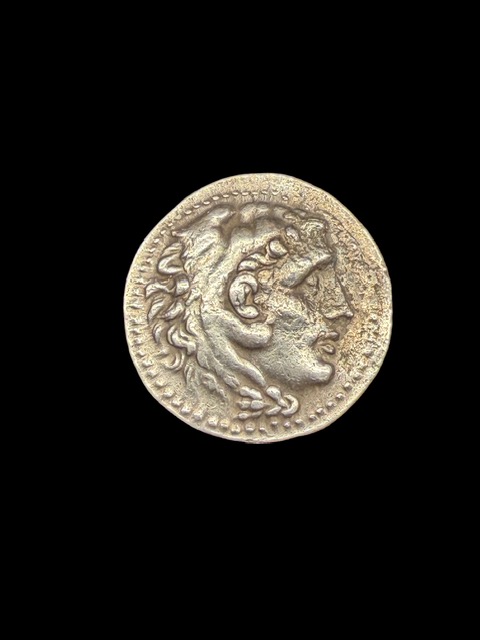
Obverse: A finely rendered head of Heracles facing right, wearing the skin of the Nemean lion, its jaws framing his forehead and the animal’s mane falling behind his neck. The powerful facial features deeply modelled eye, prominent nose, and carefully articulated lion skin reflect the established artistic conventions of Alexander’s silver coinage. Heracles, the legendary Greek hero, was closely associated with the Macedonian royal dynasty, which claimed descent from him.
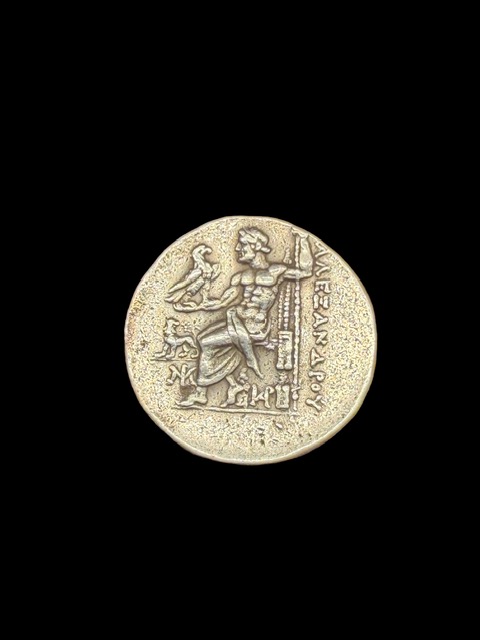
Reverse: Zeus Aëtophoros, king of the Olympian gods, seated left upon an elaborate throne, holding an eagle upon his extended right hand and a long sceptre in his left. The Greek inscription ΑΛΕΞΑΝΔΡΟΥ, meaning Of Alexander, appears vertically in the right field. A distinctive lion control symbol, accompanied by a monogram, occupies the left field, with additional control markings associated with the Miletos mint series.
Historical Significance
The tetradrachms of Alexander the Great rank among the most influential coinages of antiquity. Originally introduced during his reign, they became a widely accepted international currency, circulating across the Greek world, Egypt, the Near East, and territories extending into Central Asia.
Following Alexander’s death in Babylon in 323 B.C., numerous cities and successor kingdoms continued issuing silver coins in his name. The Miletos tetradrachms of the late third and early second centuries B.C. demonstrate the extraordinary longevity of this monetary system and the lasting political and commercial authority associated with Alexander’s legacy.
Miletos, one of the great cities of ancient Ionia, possessed a distinguished history as a centre of Greek philosophy, maritime commerce, and cultural achievement. Its continued production of Alexander-type tetradrachms reflects the importance of established monetary imagery in facilitating trade and maintaining confidence in silver currency.
Iconography and Numismatic Importance
The pairing of Heracles and Zeus was central to Alexander’s royal iconography. Heracles represented heroic strength, divine ancestry, and victorious kingship, while Zeus embodied supreme divine authority and legitimate sovereignty.
The lion control mark on the reverse is particularly significant. Such symbols, together with monograms and subsidiary marks, served to distinguish individual mint issues and production series. Their identification is essential for establishing precise numismatic classifications.
This example is attributable to the late posthumous Alexander series of Miletos, with its exact variety within the Price classification requiring confirmation of the accompanying control marks.
REFERENCE #
C5501
CIVILIZATION
Greek, Hellenistic Period, Ionia, Miletos Mint, circa 210–170 B.C. Posthumous Issue in the Name of Alexander the Great (336–323 B.C.)
CONDITION
The coin displays well-defined principal designs, with an expressive portrait of Heracles and a clearly recognizable seated Zeus. The reverse inscription and lion control symbol remain visible. The silver surfaces exhibit age-related toning and areas of wear consistent with circulation and subsequent preservation.
PRICE
$3000
PROVENANCE
Baidun private collection
Related products
-
Silver Denarius of Tiberius Tribute Penny
-
Ancient Greek Silver Tetradrachm with Portrait of Ptolemy I Soter Set in 18K Gold
-
Silver Tyre Shekel Coin in an 18K Gold Pendent
-
The Jewish Silver Full Shekel