

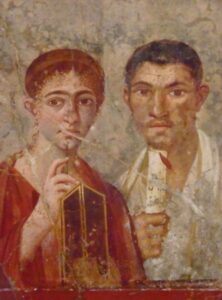
 Modern scholars have sought to assess women’s status, rights, duties, representation in the arts, and daily lives from a more objective standpoint than provided in the past. In earlier years, much of the scholars were male and were biased in a way that reflected their male-dominated world. The Ancient History Encyclopedia Online has given us some valuable insight to this topic.
IN MYTHOLOGY
When it came to Mythology, the Romans had a more neutral approach where humanity, and not specifically the male, was created by the gods from earth and water. Ovid’s Metamorphoses, for example, does not specify whether the first human was a man or a woman. At least in a physical sense, men and women were not regarded as belonging to a different species as in the Greek world, a view often reiterated in Roman medical treatises.
IN THE FAMILY
The Roman family was male-dominated, typically headed by the most senior male figure. Roman women were closely identified with their “perceived” role in society. Their duty was looking after the home and to nurture a family, in particular, to bear legitimate children. Women conceived at the young age of around 20 years old – sometimes even younger, in order to ensure the woman had no sexual history which might embarrass the future husband. Within the family, women would work on handicrafts, watch after the slaveforce, and upper class females had the right to study academic subjects such as literature and philosophy.
IN FINANCE
Women were legally obliged to have a nominated male family member act in their interests. However, in actual practice, families did not always follow these rulings. Just as with many other matters, there is evidence of women running their own financial affairs, owning businesses, running estates etc., especially in cases where the principal male of the family had died on military campaign.
IN SOCIETY
Roman women had a very limited role in public life. They could not attend, speak in, or vote at political assemblies and they could not hold any position of political responsibility. However, there were always exceptions in practice. Even so, women who were given political power and stance are very often represented in Roman literature as motivated by such negative emotions as spite and jealousy. Roman women did have a public life because they had to work for a living. Typical jobs undertaken by such women were in agriculture, markets, crafts, as midwives and as wet-nurses.
Frequently Asked Questions
In Roman mythology, women were not distinctly separated from men in terms of creation or species. For example, Ovid's Metamorphoses does not specify the gender of the first human, reflecting a more neutral view where humanity was created by the gods from earth and water. This contrasts with Greek mythology, where men and women were often seen as different species.
Roman women were primarily responsible for managing the home and nurturing the family, especially bearing legitimate children. They often married young, around 20 years old or younger, to ensure no prior sexual history. Within the household, women engaged in handicrafts, supervised slaves, and upper-class women could study literature and philosophy.
Legally, Roman women were required to have a male family member represent their financial interests. However, in practice, many women managed their own finances, owned businesses, and ran estates, particularly when the male head of the family was absent or deceased, such as during military campaigns.
Roman women were excluded from political assemblies, could not vote, speak publicly in political contexts, or hold political office. Despite these restrictions, some women did gain political influence, though literature often portrayed them negatively, attributing their power to emotions like jealousy and spite.
Roman women who worked outside the home typically engaged in agriculture, market trading, crafts, midwifery, and wet-nursing. These roles allowed them to participate in public life despite the societal limitations placed on their political and social status.
While Roman society was male-dominated, upper-class women had the opportunity to study academic subjects such as literature and philosophy. This education was not widespread but indicates that some women could pursue intellectual development within their social class.