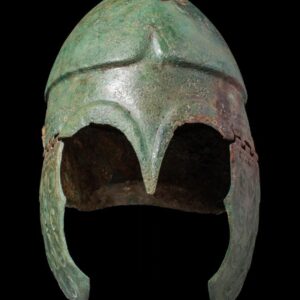
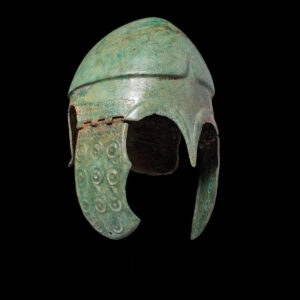
Chalcidian Bronze Helmet with Cheek Guards

This helmet has a domed crown with medial ridge, with contoured inverted ‘V’ shape above the brow continuing as an occipital rib around the helmet, with pronounced arched brows and narrow flared neck guard, the hinges connected to intact original cheek-guards with rich green patina. The domed crown has a medial ridge, with a contoured inverted ‘V’ shape above the brow continuing as an occipital rib around the helmet, pronounced arched brows and a narrow flared neck guard; the hinges remaining connecting to cheek-pieces originally attached. ‘Chalcidian’ helmets are so named as they resemble those depicted on pottery from the Euboean city of Chalcis. They were used throughout the Greek world as a lighter, less bulky version of the earlier ‘Corinthian’ helmet.


REFERENCE #

WP_GR_1009

CIVILIZATION

Greek, 500 B.C.E. – 400 B.C.E.

SIZE

H. 32.8 cm

CONDITION

Fine Condition

PRICE

Price Upon Request


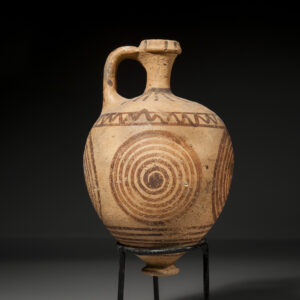
Classic Canaanite Levantine Periform Painted Ware

A classic Canaanite Levantine periform painted ware juglet[/vc_column_text]

KB_PT_0053

CIVILIZATION

Middle Bronze Age II A, 1800 B.C.E. – 1700 B.C.E.

SIZE

H. 13.5 cm

CONDITION

Excellent condition

PRICE

Price available upon request

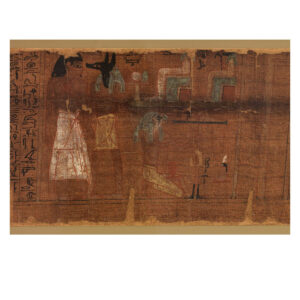
Egyptian Book of the Dead for Min-Her-Khetiu


Egyptian Book of the Dead for Min-Her-Khetiu

‘Book of the Dead’ is a modern term for a collection of magical spells that the Egyptians used to help them get into the afterlife.  They imagined the afterlife as a kind of journey you had to make to get to paradise – but it was quite a hazardous journey so you’d need magical help along the way.

Prior to the New Kingdom, The Book of the Dead was only available to the royalty and the elite. The popularity of the Osiris Myth in the period of the New Kingdom made people believe the spells were indispensible because Osiris featured so prominently in the soul’s judgment in the afterlife. As more and more people desired their own Book of the Dead, scribes obliged them and the book became just another commodity produced for sale.

From the New Kingdom through the Ptolemaic Dynasty (323 – 30 BCE) The Book of the Dead was produced this way. It continued to vary in form and size until c. 650 BCE when it was fixed at 190 uniform spells but, still, people could add or subtract what they wanted to from the text. A Book of the Dead from the Ptolemaic Dynasty which belonged to a woman named Tentruty had the text of The Lamentations of Isis and Nephthys attached to it which was never included as part of the Book of the Dead. Other copies of the book continued to be produced with more or less spells depending on what the buyer could afford. The one spell which every copy seems to have had, however, was Spell 125.

Featured here are two papyrus fragments from the Egyptian New Kingdom, 18th Dynasty (circa 1400 BCE) of an Egyptian Book of the Dead written for the Royal sandal-bearer of Isis, Min-Her-Khetiu:

The smaller papyrus sheet includes the painted figures of a woman and the dead man, their hands raised in adoration. Between them a column of hieroglyphs gives the name and title of the owner.  Seven columns of hieroglyphs in the center contain the opening of Chapter 7 headed ‘Chapter of Sailing in the Bark of Ra’.  Above this an accompanying vignette of a shallow boat containing the falcon headed Ra crowned with solar disc and flanked by wedjat eyes to signify health and security.  To the right four columns recounting part of Chapter 149,’The Fourteen Mounds’, the illustration above showing a pottery jar with liquid spilling from it.

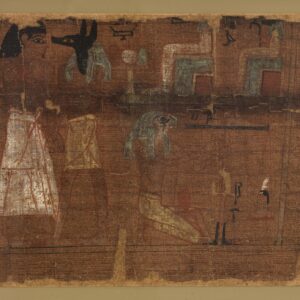
The longer sheet carries thirty columns of Chapter 125 ‘The Declaration of Innocence’ with a scene showing standing figures of Anubis with the dead man to the left of a kneeling falcon headed god (Horus though he is labelled Thoth) supervising the weighing of the heart against Maat.  Two seated gods above the scales represent the 42 gods who witness the judgement.  Two of the three columns in the center are from Chapter 81a ‘Spell for becoming a lotus’ and on the right side of the sheet are ten columns from the beginning of Chapter 144 ‘Address to the Keepers of the Underworld’ with the paired figures of the horned guardian and reporter of each gate shown at the foot of the column.

Other fragments from the same scroll can be found in the Cairo Museum and the Papyrus Museum, Syracuse, Italy.  This piece is the oldest illuminated manuscript of the Egyptian Book of the Dead in private hands, and among the oldest literary manuscripts (MSS) on papyrus.

Provenance:

Previously Maurice Nahman, Cairo, acquired 1930s; The Schøyen Collection, Norway.

Exhibited:

Kon-Tiki Museet, Oslo, 2002-3

Published Literature:

Barbara Lüscher, ‘Der Totenbuch- Papyrus des Minherchetiu‘ in Studien zur Altägyptishen Kultur, Band 36, 2006.

FOOTNOTES:
1.) The British Museum

2.) Ancient.eu


REFERENCE

#SC_EG_1001

CIVILIZATION

New Kingdom. 18th Dynasty, c.1400 B.C.E.

SIZE

H. 14 x L. 33.2 cm and H. 15.5 x L. 88.8 cm

CONDITION

Fine condition

PRICE

Available Upon Request

PROVENANCE

Maurice Nahman, Cairo, acquired 1930s; The Schøyen Collection, Norway. Exhibited: Kon-Tiki Museet, Oslo, 2002-3 Literature: Published: Barbara Lüscher, ‘Der Totenbuch- Papyrus des Minherchetiu’ in Studien zur Altägyptishen Kultur, Band 36, 2006.

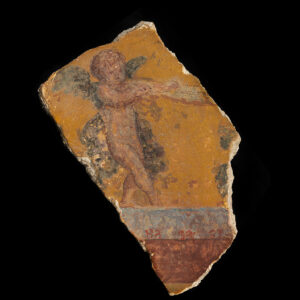
Fresco Fragment with Winged Eros

Description

A fragment from a frieze depicting Eros as a winged child pulling on one end of a swag or garland. He is depicted naked apart from a cloak that hangs from his shoulders and behind his body, visible flapping loosely on either side of his legs. The fluttering ends of a cloak belonging to a second figure, presumably another Eros or possibly a Psyche, can be seen on the right. Painted on an ochre background with remains of two bands below of sky blue and terracotta. The edge of a lower register visible.

REFERENCE #

SI_RM_1094

CIVILIZATION

Roman, 100 C.E.

SIZE

H. 27.5 cm x W. 15 cm

CONDITION

Fine condition

PRICE

Price upon request

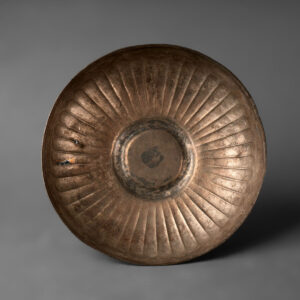
Gilded Silver Phiale Wine Ribbed Bowl

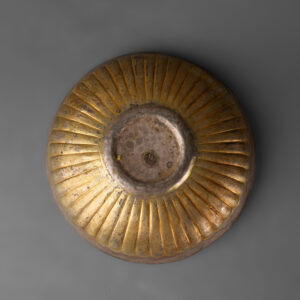
Gilded silver Phiale wine ribbed bowl from the Greco-Achaemenid period, circa 500–300 BC. This luxurious vessel measures approximately 18 cm in diameter and exemplifies the opulence of fine Greek and Persian craftsmanship during this era. The bowl features a shallow, broad form with a gently flared rim, designed both for aesthetic appeal and practical use.

The surface of the bowl is richly gilded, adding a radiant golden glow that accentuates its luxurious nature. Its most distinctive feature is the ribbed design, with evenly spaced, decorative flutes encircling the exterior that create a textured, elegant pattern and enhance its visual impact. The craftsmanship demonstrates a high level of skill, combining precise metalworking techniques with ornamental artistry.

Intended as a high-status drinking vessel for ceremonial or banquet use, this gilded silver Phiale reflects the cultural exchange and artistic refinement characteristic of the Greco-Achaemenid period. The combination of precious materials and intricate decoration signifies its importance as a symbol of wealth and prestige in social or religious contexts.REFERENCE #

MW_GR_1007

CIVILIZATION

Greek, 500 B.C.E.

SIZE

D. 18cm

CONDITION

Fine condition

PRICE

$14950

Gospel of John, in Armenian

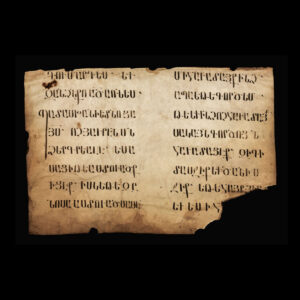
Four leaves from an extremely early Biblical codex.  4 leaves, with one complete leaf and a lower half (bisected horizontally across the page) from an early Armenian translation of John 10-11, the complete leaf 320mm. by 230mm., double column, 17 lines in dark brown ink in large  and imposing erkat’agir majuscules (the so-called ‘Iron Writing’, the earliest Armenian script to survive in manuscript) with capitals with long trailing descenders, notably similar to British Library, Add. MS.21932, trimmed to edges of text, Armenia, probably ninth or tenth century; plus the lower half of a leaf from a Biblical or liturgical manuscript, 200mm. by 135mm., with remains of double column, 12 lines in light brown ink in a smaller and squarer hand closer to that of Dublin, Chester Beatty MSS.554 and 556, both twelfth century (Catalogue of the Armenian Manuscripts, 1958 II: pls.1 and 4), Armenia, probably twelfth century; all leaves recovered from bindings and with stains, tears, folds and later pen-trials and notes, but overall in fair and sound condition.

Gospel of Mark in Greek – Fragment of a Manuscript

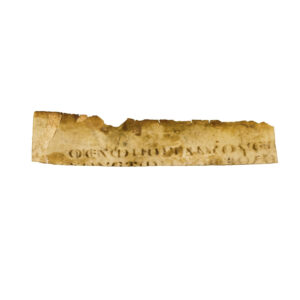
This is an extremely early and important witness to the Gospel of Mark, written within decades of the death of Jerome and Augustine of Hippo; it is perhaps from the Imperial library of Constantinople, the last of the great libraries of the ancient world This manuscript is from an important cache of early fragments, discovered in 2003, and reported to have been from a pre-War Armenian collection of antiquities and manuscripts in France. Five Biblical fragments, including the present one, were published by P.M. Head in the Journal of Theological Studies, ns.59 (2008), with short earlier notices in TC: A Journal of Biblical Textual Criticism, 8 (2003), Bulletin of the International Organization for Septuagint and Cognate Studies, 36 (2003) and the Tyndale Bulletin, 56 (2005). They include fragments of Luke (fifth century, and probably the oldest witness to that part of the text), John (late fifth century or even c.500), another fragment of Mark (fifth to sixth century) and Romans (sixth or seventh century). Subsequently, the other fragments have been identified as the oldest extant witness to the Lucianic recension of Jeremiah in Greek (early to mid-fifth century: Head ibid., pp.1-11), the only surviving witness to the Greek original text of the Testamentum Domini Nostri Jesu Christi (fifth century: Corcoran and Salway in Journal of Theological Studies, ns.62 (2011) pp.118-35), and the only surviving fragments of a series of imperial edicts made by third-century emperors and now named the Fragmenta Londiniensia Anteiustiniana (fifth century: Corcoran and Salway in Zeitschrift der Savigny Stiftung für Rechtsgeschichte: romanistische Abteilung, 127 (2010) pp.677-8, and Roman Legal Tradition, 6 (2010). Clearly these fragments of six early Bibles, a pseudo-Apostolic Church Order, and records of imperial edicts were once in a large and important library of the ancient world, in scope and chronological range far beyond that of a wealthy individual. There were large institutional libraries in Upper Egypt (such as that of the monastery founded by Pachomius c.320), Roman North Africa (as used by Augustine of Hippo in the late fourth and early fifth century), Milan (as used by Ambrose in the late fourth century) and Alexandria (as used by Bishop Gregory of Alexandria in the mid-fourth century), but the Eastern Empire was increasingly centred on Constantinople as its outlying territories fell prey to barbarian invasion. Jerome notes that the Lucianic recension of the Septuagint (including the fragment of Jeremiah noted above) was current only in Constantinople and Antioch in the early fifth century, and the collection of imperial edicts has been tentatively identified as also coming from the city. If so, it seems likely that they come from the Imperial Library in Constantinople, founded by Emperor Constantius II (reigned 337-61) as a scriptorium with the express purpose of copying fragile papyrus documents onto more stable vellum. Under Emperor Valens in 372 it employed four Greek and three Latin scribes. It survived a fire in 473, was sacked by the Normans in 1204 during the Fourth Crusade, and eventually destroyed only after the conquest of the city by the Ottoman Empire in 1453. The only other manuscript thought to be from this source is that of the Archimedes Palimpsest, which surfaced first in Constantinople in 1840 and is now in a private collection in America.


Reference #

MS_BZ_1006

Civilization

Byzantine

Size

W. 10 cm, H. 2 cm

Condition

Fine Condition

Price

SOLD

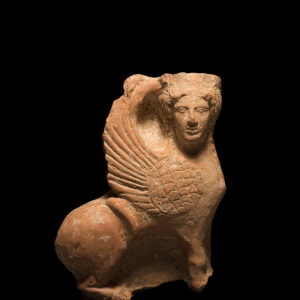
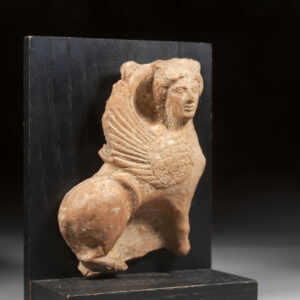
Greek Ceramic Figurine of a Sphinx

According to ancient literary sources, the sphinx was a monster with the face and bust of a woman, the talons of a lion, the body of a dog, a serpent’s tail and wings of a bird. Its pale appearance, venomous mouth and stony gaze characterised this demon of divine origin. Its presence amongst humans created uncertainty and fear. It is possible that this hybrid had its origin in Egyptian iconography, where it was represented with the body of a feline and a human face, and was probably related to the divine power of the pharaoh.

This terracotta piece shows a monster seated on its haunches and in profile, with its head turned to the right toward the public. The female countenance has idealised features of great beauty. The thick, wavy hair is crowned with a polos or crown on the Corinthian model. On the right wing the rendering of the feathers shows a clear interest in the anatomical details of birds: the feathers inserted into the body itself are small and short, rather like scales, while those at the extreme end of the wing are long and narrow, to help the bird take flight.

The sculptural prototype of Greek sphinxes appears around the 7th century BC in terracotta, and was usually found decorating large receptacles. A century later they appeared in marble crowning seated ex-votos on a column. The monstrous, aggressive nature of the hybrid was channelled into funerary art, serving as an apotropaic symbol to keep away malevolent forces. It was usual, therefore, to find this iconography in metopes and hollow acroteria in Greek necropoleis of the 6th century BC, usually with the animal in profile and turning its head toward the public in an attitude of defiance.


BIBLIOGRAPHY:

  • BILLOT, M.F. “Le Sphinx du Louvre CA 637”, Bulletin de Correspondence Hellénique. 1977.
  • MARCONI, C. Temple Decoration and Cultural Identity in the Archaic Greek World. Getty Foundation. 2007, p. 90.
  • RENGER, A.B. Oedipus and the Sphinx: The Threshold Myth from Sophocles through Freud to Cocteau. UCP. 2013.
  • STILLWELL, A. N. Corinth: The Potters’ Quarter. Harvard Univ. Press. 1952.

Reference #

SI_GR_1037

Civilization Greek,

6th – 5th century B.C.E.

Size

H. 18 cm

Condition

In a good state of preservation, without any restoration.

Provenance,

Private collection G. A., Gardena, California, USA.

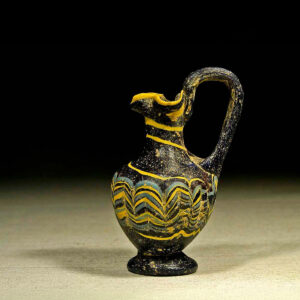
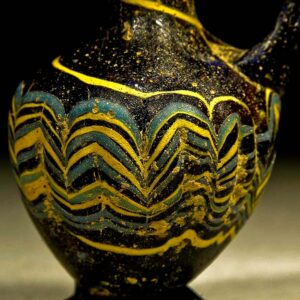
Greek Core Formed Glass Oinochoai

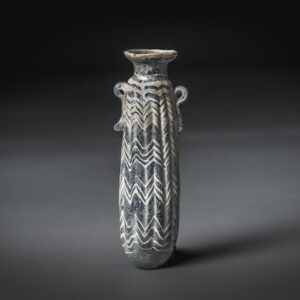
A beautiful aubergine Greek two tone core formed glass Oinochoai with opaque blue and opaque yellow decoration. A trefoil mouth with a single handle.

Cf. Grose D., The Toledo Museum of Art  Early Ancient Glass, no. 114, pg. 96

REFERENCE #

GL_GR_1003

CIVILIZATION

Greek, 600 B.C.E. – 500 B.C.E.

SIZE

10 cm

CONDITION

Fine Condition. A small chip on the rim

PRICE

Price available upon request