
Showing 65–80 of 195 results
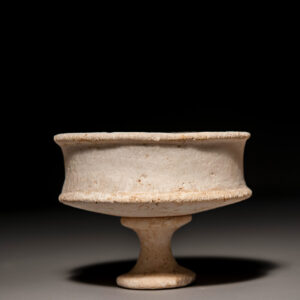
A Tazza refers to a little cup, consisting of a short stem topped by a wide receptacle. This piece comes from the Samarian region, created in the style of either Egyptian or Canaanite craftsmen. The small cup is only 6 cm in size, lending an intimacy to the object during religious ceremonies.
The cup’s body is pinched at its mouth as well as its base, which arcs downward and connects to the wide hourglass shaped stem.
KB_ST_9999
Late Bronze Age, 1500 B.C.E. -1200 B.C.E.
D. 6 cm
Part of the base is missing in antiquity
Price available upon request
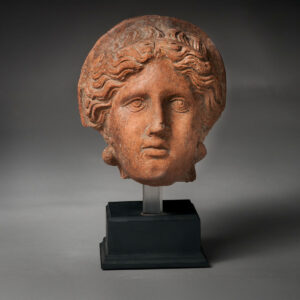
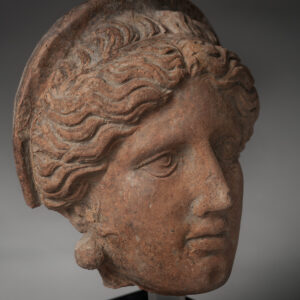
The front of the head is made from a mold and with a modeling tool reworked. The rear is Hollow. The sculpture shows a young female’s head in frontal orientation The even facial features women are very attractive. Expressive, with deep-set eyes coupled with strong eyelids. The pupils are clearly defined. A Strong protruding nose and full lips slightly opened. the chin has a gentle dimple. The symmetrically styled hair is parted in the middle, starting in soft curls that are combed back. On the cheeks is a single sleeping curls, and round earrings. The hairstyle is held by a headband. More curls on Top of the head are covered by a corona.
Cf .: St. Ohlig , antique cabinet, catalog no. 3 ( 1998) ” The Etruscans , a sign of life Civilized people . ” Fig.53 .
REFERENCE #
P 20753
Greek, 400 B.C.E.
H. 19.5 cm
A small chip on the tip of the nose, otherwise in Fine quality,
Price available upon request
Private collection of Dr. Ludenscheid , acquired in the 1960s
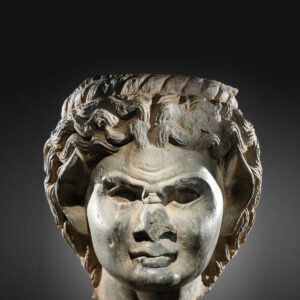
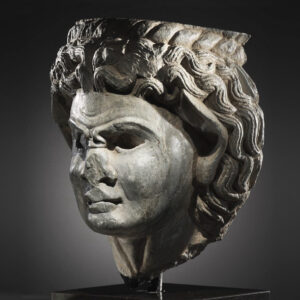
The expressive face of this satyr reveals a right eye that is slightly lower than the left and a smirk carved purposefully askew. The satyr himself may be of Greek origin, yet this piece hails from central Asia, a result of the clash of cultures that arose out of Alexander the Great’s successful campaigns throughout the region. The result was a vast melting pot of culture, art and religion that spanned the subsequent Hellenistic era of Greek history, when Greek cultural influence and power was at its zenith in Europe and Asia. At the time, this satyr’s inlaid eyes and simple braided crown were uncommon in Asian art, particularly seen in Buddhist sculptures of Siddhartha from the Gandhara region of northern Pakistan. Other examples include the famous Parthian relief from Hatra, as well as the hair and head of the Peshawar Museum’s Bodhisattva. In the years after Alexander’s conquests, the region’s sculpture incorporated such elements in the intervening years as trade and technology increased the mingling of Eastern and Western cultures, creating new currents of art and thought that still inspire us to this day.
The round face is dominated by deep holes for eyes which were originally inlaid. The root of the nose is strongly furrowed, as too is the forehead above, its series of wavy grooves mirroring the curvature of the expressive high-arched brows. Prominent cheekbones, with fleshy, rounded cheeks below; under the broad nose, full sensuous lips with dimples. To either side of the face, long, pointed ears with deep auricles. A exuberant shock of curling locks, whose individual strands are articulated with incised lines, is parted in the middle to form an anastole and spreads outwards in three luxuriant strands to frame the face.
Similarly rendered locks entirely envelope the head, wig-like, in schematically arranged rows. The sinews of the neck form a pronounced V-shape. The combination of glowering features and unruly hair impart to the head an intensely expressive quality. Encircling the crown of the head is a rope-like wreath which served as the base for an attachment, its upper surface flat to accommodate another element. Head of a statue, in all likelihood an architectural support such as a Caryatid.
SI_GR_1003
Central Asia, with influence from Ghandara, 200 B.C.E. – 100 B.C.E.
Ht. 24cm
Damage to nose, chin and two locks of hair.
$95,000
Private Collection R.J. 1962.
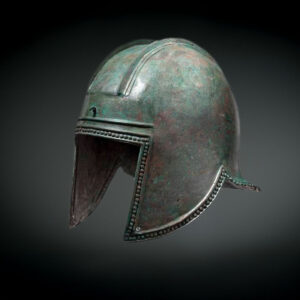
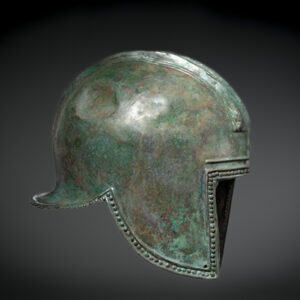
A bronze Illyrian helmet with dark green patina. Tall skull with distinctly raised and stepped ridges, fastening hooks for the attachment of a crest at front and at back. Large face-opening surmounted by two ribs across the brow, long pierced cheek-pieces and flared neck-guard. A row of lenticular decorative pins around the perimeter.
WP_GR_1008
Greek, 600 B.C.E.
H. 23 cm
Some restorations at the crown, the face-opening and the nape
Sold
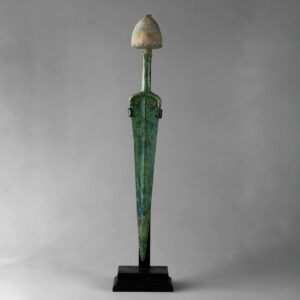
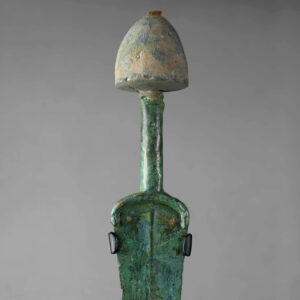
This remarkable bronze weapon is a dagger or short sword from ancient Persia, specifically attributed to the Pre-Achaemenid Empire. During this period, the empire expanded extensively, establishing a formidable and centralized administrative structure that drove the production of luxurious and highly ornate high-status artifacts. Crafted by master smiths, this piece exemplifies the exceptional skill and artistry of Persian metallurgists, renowned for creating prestige items for the military forces.
The weapon features a distinctive strengthening spine, design element that facilitates both easier thrusting. The fine craftsmanship, intricate detailing, and functional design underscore its dual role as both a battlefield implement and a symbol of status and authority.
REFERENCE #
WP_PR_1114
Persian, 1200-800 B.C.E.
L. 41 cm
Fine condition
$5000
The shape of this bronze shin guard or ‘greave’ is emphasized by the exaggeration of the anatomical muscular structure, on one side a deep crescent-shaped groove and a bulge indicates the position of the calf. The arched upper end protected the knee joint. Above the ankle, the outline of the plaque is rounded and slightly flared to allow for movement.
WP_GR_1010
Greek, 600 B.C.E.
CONDITION
Minor repairs for cracks, and some reinforcements done from the inside
Price available upon request
Previously in a private Japanese collection since the 1970’s
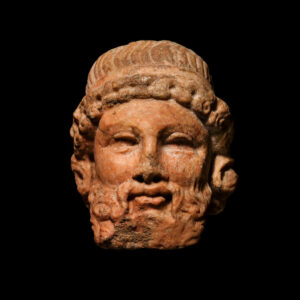
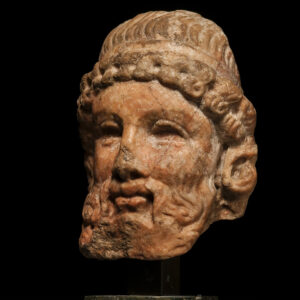
Dionysus, the god of wine, is portrayed frontal, looking forward. His hair is tied with a thick fillet with two rows of locks across his forehead. He has a long moustache and a square beard composed of curving locks. The face with arched eyebrows, large eyes sockets, pronounced cheeks, straight nose and a smiling mouth with fleshy lips. The Archaistic head is inspired by the Greek Archaic style, frontal and frozen, with stylized features and smiling mouth. It has a strong and majestic expression.
Reference: Cf. Anderson M. L., Nista L. (Eds.), Radiance in Stone. Sculptures in Colored Marble from the Museo Nazionale Romano, De Luca Edizioni d’Arte, Rome, 1989, p.72, fig. 9.
SI_RM_1081
Roman, 100 C.E. – 200 C.E.
H. 10.2 cm
Missing inlayed eyes and lower part of beard, chipped at the back of the upper part.
Price available upon request
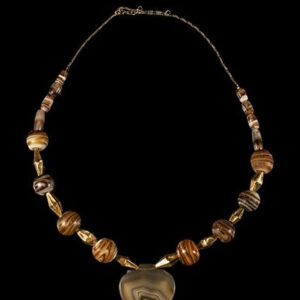
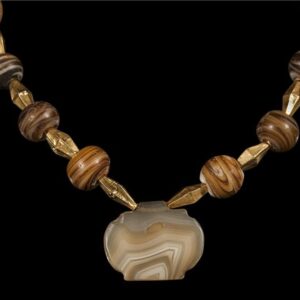
A very beautiful Byzantine banded multi shaped Agate beads necklace with 22K gold leaf covered diamond shaped inserts
JW_RM_1018
Byzantine Period, 600 C.E. – 700 C.E.
L. 47 cm
Excellent condition
$2500
The Baidun Collection
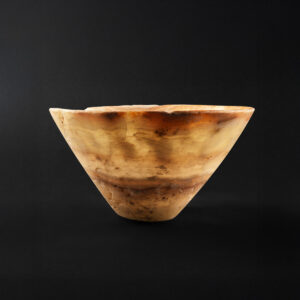
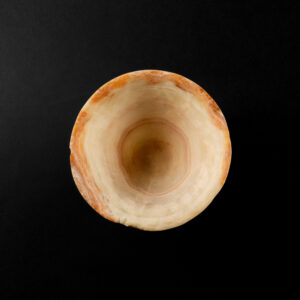
This elegant alabaster bowl exemplifies the artistry and craftsmanship of ancient Mesopotamian artisans. Crafted from fine, translucent alabaster, the bowl features a rounded, symmetrical form with a smooth, polished surface that showcases the natural beauty of the stone. Measuring approximately 12 cm in diameter and 7 cm in height, it is a compact yet finely detailed vessel.
The most striking feature of the bowl is its decorative banding, which encircles its exterior. These bands are composed of carved lines and geometric motifs, adding a sense of rhythm and harmony to the piece. The craftsmanship demonstrates a mastery of stone carving techniques, with precise incisions and smooth finishes that highlight the skilled artisanship of the period.
This vessel likely served both functional and ceremonial purposes, possibly used in ritual offerings or as a display piece in a noble or religious setting. Its durable alabaster material and sophisticated decoration reflect the high status of its owner and the cultural importance of craftsmanship in ancient Mesopotamian society.
SW-PR-1003
Mesopotamian, 1200 B.C.E. – 800 B.C.E.
L. 7cm
Fine condition
$3500
The Baidun Collection
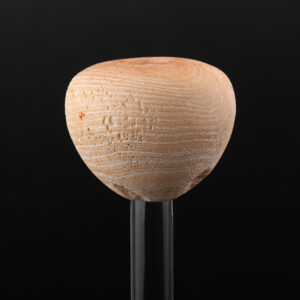
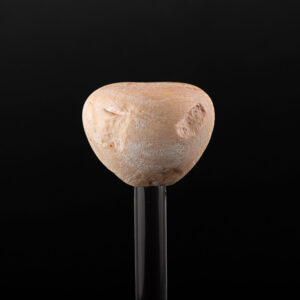
This commanding alabaster mace head exemplifies the artistry and technical skill of Egyptian stone‑workers of the Middle Bronze Age. Crafted from fine, dense alabaster, the piece presents a rounded, slightly pear‑shaped mass terminating in a short, tapering socket for hafting; its surfaces are smoothly finished to reveal the stone’s subtle veining and a soft, satin-like luster. Measuring approximately [dimensions available on request], it is a compact yet powerfully rendered implement.
The most striking feature of the mace head is its sculptural silhouette and the careful modulation of form between the striking face and the haft socket, which together create a balanced, purposeful object. The workmanship demonstrates mastery of stone‑shaping techniques, with precise contouring and evidence of controlled tool work around the socket and perimeter. Minor surface abrasions and faint impact marks may be present, consistent with functional use, while surviving tool marks are minimal and secondary to the overall polished presentation.
This object likely served both practical and symbolic roles: employed as a percussive weapon in conflict or as a status emblem and ceremonial object signaling authority and power. The selection of alabaster—a prized material—speaks to the prominence of its owner and the value attributed to finely
WP-PR-1002
Egyptian, Circa 2100 B.C.E. – 1550 B.C.E.
Time Of Abraham
L. 5cm
Fine condition
$1850
The Baidun Collection
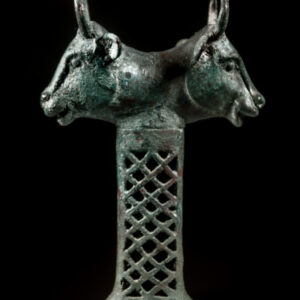
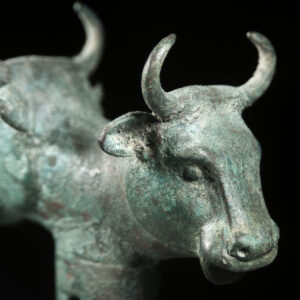
This Elamite Bronze Double-Headed Bull Mace Head, originating from the Near East region circa 2100–1550 B.C.E., is a striking example of ancient artistry and symbolism. The mace head features two imposing bull heads sculpted with remarkable detail and power, with their facial features exuding strength and dominance.
The bulls’ horns and expressions reflect the reverence for these animals in ancient cultures, often symbolizing fertility, power, and protection.
The handle, crafted in an openwork lattice style, showcases the artisan’s advanced skill in metalworking. The lattice pattern adds both aesthetic beauty and functional lightness to the piece. Though one of the bulls’ ears shows an ancient loss, the artifact remains in fine condition, its surface adorned with a rich natural patina, adding to its historical authenticity and appeal.
In the ancient Elamite kingdom, bulls were potent symbols of strength, fertility, and divine power, often associated with deities and rulers. This double-headed bull mace head likely held ceremonial or ritual significance, symbolizing authority, protection, or a connection to the divine. Its exquisite craftsmanship speaks to the advanced skills of the ancient Near Eastern metalworkers and their ability to imbue objects with profound cultural meaning.[/vc_column_text]
WP_AT_1001
Persian, Middle Bronze 2100 B.C.E. – 1550 B.C.E.
L. 19 cm, W. 13 cm
Fine condition.