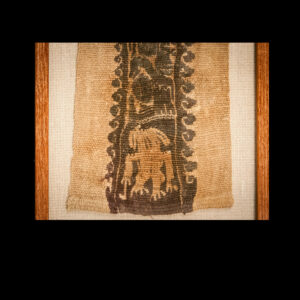
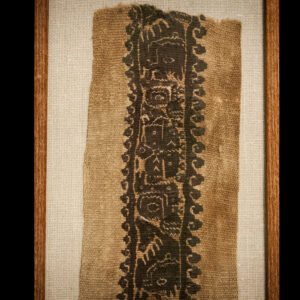
ANIMAL FRIEZE FRAGMENT. – Dark frieze of large fish and winged creatures arranged either facing each other or one behind the other on a light ground. At the left end a human figure with hunting weapon (lagobolon?) rendered in a light colour on a dark ground. Framed by spiral border.
Mounted on beige linen ground and framed. Fragments of tunics, tabulae, etc. – Cf. Cat. Leipzig – 2002, 113 ff. nos. 157–173 with ill.
REFERENCE
#TX_EG_1002
CIVILIZATION
Egypt, Coptic, 300 C.E. – 500 C.E.
SIZE
L. 29 cm, W. 10 cm
CONDITION
Fine Condition
PRICE
Sold
PROVENANCE
Formerly Coll. Eduard Schällibaum, 1950’s–60’s, Chur. – On back of frames, alleged find spot “Upper Egypt”, inv. no. “716. 269. 476”.
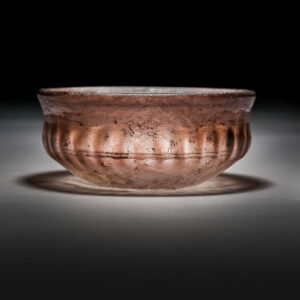
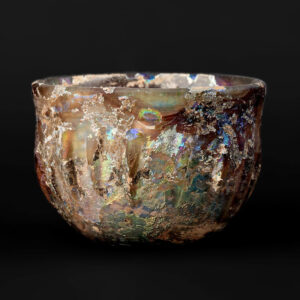
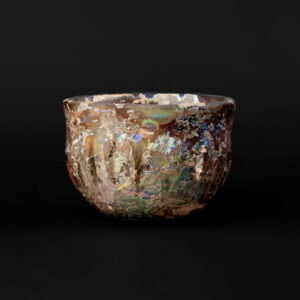
This elegant ribbed glass bowl exemplifies the artistry and technical skill of early Roman glassmakers. Crafted from a rare aubergine-hued soda‑lime glass, the bowl presents a gently flared rim and a rounded, harmonious profile with a lustrous, weathered surface that reveals a rich, multicolored iridescence developed through centuries of natural burial conditions. Measuring approximately [dimensions available on request], it is a compact yet striking domestic vessel.
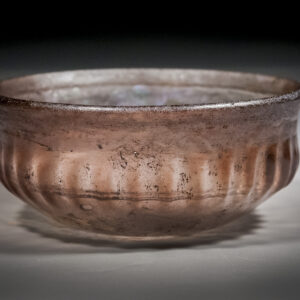
The most striking feature of the bowl is its pronounced vertical ribbing, which encircles the body and lends a rhythmic, tactile quality to the form. Two finely incised concentric lines around the midsection provide an elegant counterpoint to the ribs, demonstrating careful finishing by hand. The surface iridescence, a product of long-term chemical interaction rather than modern treatment, enhances the deep aubergine tone and accentuates the delicate interplay of light across the exterior.
The workmanship shows mastery of early glass techniques—likely mold‑forming for the ribbed body with subsequent hand incision—resulting in crisp, well-executed details and a smoothly rendered rim. The uncommon deep purple color and strong iridescent sheen mark this piece as a particularly refined example of provincial Roman glass production.
Likely used for both every day and display purposes, this bowl would have served as a functional domestic vessel and possibly as a valued item within a household’s tableware. Its durable glass, sophisticated surface effects, and rare coloration reflect both the aesthetic sensibilities and material culture of the early Imperial period. Found in Sabaste; early Roman, ca. 1st century AD.REFERENCE #
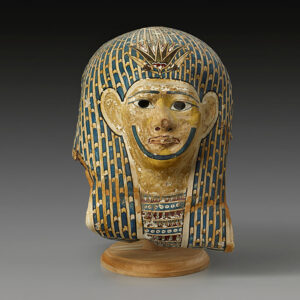
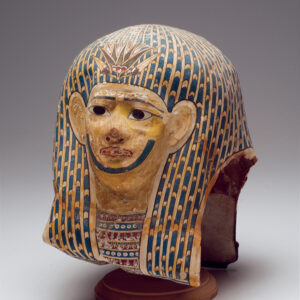
Made of cartonnage – a medium consisting of layers of fibers – this mummy mask features a broad foliate and beaded collar. The wig is decorated with an open lotus blossom on the forehead and a scarab on the crown. The cheek straps and other details are painted in blue, purple, red, pink and green on a yellow ground.
REFERENCE #
SI_EG_1049
CIVILIZATION
Egyptian, 100 C.E.
SIZE
H. 33 cm
CONDITION
Some normal areas of edge losses, mostly minor; a few open splits and some areas of the interior have been strengthened with a linen backing. Some normal minor paint flakes. Lower front portion of wig is curled under; the very tip of the nose chipped.
PRICE
Sold
PROVENANCE
Private NYS collection, ex. Sotheby’s, Sale 5464, lot 250, May 30th, 1986