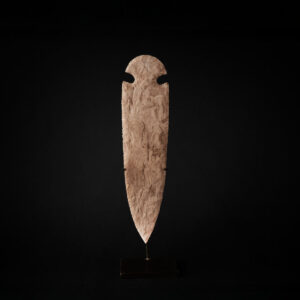
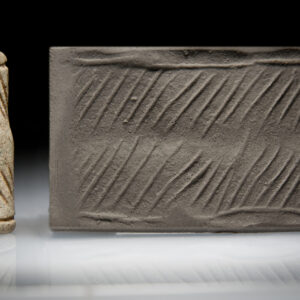
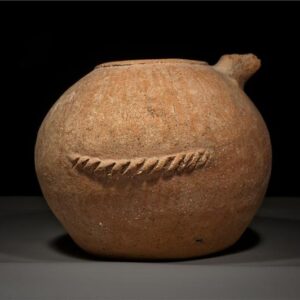
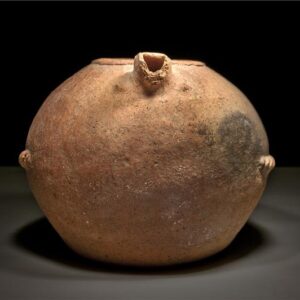
This exceptional Neolithic flint dagger exemplifies the sophisticated stone tool craftsmanship of early Egypt or the broader Levantine region, dating from approximately 6000 to 3150 BCE. The elongated, pointed form showcases skillful knapping and pressure flaking techniques, with a smooth surface and subtle signs of use wear, indicating its original function as a utilitarian weapon or ceremonial object. Made from high-quality flint, its natural color ranges from light beige to pale brown, with a finely worked edge that demonstrates the precision and artistry of Neolithic artisans. This piece retains excellent preservation and exhibits the characteristic features of early prehistoric tools—both functional and symbolic. Its history and craftsmanship make it a noteworthy acquisition for collectors, museums, or institutions seeking authentic artifacts from one of the most significant periods in human history. An opportunity to acquire a unique and visually striking example of ancient stone technology with profound cultural and archaeological significance.
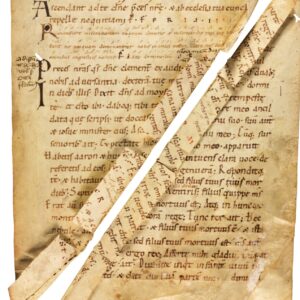
fragments: (i) 7 sections of leaves from a Missal, 5 triangular in shape (approximately 185mm. by 260mm.) and cut diagonally from the parent leaves, 2 further smaller pieces used as gathering supports (230mm. by 40mm. and 60mm. by 11mm.), the larger showing that the original codex was single column, 24 lines in light brown ink in a fine late Carolingian minuscule leaning to the right, with pronounced ct- and st-ligatures, lines of music in smaller script with simple neumes, rubrics (in ornamental capitals in style of ninth and tenth century) and simple red initials (some with tiny baubles at the head and foot), a few additions in later medieval hands including the apparent folio numbers “xxxi” and “xxxij” in late thirteenth-century script at the head of two leaves, Germany, second half of the eleventh century or c.1100; (ii) two long strips cut horizontally from a Lectionary leaf, each approximately 65mm. by 283mm., with remains of two columns of 7 lines of large and elegant early gothic script, rubrics and 17 one-line initials in red, Germany, mid-twelfth century; all recovered from bindings of early sixteenth-century books printed in Augsburg, and with some folds, scuffs, small stains and red ink oxidised to silver in places, but overall in good condition.
Reference #
MS_BZ_1012
Civilization
Byzantine, Medieval , 1100 C.E. – 1200 C.E.
Condition
Overall in good condition
Price
Price available upon request
Provenance
Baidun Collection, acquired at Sotheby’s sale December 2013
Prior to the New Kingdom, The Book of the Dead was only available to the royalty and the elite. The popularity of the Osiris Myth in the period of the New Kingdom made people believe the spells were indispensible because Osiris featured so prominently in the soul’s judgment in the afterlife. As more and more people desired their own Book of the Dead, scribes obliged them and the book became just another commodity produced for sale.
In the same way that publishers in the present day offer Print on Demand books or self-published works, the scribes offered different “packages” to clients to choose from. They could have as few or as many spells in their books as they could afford. Bunson writes, “The individual could decide the number of chapters to be included, the types of illustrations, and the quality of the papyrus used. The individual was limited only by his or her financial resources” (48).
From the New Kingdom through the Ptolemaic Dynasty (323 – 30 BCE) The Book of the Dead was produced this way. It continued to vary in form and size until c. 650 BCE when it was fixed at 190 uniform spells but, still, people could add or subtract what they wanted to from the text. A Book of the Dead from the Ptolemaic Dynasty which belonged to a woman named Tentruty had the text of The Lamentations of Isis and Nephthys attached to it which was never included as part of the Book of the Dead. Other copies of the book continued to be produced with more or less spells depending on what the buyer could afford. The one spell which every copy seems to have had, however, was Spell 125.
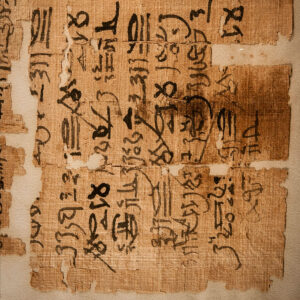
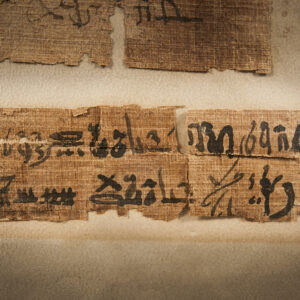
Featured here are several papyrus fragments of the Egyptian Book of the Dead from Egypt’s Ptolemaic Era (305 – 30 BCE). Examining Egyptian art during these 300 years reveals strong continuities in its traditions but also interactions with Greek art, whose forms and styles swept the world with Alexander’s armies. The encounter of the two cultures had many aspects and phases, and is easiest to comprehend by looking first at the new ruling class, its involvements and concerns, and then at religion and the arts in the greater land of Egypt.
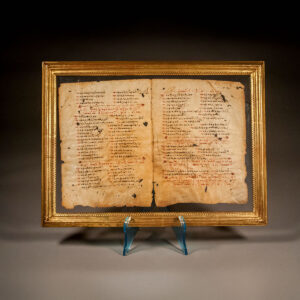
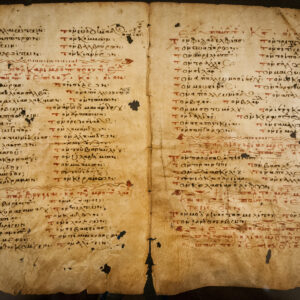
Greek bifolium from the inside of a gathering with Greek foliation in a later hand, ff. 119, 120. Written on vellum in a small, neat minuscule hand in dark brown ink with section heading, initials, and ornamental penwork divisions in red. It does not appear to have been ruled.
Date: 11th century. See V. Gardthausen, Griechische Palæographie: Zweiter Band: Die Schrift, Unterschriften und Chronologie im Altertum und im byzantinischen Mittelalter, Zweite Auglage (Leipzig: Verlag von Veit & Comp., 1913), Taf. 7.
Provenance: This was formerly in the collection of late Professor David Bitzer of the Union Theological Seminary in Richmond, Virginia, According to De Ricci & Wilson he obtained it from the London dealer Leighton. The consignor was a descendant of Bitzer.
Contents:
The contents follow that of the edition of the Notitiæ by Darrouzès. The list for each eparchy has been supplied from a scanned image of his work in Notitia 1, 144-326, pp. 207-211.