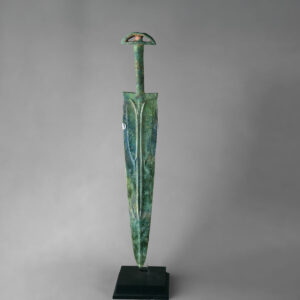
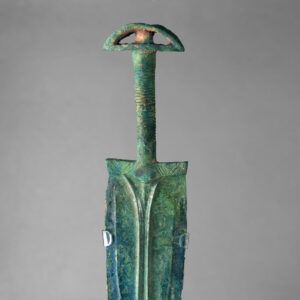
This Persian sword is a remarkable example of the technology and design that went into crafting an ancient piece of weaponry. The dark hue of this sword lends it an austere weight, while the thick ribs and large crescent of the hilt are an indication of the strength required to wield such a heavy object. The broad blade seems to be made not for bludgeoning as much as cutting, with the raised ridge that runs along its length adding force to its blows.
This is a piece that makes a forceful statement in any collection, especially for collectors looking for a simpler alternative to the overwrought designs of later civilizations. The ancient Persians were known for their battle prowess, and this weapon is a fine example as to the tools ancient warriors had at their disposal. This sword has been wonderfully restored and displays a brilliant luster that still gleams along its long blade.
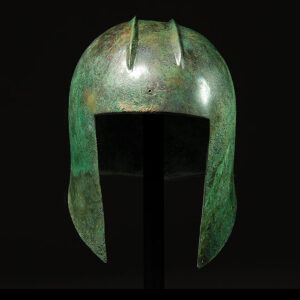
This bronze helmet is designed for combat rather than purely ceremonial purposes, with blade-like wings which slide forward under the jawline from a straight-edge forehead margin. The top of the helmet is fortified with two prominent structural ‘ribs’ designed to deflect sword blows, while the rear edge of the helmet – above the shoulders – is lipped outwards to provide a neck guard. There are faint marks indicating that the helmet was indeed struck, probably by a sword, on the left side.
The early date of this piece put it in the Illyrian (i.e. Macedonian and Albanian) kingdom of the Enchelei, an 8th and 7th century B.C.E. polity focused around Lake Ohrid in what is now Albania and Macedonia. Their economy appears to have been based mainly on fishing, and they had extensive trade networks with Greece. They also had an uneasy relationship with local tribes including Macedonians and the Dardani, among others, and the fact that they seem to have spent much of their time at war may explain why so much of their art and material culture is based around warrior-like iconography and accessories. A helmet such as this would have been worn by a lightly-armed foot-soldier (or Hoplite, in Greek terms), and was designed for skirmishing. This is an evocative and impressive piece of ancient art.
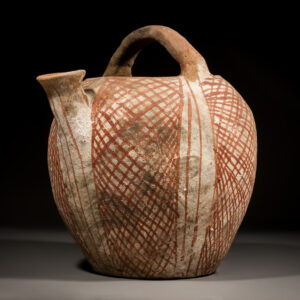
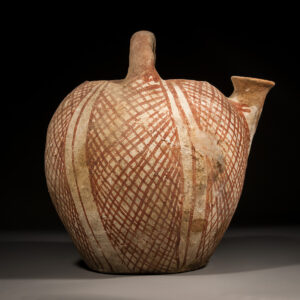
This round Canaanite jug is covered in a series of frenzied red lines that seem to buzz through time, the intersecting spaces broken up by a clearing of just three vertical marks at four spots along the jug’s body. The jug’s basket handle arches above the mouth’s large opening, while a short spout arises from the front, flaring slightly for an easy pour.
The little we know of ancient Canaan comes from the rich archeological record they left behind. This piece is an excellent example of the simple rites of ancient history, when the storage and transportation of water meant the difference between life and death in the arid realm of Canaan.
REFERENCE #
KB_PT_9993
CIVILIZATION
Early Bronze Age I, 3500 B.C.E. – 3000 B.C.E.
SIZE
H. 21.5 cm
CONDITION
Fine condition
PRICE
Price available upon request[/vc_column_text][/vc_column][/vc_row]
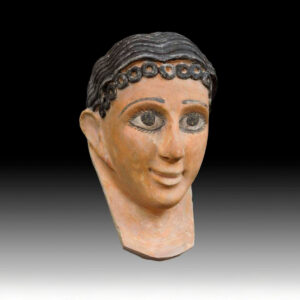
Plaster mummy portrait of a young girl, with slender features and tan flesh tones. Her full lips are pursed into a smile, rendering her features serene. Her black hair is molded with front row of small curls, and parted in the middle hair fashion. The eyes and eyebrows are stylistically delineated with black lines and beautiful lashes. She is wearing a pair of earrings. Areas of linen wrappings are preserved on the interior.
REFERENCE #
SI_EG_1053
CIVILIZATION
Ptolemaic period, 305 B.C.E. – 30 B.C.E.
SIZE
H. 29 cm
CONDITION
Professional restoration on the paint and the plaster, overall in fine condition
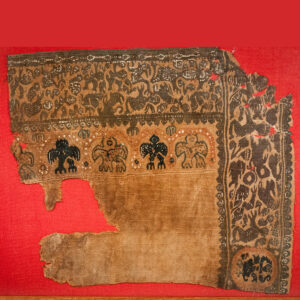
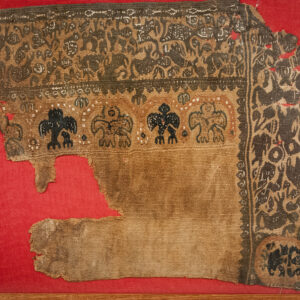
CORNER FRAGMENT – A frieze corner with framed, dark ornamental band on a light ground, densely filled with various floral patterns, kneeling human figures, fish and mythical creatures, plus filler motifs. At one end of the frieze, a small tondo with a dancing (?) human figure. Foliage-filled border at three frieze edges. Along one side inside the border another frieze of four and a half winged figures on talons.
Mounted on red linen ground and framed. Fragments of tunics, tabulae, etc. – Cf. Cat. Leipzig – 2002, 113 ff. nos. 157–173 with ill.
REFERENCE #
TX_EG_1006
CIVILIZATION
Egypt,
Coptic, 300 C.E. – 500 C.E.
SIZE
L. 26 cm, W. 22.5 cm
CONDITION
Fine Condition
PRICE
$1,500
PROVENANCE
Formerly Coll. Eduard Schällibaum, 1950’s–60’s, Chur. – On back of frames, alleged find spot “Upper Egypt”, inv. no. “716. 269. 476”.