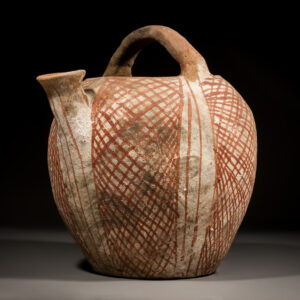
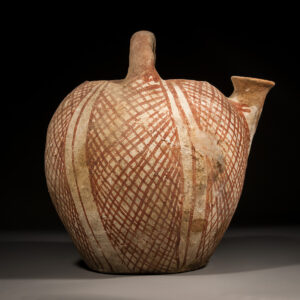
This round Canaanite jug is covered in a series of frenzied red lines that seem to buzz through time, the intersecting spaces broken up by a clearing of just three vertical marks at four spots along the jug’s body. The jug’s basket handle arches above the mouth’s large opening, while a short spout arises from the front, flaring slightly for an easy pour.
The little we know of ancient Canaan comes from the rich archeological record they left behind. This piece is an excellent example of the simple rites of ancient history, when the storage and transportation of water meant the difference between life and death in the arid realm of Canaan.
REFERENCE #
KB_PT_9993
CIVILIZATION
Early Bronze Age I, 3500 B.C.E. – 3000 B.C.E.
SIZE
H. 21.5 cm
CONDITION
Fine condition
PRICE
Price available upon request[/vc_column_text][/vc_column][/vc_row]
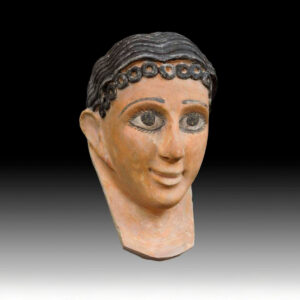
Plaster mummy portrait of a young girl, with slender features and tan flesh tones. Her full lips are pursed into a smile, rendering her features serene. Her black hair is molded with front row of small curls, and parted in the middle hair fashion. The eyes and eyebrows are stylistically delineated with black lines and beautiful lashes. She is wearing a pair of earrings. Areas of linen wrappings are preserved on the interior.
REFERENCE #
SI_EG_1053
CIVILIZATION
Ptolemaic period, 305 B.C.E. – 30 B.C.E.
SIZE
H. 29 cm
CONDITION
Professional restoration on the paint and the plaster, overall in fine condition
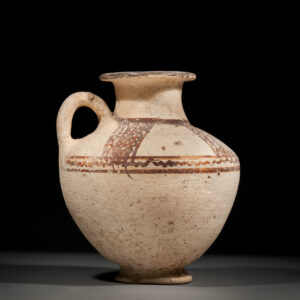
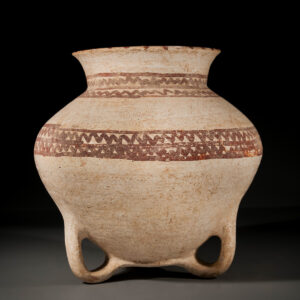
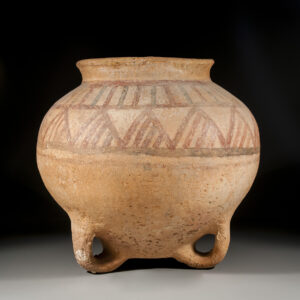
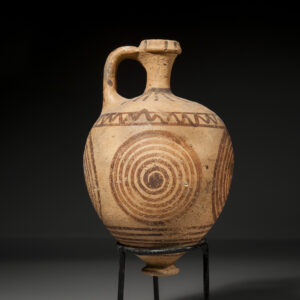
Canaanite artisans were prolific, and their pottery came in an array of fantastic shapes, colors and sizes. This white ware jug is no exception, its ghostly exterior marked with dark brown lines that zigzag across the top half of its bulbous body. A wide base supports the body itself, while the short neck above ends at a large flat mouth.
A handle rises abruptly from the body and connects at the neck’s base, making a sturdy loop for the well-worn hands of an ancient Canaanite
The distinctive base of this Canaanite jar is made of three looped legs that prop the body up in tripod-like fashion. The design is more aesthetically pleasing than innovative, yet the rest of the jug was carefully made to exacting standards that allowed for the flawless curves of its white ceramic exterior.
The upper half of the jug is decorated with chocolate brown bands that alternate between straight lines and tightly wound zigzags. The overall effect is an ancient artifact imbued with a timeless sense of artistry and originality.REFERENCE #
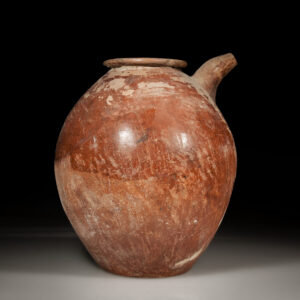
The natural polish of this red slip spouted jar shines brightly even under the softest of lights. The large ovoid body of this piece has no neck, but instead a flattened ring atop its mouth and a bent spout with a small hole for measured pouring. This suggests an efficiency commonly found throughout the arid regions of ancient Canaan, when water and wine were too important for the casual spill.
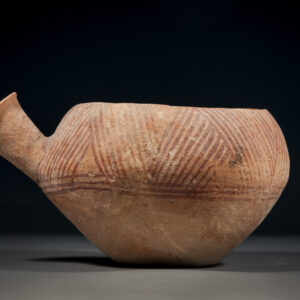
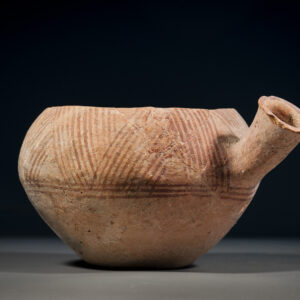
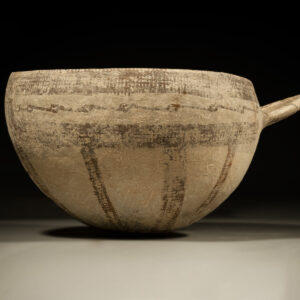
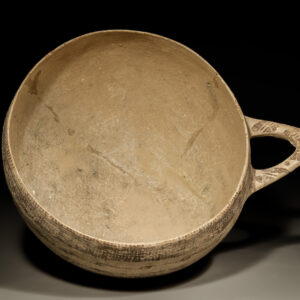
Wide Canaanite terra-cotta bowl with a single large spout protruding at a 45-degree angle from halfway up the body. The body tapers to a flattened base while the large mouth lacks embellishment. Monochrome paint marks the body’s upper half in parallel lines that intersect in diagonal planes.
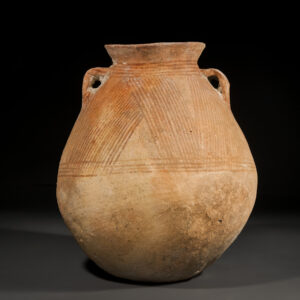
The thin lines that mark the top half of this large amphoriskos are on the primal end of art history, yet their application is so intricate as to reveal the care and attention to detail of the Canaanite artisan who applied them to the vessel’s exterior over 5000 years ago.
The large egg-shaped body of this amphoriskos allowed it to hold substantial amounts of liquid, be it wine, water or oil. The rich desert tones of its smooth exterior stand out boldly among the monochrome paint that scratch its surface.
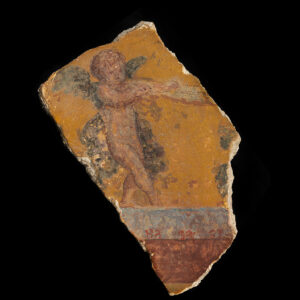
A fragment from a frieze depicting Eros as a winged child pulling on one end of a swag or garland. He is depicted naked apart from a cloak that hangs from his shoulders and behind his body, visible flapping loosely on either side of his legs. The fluttering ends of a cloak belonging to a second figure, presumably another Eros or possibly a Psyche, can be seen on the right. Painted on an ochre background with remains of two bands below of sky blue and terracotta. The edge of a lower register visible.
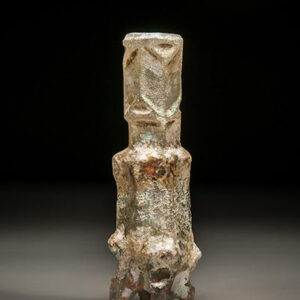
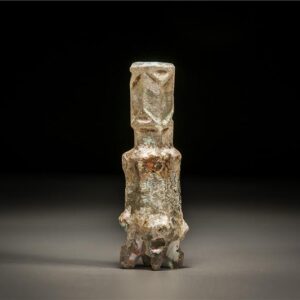
Colorless, bubbly/mold-blown. Ground rim, neck narrowing toward bottom, square body, which at the bottom part divides into four cut wedge-shaped feet arranged around a flat bottom. The Molar bottle is a characteristic example of cut Islamic glass. Its name derives from the four wedge-shaped feet, which resemble the root of a molar tooth. In Lamm’s opinion, such bottles were manufactured in Egypt, from where they were distributed throughout the Islamic world as perfume containers. Similar bottles were also fashioned from metal and ivory. They were common in the 900 and 1000 AD, but thereafter their production was ceased. They have been found in Iraq, Iran, Egypt, Syria and the holy land.
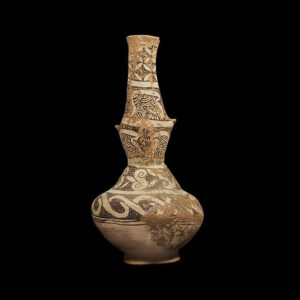
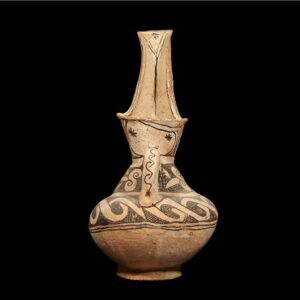
This ewer is from the reign of the Ayyubid dynasty that ruled much of the Middle East for over a century starting in approximately 1100 C.E.. The Ayybuids were Islamic warriors who conquered parts of Egypt, Syria, northern Mesoptamia, the Kingdom of Jerusalem and the southwestern swath of the Arabian Peninsula. In such a region, water was essential in daily life, and the cool relief that this ewer brought was not lost on those who received a glass from its long spout.
This ewer is of a recognizable shape, although the elongated mouth and the three careful holes at the neck’s top show how water was guarded preciously from being wasted in the desert. We see distinct Islamic designs that closely resemble the fluid movement of Arabic calligraphy. The crude craftsmanship gives way to the ewer’s brilliant front, designed with such intricate lines and patterns so as to lift this everyday object up beyond the everyday into a truly beautiful piece of antiquity. The ewer dates from approximately 1000 C.E. – 1200 C.E. and is 28 cm in height.