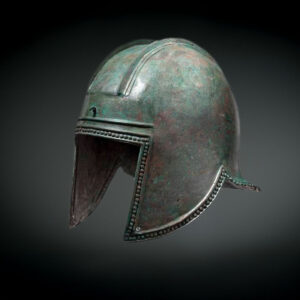
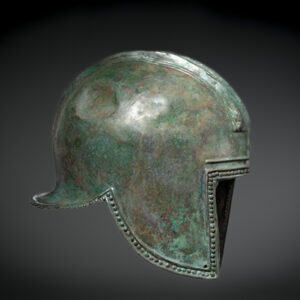
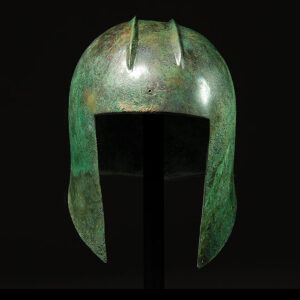
This bronze helmet is designed for combat rather than purely ceremonial purposes, with blade-like wings which slide forward under the jawline from a straight-edge forehead margin. The top of the helmet is fortified with two prominent structural ‘ribs’ designed to deflect sword blows, while the rear edge of the helmet – above the shoulders – is lipped outwards to provide a neck guard. There are faint marks indicating that the helmet was indeed struck, probably by a sword, on the left side.
The early date of this piece put it in the Illyrian (i.e. Macedonian and Albanian) kingdom of the Enchelei, an 8th and 7th century B.C.E. polity focused around Lake Ohrid in what is now Albania and Macedonia. Their economy appears to have been based mainly on fishing, and they had extensive trade networks with Greece. They also had an uneasy relationship with local tribes including Macedonians and the Dardani, among others, and the fact that they seem to have spent much of their time at war may explain why so much of their art and material culture is based around warrior-like iconography and accessories. A helmet such as this would have been worn by a lightly-armed foot-soldier (or Hoplite, in Greek terms), and was designed for skirmishing. This is an evocative and impressive piece of ancient art.
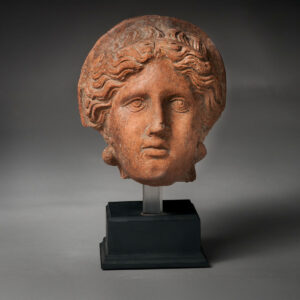
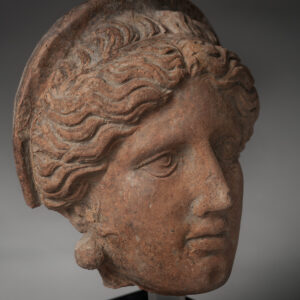
The front of the head is made from a mold and with a modeling tool reworked. The rear is Hollow. The sculpture shows a young female’s head in frontal orientation The even facial features women are very attractive. Expressive, with deep-set eyes coupled with strong eyelids. The pupils are clearly defined. A Strong protruding nose and full lips slightly opened. the chin has a gentle dimple. The symmetrically styled hair is parted in the middle, starting in soft curls that are combed back. On the cheeks is a single sleeping curls, and round earrings. The hairstyle is held by a headband. More curls on Top of the head are covered by a corona.
Cf .: St. Ohlig , antique cabinet, catalog no. 3 ( 1998) ” The Etruscans , a sign of life Civilized people . ” Fig.53 .
REFERENCE #
P 20753
CIVILIZATION
Greek, 400 B.C.E.
SIZE
H. 19.5 cm
CONDITION
A small chip on the tip of the nose, otherwise in Fine quality,
PRICE
Price available upon request
PROVENANCE
Private collection of Dr. Ludenscheid , acquired in the 1960s
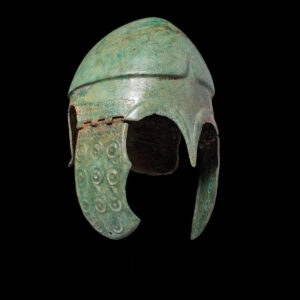
A bronze Illyrian helmet with dark green patina. Tall skull with distinctly raised and stepped ridges, fastening hooks for the attachment of a crest at front and at back. Large face-opening surmounted by two ribs across the brow, long pierced cheek-pieces and flared neck-guard. A row of lenticular decorative pins around the perimeter.
REFERENCE #
WP_GR_1008
CIVILIZATION
Greek, 600 B.C.E.
SIZE
H. 23 cm
CONDITION
Some restorations at the crown, the face-opening and the nape
The shape of this bronze shin guard or ‘greave’ is emphasized by the exaggeration of the anatomical muscular structure, on one side a deep crescent-shaped groove and a bulge indicates the position of the calf. The arched upper end protected the knee joint. Above the ankle, the outline of the plaque is rounded and slightly flared to allow for movement.
REFERENCE #
WP_GR_1010
CIVILIZATION
Greek, 600 B.C.E.
SIZE
H. 42 cm
CONDITION
Minor repairs for cracks, and some reinforcements done from the inside
PRICE
Price available upon request
PROVENANCE
Previously in a private Japanese collection since the 1970’s
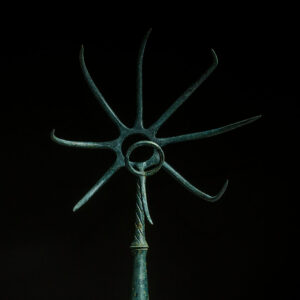
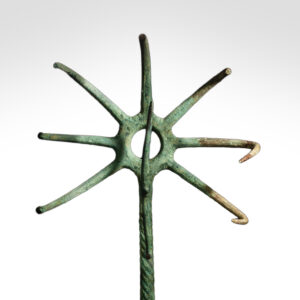
A bronze Etruscan harpago, or underwater sponge collecting hook, with seven curved tines set radially around a central torus. The hook piece is set upon a large handle with a coiled design along its shaft. An additional pair of tines protrudes just below the torus at the top of the coiled shaft.
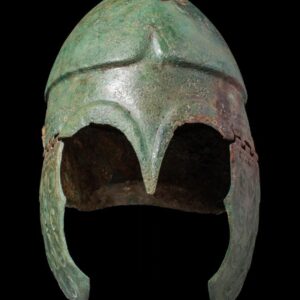
This helmet has a domed crown with medial ridge, with contoured inverted ‘V’ shape above the brow continuing as an occipital rib around the helmet, with pronounced arched brows and narrow flared neck guard, the hinges connected to intact original cheek-guards with rich green patina. The domed crown has a medial ridge, with a contoured inverted ‘V’ shape above the brow continuing as an occipital rib around the helmet, pronounced arched brows and a narrow flared neck guard; the hinges remaining connecting to cheek-pieces originally attached. ‘Chalcidian’ helmets are so named as they resemble those depicted on pottery from the Euboean city of Chalcis. They were used throughout the Greek world as a lighter, less bulky version of the earlier ‘Corinthian’ helmet.
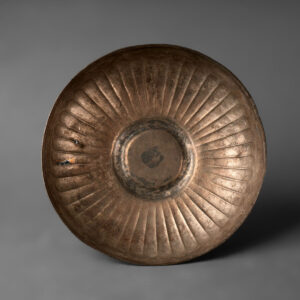
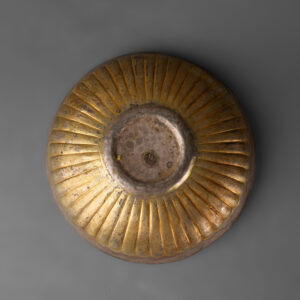
Gilded silver Phiale wine ribbed bowl from the Greco-Achaemenid period, circa 500–300 BC. This luxurious vessel measures approximately 18 cm in diameter and exemplifies the opulence of fine Greek and Persian craftsmanship during this era. The bowl features a shallow, broad form with a gently flared rim, designed both for aesthetic appeal and practical use.
The surface of the bowl is richly gilded, adding a radiant golden glow that accentuates its luxurious nature. Its most distinctive feature is the ribbed design, with evenly spaced, decorative flutes encircling the exterior that create a textured, elegant pattern and enhance its visual impact. The craftsmanship demonstrates a high level of skill, combining precise metalworking techniques with ornamental artistry.
Intended as a high-status drinking vessel for ceremonial or banquet use, this gilded silver Phiale reflects the cultural exchange and artistic refinement characteristic of the Greco-Achaemenid period. The combination of precious materials and intricate decoration signifies its importance as a symbol of wealth and prestige in social or religious contexts.REFERENCE #
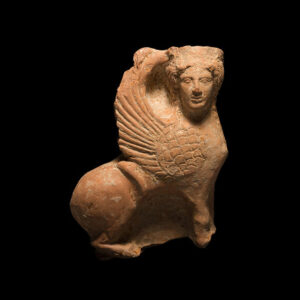
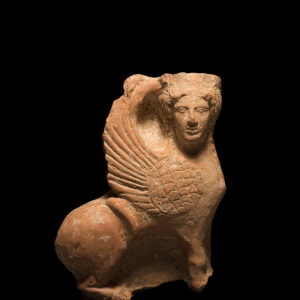
According to ancient literary sources, the sphinx was a monster with the face and bust of a woman, the talons of a lion, the body of a dog, a serpent’s tail and wings of a bird. Its pale appearance, venomous mouth and stony gaze characterised this demon of divine origin. Its presence amongst humans created uncertainty and fear. It is possible that this hybrid had its origin in Egyptian iconography, where it was represented with the body of a feline and a human face, and was probably related to the divine power of the pharaoh.
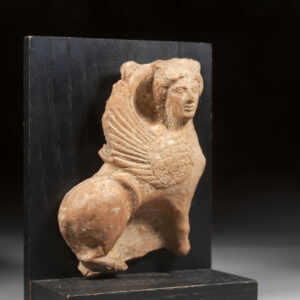
This terracotta piece shows a monster seated on its haunches and in profile, with its head turned to the right toward the public. The female countenance has idealised features of great beauty. The thick, wavy hair is crowned with a polos or crown on the Corinthian model. On the right wing the rendering of the feathers shows a clear interest in the anatomical details of birds: the feathers inserted into the body itself are small and short, rather like scales, while those at the extreme end of the wing are long and narrow, to help the bird take flight.
The sculptural prototype of Greek sphinxes appears around the 7th century BC in terracotta, and was usually found decorating large receptacles. A century later they appeared in marble crowning seated ex-votos on a column. The monstrous, aggressive nature of the hybrid was channelled into funerary art, serving as an apotropaic symbol to keep away malevolent forces. It was usual, therefore, to find this iconography in metopes and hollow acroteria in Greek necropoleis of the 6th century BC, usually with the animal in profile and turning its head toward the public in an attitude of defiance.
BIBLIOGRAPHY:
BILLOT, M.F. “Le Sphinx du Louvre CA 637”, Bulletin de Correspondence Hellénique. 1977.
MARCONI, C. Temple Decoration and Cultural Identity in the Archaic Greek World. Getty Foundation. 2007, p. 90.
RENGER, A.B. Oedipus and the Sphinx: The Threshold Myth from Sophocles through Freud to Cocteau. UCP. 2013.
STILLWELL, A. N. Corinth: The Potters’ Quarter. Harvard Univ. Press. 1952.
REFERENCE #
SI_GR_1034
Civilization Greek,
6th – 5th century B.C.E.
SIZE
H. 18 cm
CONDITION
In a good state of preservation, without any restoration.
PROVENACE,
Private collection G. A., Gardena, California, USA.
According to ancient literary sources, the sphinx was a monster with the face and bust of a woman, the talons of a lion, the body of a dog, a serpent’s tail and wings of a bird. Its pale appearance, venomous mouth and stony gaze characterised this demon of divine origin. Its presence amongst humans created uncertainty and fear. It is possible that this hybrid had its origin in Egyptian iconography, where it was represented with the body of a feline and a human face, and was probably related to the divine power of the pharaoh.
This terracotta piece shows a monster seated on its haunches and in profile, with its head turned to the right toward the public. The female countenance has idealised features of great beauty. The thick, wavy hair is crowned with a polos or crown on the Corinthian model. On the right wing the rendering of the feathers shows a clear interest in the anatomical details of birds: the feathers inserted into the body itself are small and short, rather like scales, while those at the extreme end of the wing are long and narrow, to help the bird take flight.
The sculptural prototype of Greek sphinxes appears around the 7th century BC in terracotta, and was usually found decorating large receptacles. A century later they appeared in marble crowning seated ex-votos on a column. The monstrous, aggressive nature of the hybrid was channelled into funerary art, serving as an apotropaic symbol to keep away malevolent forces. It was usual, therefore, to find this iconography in metopes and hollow acroteria in Greek necropoleis of the 6th century BC, usually with the animal in profile and turning its head toward the public in an attitude of defiance.
BIBLIOGRAPHY:
BILLOT, M.F. “Le Sphinx du Louvre CA 637”, Bulletin de Correspondence Hellénique. 1977.
MARCONI, C. Temple Decoration and Cultural Identity in the Archaic Greek World. Getty Foundation. 2007, p. 90.
RENGER, A.B. Oedipus and the Sphinx: The Threshold Myth from Sophocles through Freud to Cocteau. UCP. 2013.
STILLWELL, A. N. Corinth: The Potters’ Quarter. Harvard Univ. Press. 1952.
Reference #
SI_GR_1037
Civilization Greek,
6th – 5th century B.C.E.
Size
H. 18 cm
Condition
In a good state of preservation, without any restoration.
Provenance,
Private collection G. A., Gardena, California, USA.
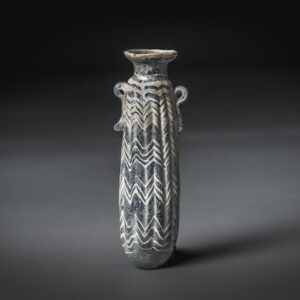
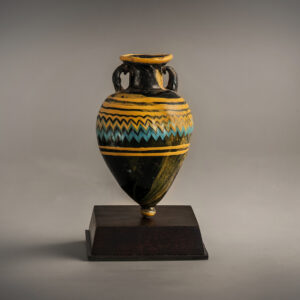
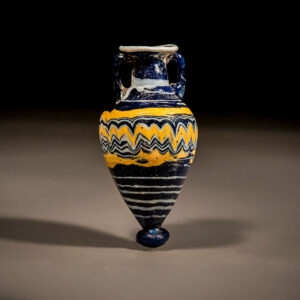
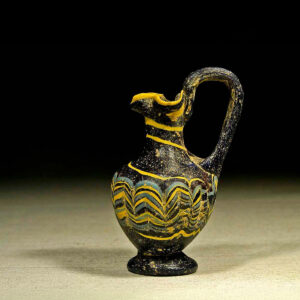
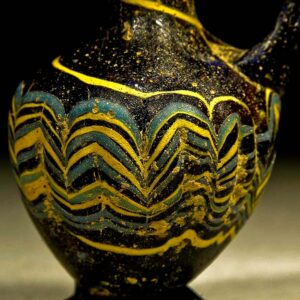
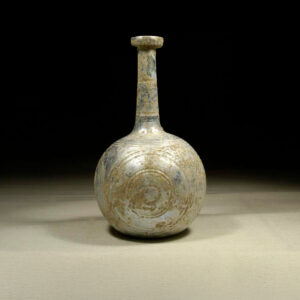
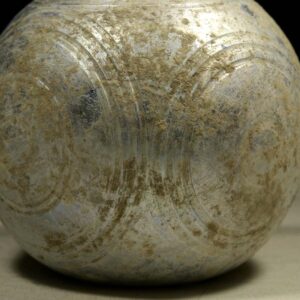
A beautiful and graceful long necked glass flask, decorated with four concentric circles around the body. And more circles at the bottom of the neck and along it. It is a very heavy piece because of its thick walls. The circles were done by etching the glass with a stone tool.

 Out of stock