A Bronze Greek Helmet of Illyrian TypeOut of stock

A Bronze Greek Helmet of Illyrian Type

Description

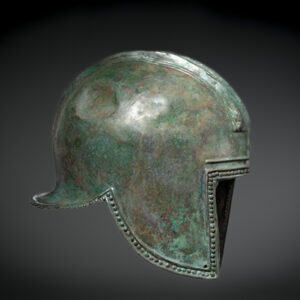
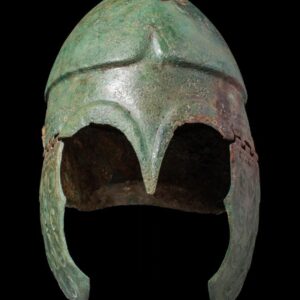
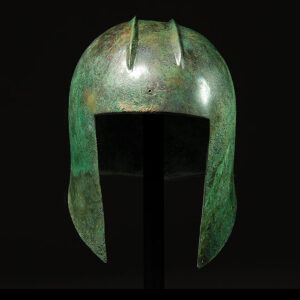
This bronze helmet is designed for combat rather than purely ceremonial purposes, with blade-like wings which slide forward under the jawline from a straight-edge forehead margin. The top of the helmet is fortified with two prominent structural ‘ribs’ designed to deflect sword blows, while the rear edge of the helmet – above the shoulders – is lipped outwards to provide a neck guard. There are faint marks indicating that the helmet was indeed struck, probably by a sword, on the left side.

The early date of this piece put it in the Illyrian (i.e. Macedonian and Albanian) kingdom of the Enchelei, an 8th and 7th century B.C.E. polity focused around Lake Ohrid in what is now Albania and Macedonia. Their economy appears to have been based mainly on fishing, and they had extensive trade networks with Greece. They also had an uneasy relationship with local tribes including Macedonians and the Dardani, among others, and the fact that they seem to have spent much of their time at war may explain why so much of their art and material culture is based around warrior-like iconography and accessories. A helmet such as this would have been worn by a lightly-armed foot-soldier (or Hoplite, in Greek terms), and was designed for skirmishing. This is an evocative and impressive piece of ancient art.

REFERENCE #

WP_GR_1007

CIVILIZATION

Greek, 700 B.C.E. – 500 B.C.E.

SIZE

H. 27 cm

CONDITION

Fine condition

PRICE

Sold
An Illyrian Helmet

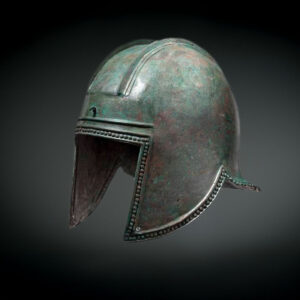
A bronze Illyrian helmet with dark green patina. Tall skull with distinctly raised and stepped ridges, fastening hooks for the attachment of a crest at front and at back. Large face-opening surmounted by two ribs across the brow, long pierced cheek-pieces and flared neck-guard. A row of lenticular decorative pins around the perimeter.


REFERENCE #

WP_GR_1008

CIVILIZATION

Greek, 600 B.C.E.

SIZE

H. 23 cm

CONDITION

Some restorations at the crown, the face-opening and the nape

PRICE

Sold

Archaic Bronze Greave

The shape of this bronze shin guard or ‘greave’ is emphasized by the exaggeration of the anatomical muscular structure, on one side a deep crescent-shaped groove and a bulge indicates the position of the calf. The arched upper end protected the knee joint. Above the ankle, the outline of the plaque is rounded and slightly flared to allow for movement.

REFERENCE #

WP_GR_1010

CIVILIZATION

Greek, 600 B.C.E.

SIZE

H. 42 cm

CONDITION

Minor repairs for cracks, and some reinforcements done from the inside

PRICE

Price available upon request

PROVENANCE

Previously in a private Japanese collection since the 1970’s


Chalcidian Bronze Helmet with Cheek Guards

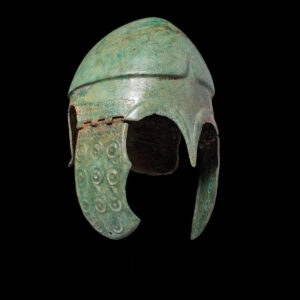
This helmet has a domed crown with medial ridge, with contoured inverted ‘V’ shape above the brow continuing as an occipital rib around the helmet, with pronounced arched brows and narrow flared neck guard, the hinges connected to intact original cheek-guards with rich green patina. The domed crown has a medial ridge, with a contoured inverted ‘V’ shape above the brow continuing as an occipital rib around the helmet, pronounced arched brows and a narrow flared neck guard; the hinges remaining connecting to cheek-pieces originally attached. ‘Chalcidian’ helmets are so named as they resemble those depicted on pottery from the Euboean city of Chalcis. They were used throughout the Greek world as a lighter, less bulky version of the earlier ‘Corinthian’ helmet.


REFERENCE #

WP_GR_1009

CIVILIZATION

Greek, 500 B.C.E. – 400 B.C.E.

SIZE

H. 32.8 cm

CONDITION

Fine Condition

PRICE

Price Upon Request


Gilded Silver Phiale Wine Ribbed Bowl

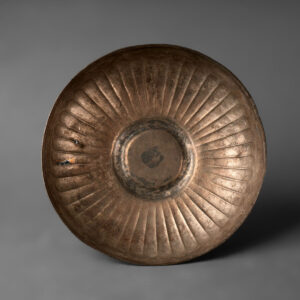
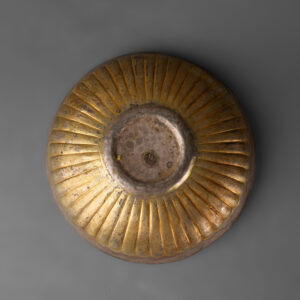
Gilded silver Phiale wine ribbed bowl from the Greco-Achaemenid period, circa 500–300 BC. This luxurious vessel measures approximately 18 cm in diameter and exemplifies the opulence of fine Greek and Persian craftsmanship during this era. The bowl features a shallow, broad form with a gently flared rim, designed both for aesthetic appeal and practical use.

The surface of the bowl is richly gilded, adding a radiant golden glow that accentuates its luxurious nature. Its most distinctive feature is the ribbed design, with evenly spaced, decorative flutes encircling the exterior that create a textured, elegant pattern and enhance its visual impact. The craftsmanship demonstrates a high level of skill, combining precise metalworking techniques with ornamental artistry.

Intended as a high-status drinking vessel for ceremonial or banquet use, this gilded silver Phiale reflects the cultural exchange and artistic refinement characteristic of the Greco-Achaemenid period. The combination of precious materials and intricate decoration signifies its importance as a symbol of wealth and prestige in social or religious contexts.REFERENCE #

MW_GR_1007

CIVILIZATION

Greek, 500 B.C.E.

SIZE

D. 18cm

CONDITION

Fine condition

PRICE

$14950

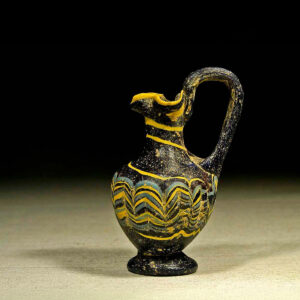
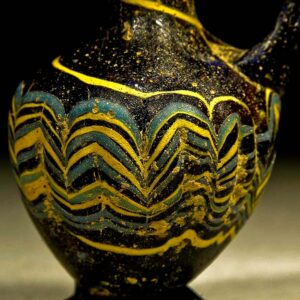
Greek Core Formed Glass Oinochoai

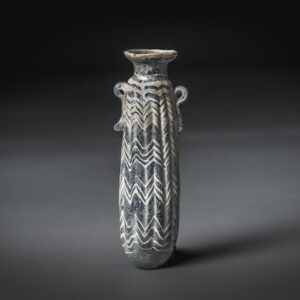
A beautiful aubergine Greek two tone core formed glass Oinochoai with opaque blue and opaque yellow decoration. A trefoil mouth with a single handle.

Cf. Grose D., The Toledo Museum of Art  Early Ancient Glass, no. 114, pg. 96

REFERENCE #

GL_GR_1003

CIVILIZATION

Greek, 600 B.C.E. – 500 B.C.E.

SIZE

10 cm

CONDITION

Fine Condition. A small chip on the rim

PRICE

Price available upon request

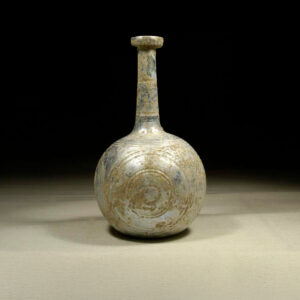
Greek Long Necked Glass Flask

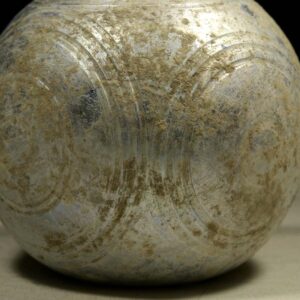
A beautiful and graceful long necked glass flask, decorated with four concentric circles around the body. And more circles at the bottom of the neck and along it. It is a very heavy piece because of its thick walls.  The circles were done by etching the glass with a stone tool.

REFERENCE #

GL_GR_1001

CIVILIZATION

Greek, 500 B.C.E. – 400 B.C.E.

SIZE

18 cm

CONDITION

Fine condition

Price

available upon request

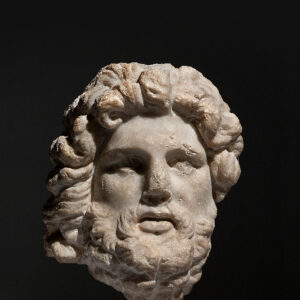
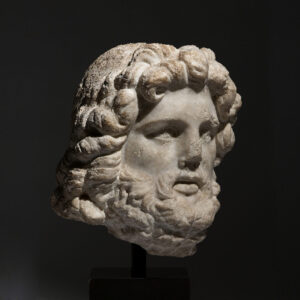
Hellenistic Marble Head of Zeus

Zeus’ imposing presence was felt throughout Ancient Greece as evidenced by the many sculptures and paintings of his image that make up the region’s archaeological record. This white marble sculpture of Zeus dates from Greece’s Hellenistic period of approximately 300-200 B.C.E., a time when Greek sculpture had entered a Classical period defined by its rigid poses and severe features. This figure’s lush hair, parted lips, and strong brow show the emphasis placed on such stylized details during Greece’s Classical period.

This sculpture is a highly realistic representation of Zeus, and it may be that the sculptor based this image on someone he knew from his everyday life. This sculpture is a breathtaking example of the technical skill and detailed eye of Greece’s celebrated sculptors. The piece has been restored to reveal the sculpture’s original power, although the body has been lost to history’s vagaries.

REFERENCE #

SI_GR_1011

CIVILIZATION

Greek Hellenistic, 300 B.C.E. – 200 B.C.E.

SIZE

H. 30 cm

CONDITION

Fine condition

PRICE

P.O.R

PROVENANCE

English Private Collection of a German Professor, ca 1970’s