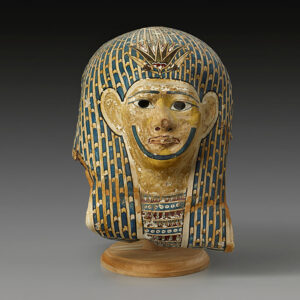
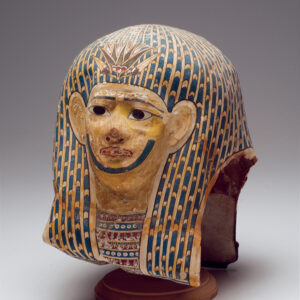
Made of cartonnage – a medium consisting of layers of fibers – this mummy mask features a broad foliate and beaded collar. The wig is decorated with an open lotus blossom on the forehead and a scarab on the crown. The cheek straps and other details are painted in blue, purple, red, pink and green on a yellow ground.
Showing all 7 results
An Egyptian Mummy Mask
Description
REFERENCE #
SI_EG_1049
CIVILIZATION
Egyptian, 100 C.E.
SIZE
H. 33 cm
CONDITION
Some normal areas of edge losses, mostly minor; a few open splits and some areas of the interior have been strengthened with a linen backing. Some normal minor paint flakes. Lower front portion of wig is curled under; the very tip of the nose chipped.
PRICE
Sold
PROVENANCE
Private NYS collection, ex. Sotheby’s, Sale 5464, lot 250, May 30th, 1986
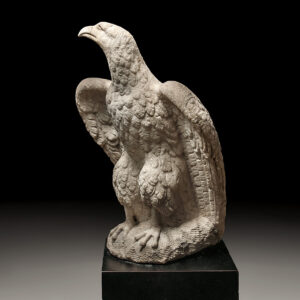
Monumental Imperial Roman Marble Eagle
Description
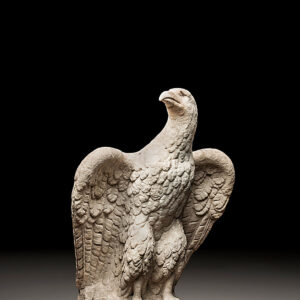
A large and imposing majestic Roman marble eagle, straight gaze, with its wings spread and legs bent preparing to take flight
REFERENCE #
SI_RM_1100
CIVILIZATION
Roman, 100 C.E. – 200 C.E.
SIZE
H. 64 cm
CONDITION
The beak is restored, otherwise in perfect condition.
PRICE
Price available upon request
PROVENANCE
French Private Collection purchased in Paris in the 1970’s.
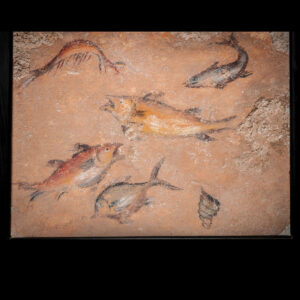
Roman Pompeian Wall Fresco with Aquarium-like Swimming Fish
The origins of fresco painting are unknown, but it was used as early as the Minoan civilization (at Knossos on Crete) and by the ancient Romans (at Pompeii). The Italian Renaissance was the great period of fresco painting, as seen in the works of Cimabue, Giotto, Masaccio, Fra Angelico, Correggio and many other painters from the late 13th to the mid-16th century.
Fresco is a technique of mural painting executed upon freshly-laid lime plaster. Water is used as the vehicle (or medium) for the pigment, and with the setting of the plaster the painting becomes an integral part of the wall.
Roman Pompeian Wall Fresco – 3rd Style (Period)
This extremely fine fresco is an exquisite example of ancient Roman art, originates from Pompeii in ancient Rome, and is of the 3rd Pompeian Style that was popular 20-10 BCE. This 3rd Pompeian Style (and Period) emerged and developed as a reaction to the austerity of the previous period. It leaves room for more figurative and colorful decoration, with an overall more ornamental feeling, and often presents great finesse in execution. This style is typically noted as simplistically elegant.
One who beholds this fresco today wonders if the ancient Romans were making a first proto-attempt to illustrate the conceived notion of an aquarium before the advent of modern glass and other technologies that would make the invention of aquariums actually possible in the 19th century CE. It seems that the artist who painted this fresco was attempting to create a calm and relaxing environment for those who sat in the room whose walls were decorated with this fresco of swimming fish in an Aquarium-like motif – which was extremely innovative and insightful to have the foresight in his/her day 19 centuries before the advent and invention of glass aquariums!
Pompeii Destroyed by Volcanic Eruption of Vesuvius
On 24 August 79 CE, the city of Pompeii was destroyed by the violent eruption of the volcano Vesuvius. The eruption destroyed the city, killing its inhabitants and burying it under tons of ash. The circumstances of their destruction preserved their remains as a unique document of Greco-Roman life. Pompeii supported between 10,000 and 20,000 inhabitants at the time of its destruction. Fortunately for this Fresco, it also has survived and has remained intact in Fine Condition. Provenance is excellent: acquired in the 1980s, Ex. Private Swiss Collection.
The ruins at Pompeii were first discovered late in the 16th century CE by the architect Domenico Fontana. Herculaneum was discovered in 1709 CE, and systematic excavation began there in 1738 CE. Work did not begin at Pompeii until 1748 CE, and in 1763 CE an inscription (“Rei publicae Pompeianorum”) was found that identified the site as Pompeii. The work at these towns in the mid-18th century marked the start of the modern science of archaeology.
Mount Vesuvius erupted 24 August 79 CE. A vivid eyewitness report is preserved in two letters written by Pliny the Younger to the historian Tacitus, who had inquired about the death of Pliny the Elder, commander of the Roman fleet at Misenum. Site excavations and volcanological studies, notably in the late 20th century CE.
Just after midday on 24 August, fragments of ash, pumice, and other volcanic debris began pouring down on Pompeii, quickly covering the city to a depth of more than 9 feet (3 metres) and causing the roofs of many houses to fall in. Surges of pyroclastic material and heated gas, known as nuées ardentes, reached the city walls on the morning of 25 August and soon asphyxiated those residents who had not been killed by falling debris. Additional pyroclastic flows and rains of ash followed, adding at least another 9 feet of debris and preserving in a pall of ash the bodies of the inhabitants who perished while taking shelter in their houses or trying to escape toward the coast or by the roads leading to Stabiae or Nuceria.
Thus Pompeii remained buried under a layer of pumice stones and ash 19 to 23 feet (6 to 7 metres) deep. The city’s sudden burial served to protect it for the next 17 centuries from vandalism, looting, and the destructive effects of climate and weather.
REFERENCE #
SW_MS_1103
CIVILIZATION
Roman, Pompeii 3rd Period, 100
SIZE
31 cm x H. 36.5 cm
CONDITION
Fine condition
PRICE
Price available upon request
PROVENANCE
Ex. Private Swiss collection, Acquired 1980s

Sabaean Alabaster Relief
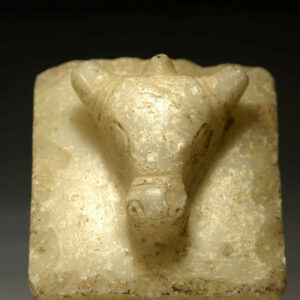
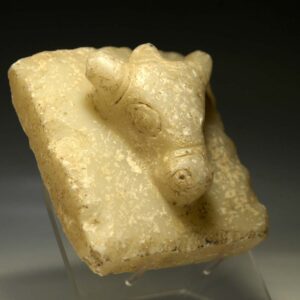
$4,000.00This expertly carved alabaster relief, dating from approximately 300–100 BCE, depicts the commanding head of a bull, exemplifying the high level of artistry achieved by Sabaean sculptors. The broad forehead and prominent, outward-curving horns are rendered with meticulous precision, capturing the animal’s majestic presence. Carved with subtle incisions, the detailed facial features include expressive eyes that convey a sense of calm strength, along with alert ears that subtly indicate the bull’s awareness. The animal’s facial contours are skillfully emphasized, contrasting with the smooth, polished alabaster surface of the rectangular block.
The relief reflects the cultural reverence for bulls within Sabaean society, where such figures symbolized fertility, power, and divine authority. The preservation of fine detail and polished finish underscores its significance as both a religious and artistic object. This piece offers valuable insight into the spiritual and artistic traditions of the Sabaean civilization, standing as a striking testament to their craftsmanship and symbolic imagery.
REFERENCE #
SI_SA_1003
CIVILIZATION
Sabaean, 300 B.C.E. – 100 B.C.E.
SIZE
L. 11cm, W. 10cm
CONDITION
Some natural weathering, Fine condition
PRICE
$4000
PROVENANCE
The Baidun Collection. Purchased from the Jerusalem Local Market, 1980’s.
Statuette of an Idol
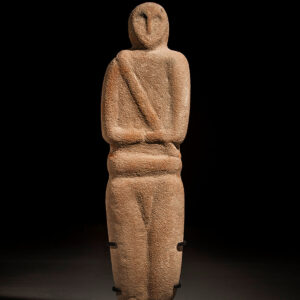
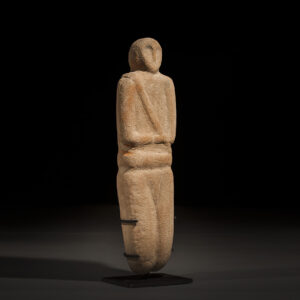
Pink statuette of Sabaean idol with stylized representation for the eyes and nose set on an oval face. Rectangular body is marked by diagonal sash running along torso. Arms are folded at right angles from the shoulders, set above belted waist and smooth legs.
REFERENCE #
SI_SA_1015
CIVILIZATION
Sabaean, 3000 B.C.E. – 2000 B.C.E.
SIZE
H. 39 cm
CONDITION
Fine condition
PRICE
Sold
PROVENANCE
Former Swiss private collection, acquired ca. 1980.
Trapezophoros Leg in the Form of a Lion
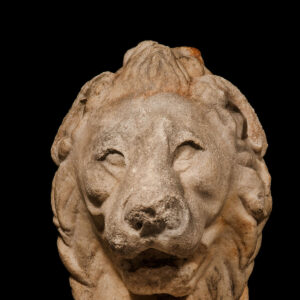
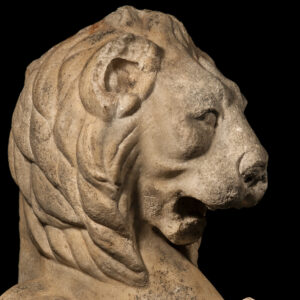
Table leg in the form of an upright lion. It’s back forms an S-shaped curve. The Jaws are wide open, revealing the canines and the tongue. The hair of the mane is arranged in regular tufts. Originally, acanthus leaves adorned it’s chest and sides. The reverse from the shoulders blades upward is flattened, forming a rectangular support. A circular drill hole between the shoulders to insert a horizontal bar supporting the table. On the top of the head, part of the pilaster on which the table top rested is missing. The lack of incised iris and pupil as well as the simple execution of the curls without drilling are indicative of an early date Drill holes on both sides of the lion’s chest where the acanthus emerge.
Reference: For the construction of a Roman table with trapezophoroi in the form of lions, cf. a marble table in the National Museum, Naples, in Richter – 1966, pl 577.
cf. two trapezophori in the Musei Vaticani in Rome, Arachne – 53732 and the Museum of Ancient Art Stockholm, Arachne – 130164
REFERENCE #
SI_RM_1082
CIVILIZATION
Roman, 100 C.E.
SIZE
H. 50 cm
CONDITION
Nose slightly worn, lower jaw and ears fragmentary. The rolled up leaf on the right largely preserved. The leaves on the chest and the left side missing. Preserved from the hips upward. Reassembled from two parts. Right hip slightly worn. Transition to foot preserved
PRICE
Price available upon request
PROVENANCE
English priv. collection 1940’s