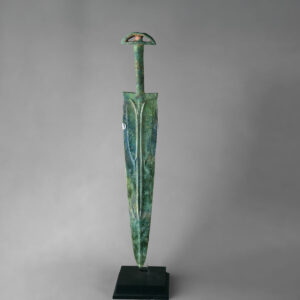
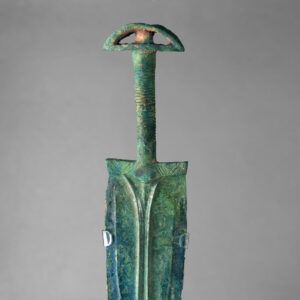
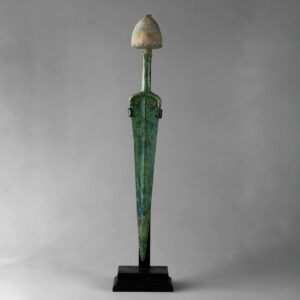
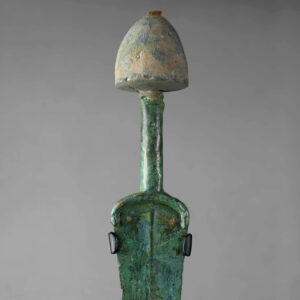
This Persian sword is a remarkable example of the technology and design that went into crafting an ancient piece of weaponry. The dark hue of this sword lends it an austere weight, while the thick ribs and large crescent of the hilt are an indication of the strength required to wield such a heavy object. The broad blade seems to be made not for bludgeoning as much as cutting, with the raised ridge that runs along its length adding force to its blows.
This is a piece that makes a forceful statement in any collection, especially for collectors looking for a simpler alternative to the overwrought designs of later civilizations. The ancient Persians were known for their battle prowess, and this weapon is a fine example as to the tools ancient warriors had at their disposal. This sword has been wonderfully restored and displays a brilliant luster that still gleams along its long blade.
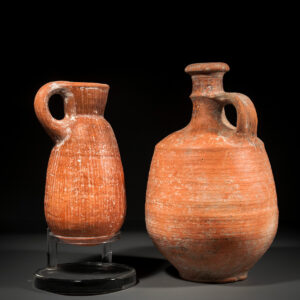
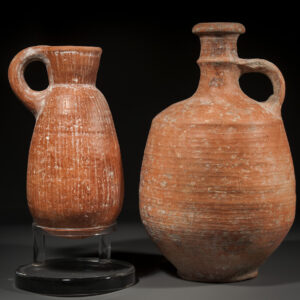
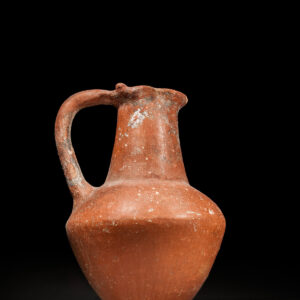
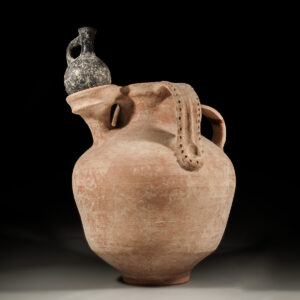
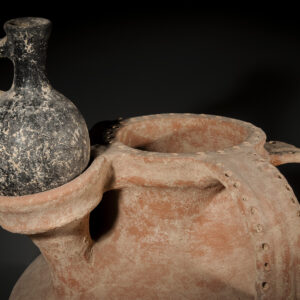
These ancient Israeli red slip ceramic vessels were found together in the mountains west of the Jordan River, an area known both then and now as Samaria. The smaller vessel with the large mouth is a wine decanter while the larger jug was made to hold large amount of cooking oil for generous use in old Israeli cuisine.
There is something homey, even quirky, about the thick handles that loop at the top of each vessel. The warm red colors of their grooved exterior transports us to a dimly lit kitchen filled with the smells of traditional meals still savored today across the Levant.
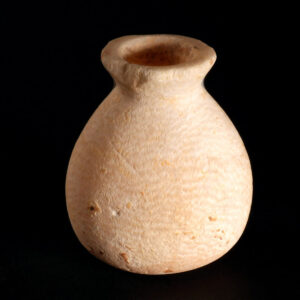
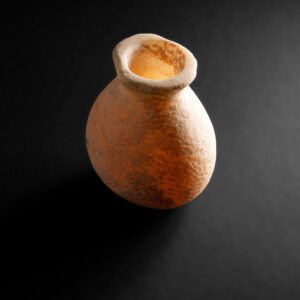
This elegant translucent alabaster perfume flask exemplifies the artistry and craftsmanship of Israelite artisans of the Iron Age, First Temple Period. Crafted from fine, translucent alabaster, the flask presents an ovoid body with a narrow, well‑formed neck and a gently everted mouth, its surface smoothly polished to reveal the subtle veining and soft luminosity of the stone.
The most striking feature of the flask is its delicate, refined profile and the way the translucent material captures and diffuses light, lending a quiet, luminous quality to the form. The workmanship demonstrates mastery of stone‑carving techniques, with a precise, symmetrical shape and a satin finish that highlights the inherent beauty of the alabaster. Any surviving tool marks are minimal and secondary to the overall polished presentation.
This object likely served both personal and ritual functions, used to contain precious oils or perfumes for daily grooming, anointing, or sacred ceremonies. Its refined material and careful execution reflect the value placed on aromatic substances in Israelite society and suggest ownership by an individual of some standing. Found in Jerusalem. Iron Age, First Temple Period (circa 10th–6th centuries BCE).
This remarkable bronze weapon is a dagger or short sword from ancient Persia, specifically attributed to the Pre-Achaemenid Empire. During this period, the empire expanded extensively, establishing a formidable and centralized administrative structure that drove the production of luxurious and highly ornate high-status artifacts. Crafted by master smiths, this piece exemplifies the exceptional skill and artistry of Persian metallurgists, renowned for creating prestige items for the military forces.
The weapon features a distinctive strengthening spine, design element that facilitates both easier thrusting. The fine craftsmanship, intricate detailing, and functional design underscore its dual role as both a battlefield implement and a symbol of status and authority.
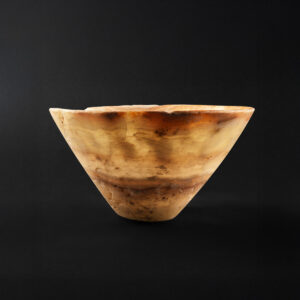
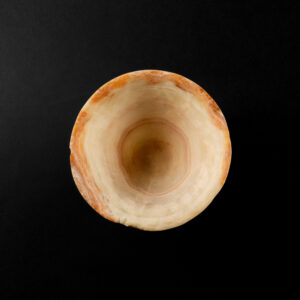
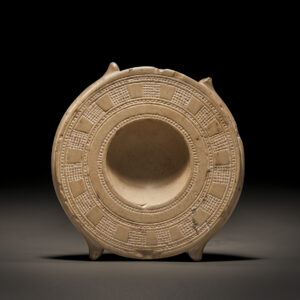
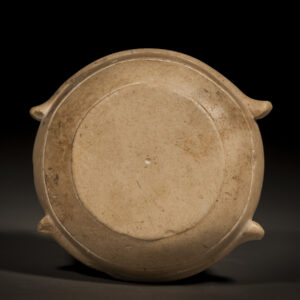
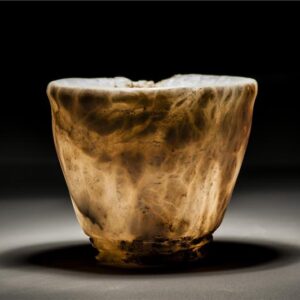
This elegant alabaster bowl exemplifies the artistry and craftsmanship of ancient Mesopotamian artisans. Crafted from fine, translucent alabaster, the bowl features a rounded, symmetrical form with a smooth, polished surface that showcases the natural beauty of the stone. Measuring approximately 12 cm in diameter and 7 cm in height, it is a compact yet finely detailed vessel.
The most striking feature of the bowl is its decorative banding, which encircles its exterior. These bands are composed of carved lines and geometric motifs, adding a sense of rhythm and harmony to the piece. The craftsmanship demonstrates a mastery of stone carving techniques, with precise incisions and smooth finishes that highlight the skilled artisanship of the period.
This vessel likely served both functional and ceremonial purposes, possibly used in ritual offerings or as a display piece in a noble or religious setting. Its durable alabaster material and sophisticated decoration reflect the high status of its owner and the cultural importance of craftsmanship in ancient Mesopotamian society.
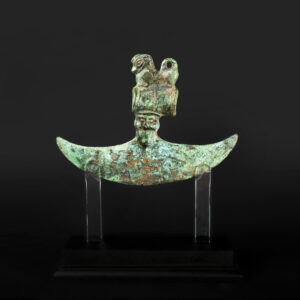
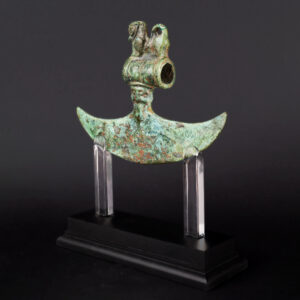
This remarkable ancient Elamite crescent axe features a distinctively curved, finely detailed blade that appears to emerge from the mouth of a bearded man, creating a powerful and evocative visual narrative. The figure of the bearded man, likely representing a deity or a legendary figure, is elegantly cast or carved, with a well-defined facial expression and beard, symbolizing strength or authority. The blade itself, attached seamlessly to the mouth, displays polished surfaces and sharp edges, indicative of high-quality craftsmanship from the Achaemenid periods. The axe’s shaft extends from the figure and is adorned with an intricate relief of a horse, symbolizing power, nobility, or martial prowess. The combination of the mythic figure, the dynamic crescent blade, and the equine motif reflects the sophisticated iconography and artistry characteristic of ancient Persia’s ceremonial weaponry. Crafted from bronze, this artifact exemplifies the masterful metallurgical techniques and symbolic artistry of the period.
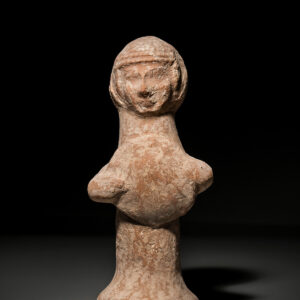
A Israelite figurine of Astarte holding a drum or bread?. The head on this figure was made in mould wearing a wig like headdress, the neck was then inserted into the pillar-shaped body. The pillar-shaped body is holding drum or bread. There is no doubt that the figurines were considered to have some magical properties and were kept in the household as amulets to enhance fertility.[/vc_column_text]
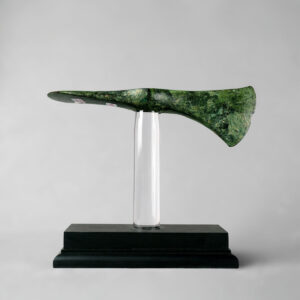
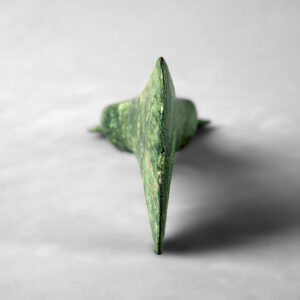
A cast bronze axe head with a cylindrical socketing shaft, a tapered spike on the back end, and a horizontal axe blade on the front.
For similar see: Nikolaus Boroffka, Simple technology. Casting moulds for axe-heads. In: Tobias L. Kienlin, Ben Roberts (ed.), Metals and society. Studies in honour of Barbara S. Ottaway.
Universitätsforschungen zur Prähistorischen Archäologie 169. Vertag
Dr. Rudolf Habelt GmbH (Bonn 2009), pp. 246-257, n. 1-2.
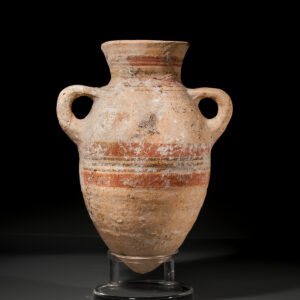
The dull pointed base of this large Phoenician amphora hints to the worker’s toil in an ancient time. With nary a bottom upon which to rest, this vessel would have been lugged by its two handles through the winding streets of a grand Phoenician city. In order to keep tabs on his investment, this vessel’s owner would have used the lovely bichrome decorations that ring its body and neck as a mark of possession, individualizing it among the others in the market.
The smooth sides of this terracotta amphora remain in excellent condition, while the bichrome bands are still crisp and distinctly colored.