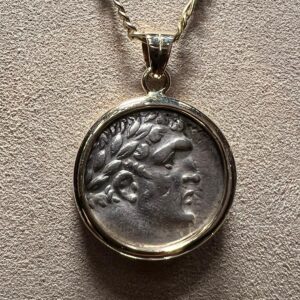
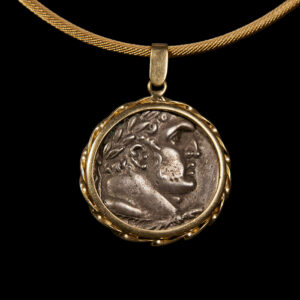
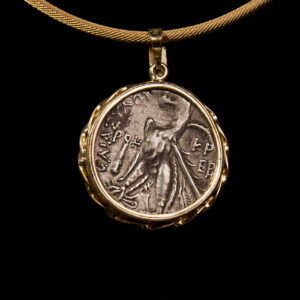
Suspended elegantly from an 18K gold necklace, this striking silver shekel coin features the visage of a distinguished figure crowned with an olive leaf, symbolizing peace and prosperity from ancient Tyre, a historic city in southern Lebanon. On the reverse side, an intricately detailed eagle, accompanied by ancient inscriptions, displays its sharp talons and delicate plumage, showcasing skilled craftsmanship and artistic finesse. The coin’s surface is polished to a brilliant finish, accentuating the bold, embossed designs that grace both sides.
Dating from 126 B.C.E. to 66 C.E., this pendant hails from a period when Tyre had reasserted its independence, even as neighboring provinces fell under Roman dominion. Its preservation is exquisite, retaining a beauty that transcends time, making it a wearable artifact that maintains its elegance and historical significance to this day.
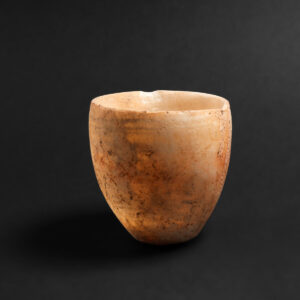
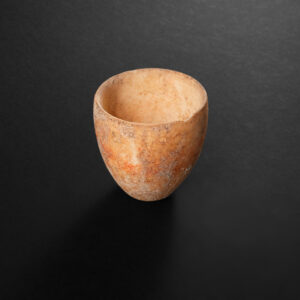
Alabaster cup from the Israelite kingdom period, dating to the time of King David, circa 1200–800 BC. This vessel has been carefully fashioned from fine, translucent alabaster, which remains in perfect condition, emphasizing the skill of its ancient maker. The cup measures approximately 6 cm in height and features a simple, elegant form with a rounded bowl and a narrow, slightly flared lip.
The use of alabaster, a soft stone prized for its translucence and smooth finish, suggests the object was valued and possibly used in ceremonial contexts. Both the interior and exterior surfaces have been polished to a glossy, refined texture, with no visible signs of damage or deterioration. Its translucent quality would have enhanced its visual appeal when held in light, creating a delicate play of shadow and glow.
Discovered in the Judean hills, this cup is linked to the material culture of early Israelite society during the Iron Age. Its form and material imply it may have played a role in rituals or religious offerings typical of the period, serving both practical and symbolic functions within domestic or religious settings. Objects of this nature are rare, providing valuable insight into the craftsmanship and spiritual practices of the ancient Israelites during the era of King David.
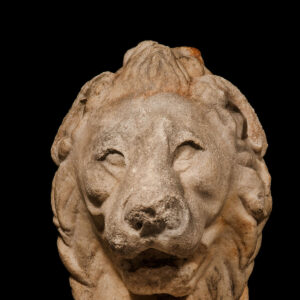
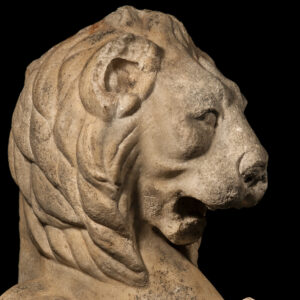
Table leg in the form of an upright lion. It’s back forms an S-shaped curve. The Jaws are wide open, revealing the canines and the tongue. The hair of the mane is arranged in regular tufts. Originally, acanthus leaves adorned it’s chest and sides. The reverse from the shoulders blades upward is flattened, forming a rectangular support. A circular drill hole between the shoulders to insert a horizontal bar supporting the table. On the top of the head, part of the pilaster on which the table top rested is missing. The lack of incised iris and pupil as well as the simple execution of the curls without drilling are indicative of an early date Drill holes on both sides of the lion’s chest where the acanthus emerge.
Reference: For the construction of a Roman table with trapezophoroi in the form of lions, cf. a marble table in the National Museum, Naples, in Richter – 1966, pl 577.
cf. two trapezophori in the Musei Vaticani in Rome, Arachne – 53732 and the Museum of Ancient Art Stockholm, Arachne – 130164
REFERENCE #
SI_RM_1082
CIVILIZATION
Roman, 100 C.E.
SIZE
H. 50 cm
CONDITION
Nose slightly worn, lower jaw and ears fragmentary. The rolled up leaf on the right largely preserved. The leaves on the chest and the left side missing. Preserved from the hips upward. Reassembled from two parts. Right hip slightly worn. Transition to foot preserved